
Research Dossier for Target Company: A Complete Guide to Company Research (2026)
Picture a deal team walking into a big pitch. The slides look sharp, but one quiet detail slips past them: the target has a pending lawsuit. The rival firm knew about it and used it. The deal is gone in one meeting.
A research dossier for target company work stops that story from happening to you. It pulls facts, numbers, and risks into one clear file. This guide shows you how to build one, step by step. You will learn the sources, the metrics, the checks, and the tools. Every section uses plain words, so you can start today.
What Is a Research Dossier for a Target Company?
A research dossier for target company projects is a structured file about one business. It holds the company background, the money story, the people, the market, and the risks. Think of it as a map you study before a long road trip. You see the hills, the tolls, and the dead ends before you leave. It works for public and private firms in any country.
A good company research report does more than list facts. It explains what the facts mean for your goal. This is the heart of target company research. A business research dossier turns scattered notes into one clear story. It helps you decide, argue, and act with confidence.
Research Dossier vs. Company Profile
A company profile analysis gives you a short snapshot. It tells you who the firm is, where it sits, and what it sells. A dossier goes much deeper. It adds risks, financial trends, competitor moves, and your own view on strategic decision-making. In short, a profile informs you, while a dossier helps you decide. Here is how the two compare.
| Feature | Company Profile | Research Dossier |
| Length | 1 to 2 pages | 15 to 25 pages |
| Purpose | Quick awareness | Deal or sales decision |
| Depth | Surface facts | Verified facts plus analysis |
| Risk review | Rarely included | Always included |
| Update rate | Occasional | Before each milestone |
Who Needs a Target Company Research Dossier?
Many roles need a target company research dossier. Investors use it to size up a stake. M&A teams use it for corporate due diligence. Sales reps use it to tailor a pitch. Procurement teams use it to vet a new supplier. Recruiters, journalists, and founders also lean on it. Anyone who must trust a company before acting can gain from one.
Key Benefits of Company Research
Strong company research saves time and money. It cuts surprises, because you spot problems early. It also gives you leverage in talks, since you know the other side’s weak spots. Your team stays aligned, because everyone reads the same facts. Finally, it builds trust. People respect a person who walks in with real answers.
Why Is a Target Company Research Dossier Important?
Blind deals fail often. A well-known Harvard Business Review article states that 70% to 90% of mergers and acquisitions fail. Weak homework sits near the top of the causes. A company due diligence habit changes those odds. You find the hidden debt before you sign. You find the culture clash before you merge.
The value goes beyond big deals. A sales rep with a good dossier opens better calls. A buyer with a dossier negotiates better terms. As Warren Buffett has said, “Risk comes from not knowing what you’re doing.” Research is how you remove that risk. It turns guesses into business intelligence research you can defend.
Making Better Business and Investment Decisions
Good choices need good inputs. Investment analysis built on verified numbers beats gut feeling every time. A dossier lets you compare the target with other options on equal terms. It shows growth, margins, and debt in one place. With this view, company research for investment decisions becomes calm and clear. You can say yes, no, or “not at this price” with proof.
Identifying Risks Before Signing a Deal
Every deal hides some danger. A proper business risk assessment brings it to light. You look for lawsuits, heavy debt, weak contracts, and rule problems. You also check customer concentration, because one lost client can sink a small firm. Finding these issues early gives you three choices. You can walk away, fix the price, or add protections to the contract.
Finding Sales, Partnership, and Growth Opportunities
Research does not only expose danger. It also reveals openings. New job posts may show a team that is growing fast. A fresh funding round may signal a budget to spend. A new market launch may need a local partner. Spotting these growth opportunities early lets you reach out at the right moment.
What Information Should a Target Company Research Dossier Include?
Strong dossiers share the same essential elements of a company research dossier. These are an executive summary, the company background, the money story, the market, the people, and the risks. Each part should stand alone. A busy reader can then jump straight to the section that matters.
Length matters too. Aim for 15 to 25 pages. A short, sharp file beats a 100-page data dump. Use tables to save space. Add a source list at the end, so readers can check your claims.
Company Background, History, and Legal Structure
Start with the basics. Record the legal name, trade names, founding date, and headquarters. Note the type of entity, such as a corporation or an LLC. Map every subsidiary and parent company. This company background step also confirms the firm is real and in good standing. A company background check of this kind often reveals name changes, past mergers, and shell entities that deserve a closer look.
Business Model, Products, and Services
Next, explain how the firm makes money. List its products and services, its pricing style, and its main revenue streams. Is the income recurring or one-time? Is it driven by subscriptions, fees, or hardware? This business model and revenue analysis shows how stable the income really is. A firm with 80% recurring revenue carries less risk than one that lives on single big projects.
Leadership, Ownership, and Management Team
People run companies, so profile them. Write short bios for the leadership team. Note their past roles, tenure, and any recent exits. Then map company ownership. Who holds the shares? Does a founder, a fund, or a parent group control the votes? Good company ownership and management research also checks the board for independence. Sudden departures of senior leaders can be an early warning sign.
Customers, Employees, and Target Markets
Now study who buys and who works there. A solid customer analysis covers customer types, top accounts, and churn. Identify the target market by region, industry, and size. Look at headcount trends and employee reviews, because they hint at culture and stability. A company that loses talent quickly often struggles to deliver on promises.
Recent News, Funding, and Business Developments
Finish with the latest events. Scan press releases, news stories, and filings from the last 12 months. Note new products, deals, lawsuits, and leadership changes. Record any funding rounds and who led them. Fresh news keeps your dossier current. It also shows where the company is heading, not only where it has been.
How to Build a Research Dossier for a Target Company Step by Step
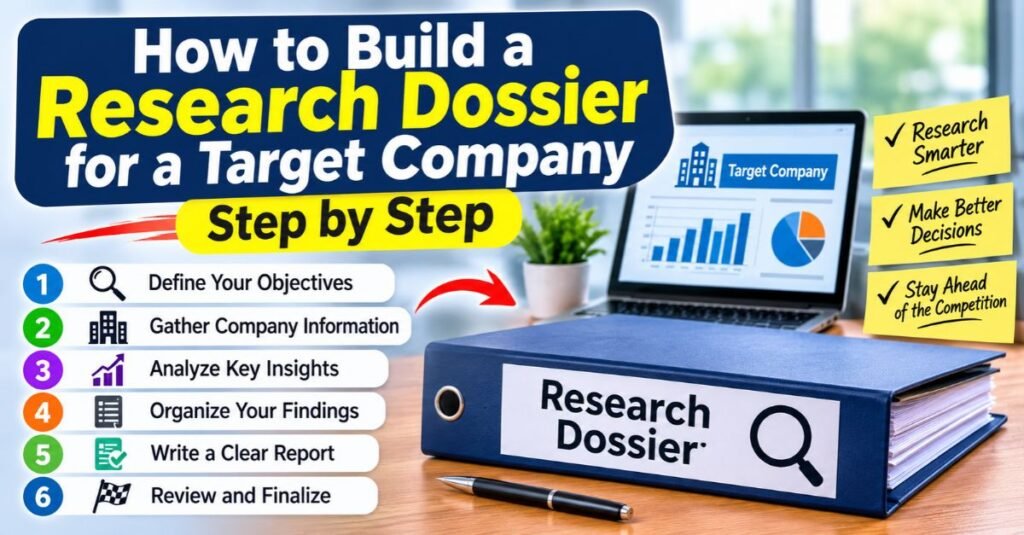
The target company research process has eight steps. You define your goal, confirm the company is real, gather facts, and study how it earns money. Then you check the numbers, compare rivals, flag risks, and write the report. Each step feeds the next one. Skipping one leaves a gap that shows up later.
This method answers the question of how to build a research dossier for a target company in a repeatable way. Follow the order the first time. Once you know the flow, you can adjust it to fit your deal size. Below, each step gets its own short guide.
Step 1: Define Your Research Objectives
Every strong dossier starts with clear research objectives. Ask yourself why you need it. Are you buying the firm, investing, selling to it, or partnering with it? Each goal needs different facts. A buyer cares about debt and integration. A sales rep cares about budget and pain points. Write your goal in one sentence at the top of the file. It keeps the whole project focused.
Step 2: Identify and Verify the Official Company Website
Find the official company website first. Many companies share similar names, and fake sites exist. Check that the domain matches the name in the business registry. Look for a secure connection and a real address. Review the domain registration date as well. A site made last month for a firm founded in 1995 should raise your eyebrows. This small check prevents big mix-ups.
Step 3: Collect Information From Reliable Sources
Now gather facts. Start with primary sources, such as filings, annual reports, and press rooms. Add trusted secondary sources, such as industry reports and quality news. Use reliable sources for company research whenever possible. Keep a running log of every source with its link and access date. This habit makes source verification much easier later.
Read More About: BD268XZ Explained: Meaning, Uses, Benefits, and Safety Guide (2026)
Step 4: Analyze the Company’s Business Model
Study how the firm creates and captures value. Ask who pays, how much, and how often. Look at costs too. Which expenses grow as sales grow? Which stay flat? The business model tells you where margins come from and where they could crack. If one customer or supplier holds too much power, note it clearly.
Step 5: Evaluate Financial Performance and Growth
Look at three to five years of data, not a single snapshot. This company financial performance evaluation shows direction. Is revenue rising faster than costs? Is cash building or draining? Compare each result with industry norms. A company that grows 10% in a market growing 25% is actually losing ground. Context turns numbers into insight.
Step 6: Research Competitors and Market Position
No company stands alone. List the top three to five rivals. Compare their size, pricing, products, and reach. This work defines the target company market position. Is the firm a leader, a challenger, or a niche player? Knowing the answer helps you judge how much pricing power the company really has.
Step 7: Identify Risks, Red Flags, and Opportunities
Gather your findings into a risk and reward list. Red flags include late filings, auditor changes, falling margins, big lawsuits, and rapid executive turnover. Opportunities include new markets, strong product demand, and weak rivals. This step is the core of identifying business risks and opportunities. Rank each item by impact and likelihood so the biggest issues stand out.
Step 8: Organize Findings and Prepare the Final Report
Finally, shape everything into a clean report. Begin with a one-page executive summary. Follow with short sections, tables, and charts. Close with strategic advice and an open-questions list. Attach your source log at the end. A good corporate research report reads fast, and every claim traces back to a source.
Which Sources Are Best for Target Company Research?
Great research depends on great sources. Primary sources come straight from the company or a regulator. Secondary sources interpret that data. Both matter, but primary sources deserve more trust. When they disagree, believe the filing over the brochure.
The table below ranks common sources. Use it as a quick guide when you plan your business intelligence gathering.
| Source Type | Best For | Typical Cost | Reliability |
| Regulatory filings | Audited numbers, risks | Free | Very high |
| Business registries | Legal status, directors | Free to low | Very high |
| Company website | Products, leadership | Free | Medium |
| Industry reports | Market size, trends | Paid | High |
| News and reviews | Recent events, sentiment | Free to paid | Medium |
| Job posts and patents | Growth and R&D signals | Free | Medium |
Official Company Websites and Investor Relations Pages
The official company website is your first stop. Read the About page, leadership page, and product pages. Public firms also run investor relations pages. These hold annual reports, earnings decks, and call transcripts. Remember that this material is self-reported. It shows how the firm wants to be seen. Use it for facts about products and structure, then test the claims elsewhere.
Business Registries and Regulatory Filings
Regulatory filings are the gold standard. In the United States, the SEC EDGAR database offers 10-K and 10-Q reports. In the United Kingdom, Companies House lists directors and accounts. For global coverage, try OpenCorporates. These records confirm legal status, ownership, and audited results. They are free to use and hard to fake.
Financial Reports and Industry Publications
Paid tools add depth. PitchBook and Bloomberg cover deals, valuations, and market data. IBISWorld, Statista, and Gartner supply market research report data on size and growth. Use them to benchmark the target against its peers. Always check the date and method of each report. Old data can mislead you.
News Articles, Customer Reviews, and Professional Networks
News shows what is happening now. Reviews show how customers feel. Professional networks like LinkedIn show who works there and who just left. Together they add the human layer that numbers miss. Read with care, though. A few angry reviews rarely tell the full story. Look for repeated patterns instead.
Job Postings, Patents, and Company Announcements
Job posts are quiet clues. A wave of sales hires may signal expansion. A surge in legal roles may signal trouble. Patents reveal where the firm invests in research, and you can search them at Google Patents. Company announcements show partnerships and launches. These small signals often arrive before the big news does.
Read More About: 98+TheStripesBlog.com Contact Guide: Frank Fisher, Email, Website, and Official Details
How to Evaluate Source Credibility
Not every source deserves your trust. Use four quick questions. Who wrote it? When was it written? How do they know what they claim? What do they gain from it? A regulator has no sales goal. A press release does. Weigh each source with that in mind, and you will rarely get fooled.
Which Financial Metrics Should You Include in a Company Research Dossier?
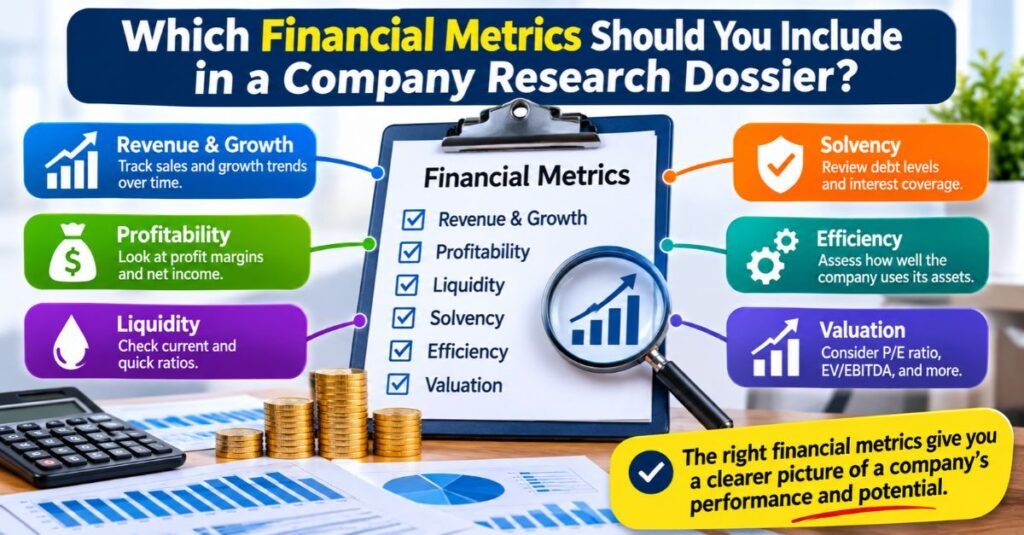
Numbers tell the real story. Still, headline revenue alone hides a lot. A firm can grow sales while burning cash. A solid corporate financial analysis looks at profit, cash, debt, and trends together. McKinsey has long argued that buyers who study unit economics and cash conversion do better than those who chase top-line growth.
Use the table below as a starter kit for financial due diligence.
| Metric | Simple Formula | What It Tells You |
| Revenue growth | (This year – last year) ÷ last year | Speed of expansion |
| Gross margin | (Revenue – cost of goods) ÷ revenue | Core product profit |
| EBITDA margin | EBITDA ÷ revenue | Operating strength |
| Operating cash flow | Cash from operations | Real cash generation |
| Debt-to-equity | Total debt ÷ total equity | Leverage and risk |
| Current ratio | Current assets ÷ current liabilities | Short-term safety |
| CAC vs. LTV | Cost to win vs. lifetime value | Sales efficiency |
Revenue, Profit Margins, and Cash Flow
Start with revenue analysis. Check growth rate, revenue mix, and customer concentration. Then study profit margins. Gross margin shows product strength, while EBITDA margin shows operating strength. Finally, review cash flow. Profit on paper means little if cash does not arrive. Strong operating cash flow shows a healthy engine. Weak cash flow with rising sales often signals trouble ahead.
Assets, Liabilities, and Debt Levels
The balance sheet shows what a firm owns and owes. Review cash, receivables, inventory, and property on the asset side. Then review loans, bonds, leases, and unpaid bills. Compute the debt-to-equity ratio and the current ratio. Watch for hidden items, such as guarantees and lease duties. High debt is not always bad. However, debt that outgrows earnings always deserves a closer look.
Funding History and Valuation
For private firms, funding history is a key clue. List each round, its date, its size, and its lead investors. Note any change in company valuation between rounds. A falling valuation, called a “down round,” can signal stress. For private firms, treat valuation numbers as estimates unless a filing confirms them. Compare with similar deals to judge if the price looks fair.
Financial Trends and Warning Signs
Trends matter more than single numbers. Shrinking margins, rising receivables, and growing debt all deserve attention. Late filings and auditor changes are louder alarms. So are restated results. One bad sign may be noise. Three together form a pattern. Mark each warning sign in your dossier and explain why it matters for your goal.
How to Conduct Competitor and Market Analysis
No company wins alone. Its rivals shape its prices, its growth, and its future. Strong competitor research shows where the target leads and where it slips. It also reveals gaps that you can use in negotiations or sales talks.
A clear competitor analysis framework keeps the work tidy. Compare the target with three to five rivals. Use the same yardsticks for each one. The table below gives a simple template.
| Dimension | Target | Rival A | Rival B |
| Core products | |||
| Pricing style | |||
| Market share | |||
| Regions served | |||
| Customer ratings | |||
| R&D focus |
Identify Direct and Indirect Competitors
Direct rivals sell the same thing to the same buyers. Indirect rivals solve the same problem in a different way. Think of a taxi firm. Other taxi firms are direct rivals. Ride apps and public trains are indirect ones. Many analysts miss the second group. Yet substitutes often cause the biggest shifts in the competitive landscape.
Compare Products, Pricing, and Market Share
Line up the offers side by side. Compare features, price points, and discount habits. Estimate market share using industry reports and revenue figures. Look at customer ratings and churn when you can. This comparison shows if the target wins on price, quality, or service. It also shows who is gaining ground and who is losing it.
Read More About: BackToFrontShow Pricing 2026: Plans, Costs, Features, and Honest Review
Evaluate Competitive Advantages and Weaknesses
A moat protects a firm from attack. Common moats include a strong brand, unique technology, scale, and long contracts. Test each claimed advantage with evidence. Does the brand allow higher prices? Does the technology hold patents? Then list the weak points. Slow delivery, aging systems, or reliance on one supplier can all open the door for rivals.
Identify Industry Trends and Growth Opportunities
Zoom out and study industry trends. Look at new rules, changing buyer habits, and fresh technology. Ask whether the market is growing, flat, or shrinking. A fast-growing market can lift even a mediocre firm. A shrinking one can sink a great firm. Matching the target to the trend reveals real growth opportunities and the risks that come with them.
How to Use SWOT Analysis in a Target Company Dossier
A SWOT analysis adds the “so what?” layer. Facts alone do not decide anything. SWOT forces you to sort facts into strengths, weaknesses, opportunities, and threats. This target company SWOT analysis links raw data to your deal goal. It also makes the report easy to scan.
Keep each box short and backed by proof. A claim without evidence is just an opinion. Use two or three points per box. Draw the grid below in your report, and tie every entry back to a source.
| Helpful | Harmful | |
| Internal | Strengths | Weaknesses |
| External | Opportunities | Threats |
Company Strengths and Core Advantages
Strengths are internal wins. Examples include proprietary technology, loyal customers, strong cash flow, and a skilled team. Support each one with data. If you call the brand strong, show survey results or price premiums. If you call the team strong, show tenure and results. Proven strengths help you set a fair price and plan post-deal growth.
Internal Weaknesses and Business Limitations
Weaknesses are internal gaps. Think of high staff turnover, old systems, thin margins, or too much reliance on one client. These issues cost money and slow growth. Be honest here. A rosy view hurts you later. A clear list of weaknesses also shapes your integration plan and your price offer.
Market Opportunities and Expansion Potential
Opportunities come from outside the firm. They include new regions, unmet demand, fresh partnerships, and friendly rules. Ask which ones the target can truly reach. A big market means little if the firm lacks the means to enter it. Rank each chance by size and ease. That ranking feeds directly into your strategic business research conclusions.
External Threats and Competitive Risks
Threats also come from outside. New entrants, price wars, tougher laws, and economic shocks all count. So do shifts in customer taste. Estimate how likely each threat is and how hard it would hit. Then ask what the firm has done to defend itself. A threat with no defense is a serious red flag.
How to Verify Information in a Research Dossier
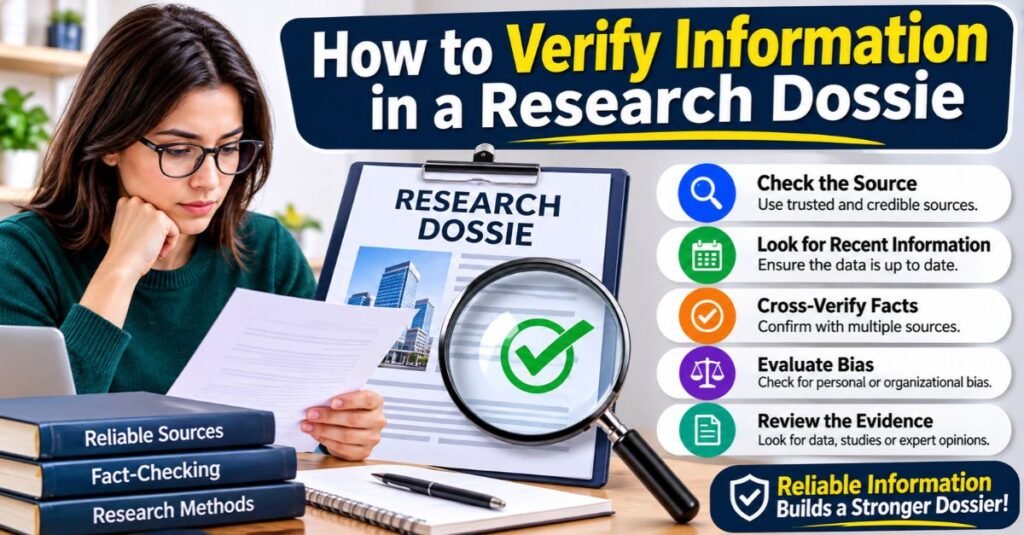
One wrong number can wreck a deal. It can also wreck your credibility. That is why verifying company information matters as much as finding it. Build checks into every step, not just at the end.
Try a simple confidence tag system. Mark each fact as Verified, Estimated, or Unconfirmed. Readers then know how far to trust it. This small habit raises the quality of your company research report at almost no cost.
Distinguish Verified Facts From Company Claims
A verified fact comes from an audited filing or an official record. A claim comes from marketing copy or an executive interview. Both have value, but they are not equal. “We serve 5,000 customers” is a claim until a document proves it. Label claims clearly. Doing so protects your team from building plans on sand.
Separate Estimates From Confirmed Data
Many private-company numbers are estimates. Tools like Owler and Crunchbase often guess revenue and headcount. Those figures can be useful starting points. However, they can be far off. Mark every estimate and note its source. When a confirmed number arrives, replace the guess and log the change.
Cross-Check Information Across Multiple Sources
Follow the two-source rule. Confirm each key fact with two independent sources. Compare a registry record with a news story, or a filing with an industry report. If the sources match, you can relax. If not, dig deeper. This process, known as source triangulation, is the backbone of good source verification.
Record Citations, Dates, and Reporting Periods
Keep a clean source log. For each fact, record the link, the access date, and the period it covers. A 2023 revenue number is not a 2025 number. Dates prevent that confusion. A good log also lets a colleague repeat your work. In short, it turns your dossier from a personal opinion into a checkable record.
How to Use AI Tools to Build a Research Dossier
AI-powered research tools can speed up the first draft by a wide margin. They scan pages, summarize long reports, and spot patterns fast. Treat them as a quick assistant. They are not the final judge. A human must check every key claim.
The table below shows common uses. It also shows the level of risk in each task. This view supports smart AI tools for company research choices.
| Task | AI Use | Risk Level |
| Finding company lists | Discovery tools | Low |
| Summarizing 10-K reports | Text summary | Medium |
| Drafting a SWOT | First draft | Medium |
| Quoting financial figures | Data extraction | High |
| Judging legal issues | Not advised | Very high |
AI-Powered Web Research and Fact Collection
AI search assistants can collect public facts in minutes. Ask them for a company overview, recent news, and key people. Then ask for sources. Open each source and read it yourself. This method gives you speed without blind trust. Use the AI output as a map, and use the original pages as the ground truth.
Tools for Company Discovery and Competitive Intelligence
Several platforms help with discovery. Crunchbase covers startups and funding. Owler tracks rivals and news alerts. SimilarWeb estimates website traffic and audience. These tools support business intelligence gathering and quick competitor checks. Features and prices change often, so review each vendor’s current plans before you commit.
Read More About: Methatreams Explained (2026): Meaning, Safety, Legality, and Best Alternatives
Using AI to Summarize Reports and Analyze Data
Long filings take hours to read. AI can summarize a 10-K in minutes and point to the key risk sections. It can also scan spreadsheets for odd trends. Use these summaries to decide where to read closely. Never copy a figure from a summary without checking the original table. Small errors in numbers can slip in unnoticed.
AI Research Limitations, Privacy, and Fact-Checking
AI can invent facts that sound real. Experts call this a hallucination. It can also use old data without telling you. Watch for privacy issues too. Do not paste confidential deal documents into public tools. Follow data rules such as GDPR when you handle personal details. So, can AI replace the analyst? Not yet. It speeds the work, but people carry the responsibility.
Common Mistakes to Avoid When Researching a Target Company
Even skilled analysts slip. Consider a small illustrative case. A sales team once targeted a firm after reading its glossy website. They never checked the filings. The firm was months behind on payments, and the deal collapsed after weeks of effort. One hour of company due diligence would have saved them.
Most errors fall into five groups. Learn them now, and you can avoid them later. Each one has a simple fix.
Relying Only on the Official Website
Company sites show the bright side. They rarely mention lawsuits, churn, or failed launches. Use the site as a starting point, not the finish line. Balance it with filings, news, reviews, and third-party data. When the website and the filings disagree, trust the filings.
Using Outdated or Unverified Information
Old data leads to wrong choices. Flag anything older than 12 months and look for a fresh figure. Also avoid facts you cannot trace to a source. A number from a forum post is not research. Add dates to every fact. Then your readers can judge freshness on their own.
Confusing Company Names, Brands, and Domains
Many firms share similar names. Brands may belong to a parent group. Lookalike domains may trick you. Always match the legal name, registration number, and domain across sources. Check who owns each brand as well. Mixing up two companies can ruin an entire report.
Ignoring Financial Risks and Competitor Activity
Some teams fall in love with a target and skip the bad news. Others focus only on the target and ignore its rivals. Both habits are costly. Review debt, cash flow, and margins every time. Then scan competitor moves for new threats. A balanced view keeps your business risk assessment honest.
Failing to Document Sources and Research Dates
Undocumented work cannot be defended. If a boss asks where a number came from, you need an answer. Keep a log of links, dates, and periods from day one. It takes seconds per entry. It also makes later updates far quicker.
How Long Does It Take to Build a Company Research Dossier?
The honest answer is “it depends.” A quick screen may take two to four hours. A full dossier for a mid-market deal may take five to ten business days. Public firms often go faster, since their data sits in standard filings. Private firms take longer, because facts are harder to find.
Plan your time by stage. The table below gives a practical split for a ten-day project. Set a firm deadline and stick to it. Rushing creates gaps, while dragging creates stale data.
| Days | Focus |
| 1 to 2 | Company overview and financial data |
| 3 to 4 | Competitors and market analysis |
| 5 to 6 | Leadership profiles and risk review |
| 7 to 8 | SWOT and strategic fit |
| 9 to 10 | Verification, formatting, and review |
Quick Research for Initial Screening
A screening pass answers one question: is this target worth more time? Spend two to four hours. Confirm the legal entity, scan the latest financials, read recent news, and note the main rivals. Keep the output to one or two pages. If red flags appear, you stop early and save days of work.
Detailed Research for Business Deals and Investments
A full corporate due diligence checklist review takes much longer. Expect five to ten business days for a mid-market target. Large or complex deals can take weeks and may need legal and accounting experts. In these cases, the dossier supports price talks, risk plans, and board approvals. Give it the time it needs.
Factors That Affect Research Time and Depth
Several things change the timeline. Public firms offer more data than private ones. Some countries publish more records than others. Deal size matters, since bigger deals need deeper checks. Finally, data access plays a role. Paid databases and direct access to management speed things up. Match your effort to the stakes.
How to Turn Your Research Dossier Into an Actionable Strategy
A dossier on a shared drive wins nothing. Value comes from action. The goal is actionable company research insights, meaning clear findings that lead to clear next steps. Every section should answer the same question: what should we do about this?
End your report with a strategy section. Answer three simple questions. Should we proceed? What is our opening position? What must we verify next? Those answers turn research into a playbook your team can run.
Summarize Key Findings and Business Implications
Write a one-page summary first. State the target, the main findings, and what they mean for your goal. Use plain words and short sentences. A senior reader should grasp the story in two minutes. If they want proof, they can flip to the detailed sections.
Prioritize Risks and Opportunities
Not every issue deserves equal attention. Rank each one by impact and likelihood. A simple grid works well. High impact and high likelihood come first. Low and low can wait. This ranking helps your team spend effort where it counts and keeps the discussion calm and fact-based.
Prepare Questions for Meetings and Negotiations
Gaps in your research are gifts. Turn each one into a question. Ask about the lawsuit, the churn rate, or the drop in margins. Smart questions show that you did your homework. They also draw out answers that no database can give. Put them in a short list for each meeting.
Create an Action Plan and Update the Dossier
Assign every next step to a named person with a date. Then schedule updates. Refresh the dossier before key milestones, and review active targets each quarter. Markets move fast. A living dossier keeps your strategic decision-making sharp long after the first draft.
Target Company Research Dossier Checklist
A checklist keeps you from missing key items. It also makes team reviews quicker. Use the tables below as a copy-and-paste tool. Mark each row as done, partial, or missing. This simple target company due diligence checklist works for most deals.
Adapt the list to your industry. A software firm needs more on churn and security. A factory needs more on supply chains and safety. Add rows as needed, but keep the file short and clear.
Essential Information to Collect
Gather the core facts first. Cover legal, financial, people, market, risk, and news items. The table below lists the must-haves for any target company profile.
| Area | Item to Collect | Done |
| Legal | Full legal name, registration number, subsidiaries | ☐ |
| Ownership | Shareholders, board, beneficial owners | ☐ |
| Financial | 3 to 5 years of revenue, margins, cash flow | ☐ |
| Balance sheet | Debt, assets, liabilities | ☐ |
| Market | Competitors, share, trends | ☐ |
| People | Leadership bios, headcount trends | ☐ |
| Risk | Lawsuits, regulatory issues, red flags | ☐ |
| News | Last 12 months of major events | ☐ |
Final Verification Before Making a Decision
Before you decide, run a last check. Confirm each major fact has two sources. Check that every date and period is logged. Label all estimates. Note any conflicts between sources. Finally, ask a peer to review the draft. Fresh eyes often catch what the author misses.
| Check | Question | Done |
| Two-source rule | Is each key fact confirmed twice? | ☐ |
| Dates logged | Does each fact show a source date? | ☐ |
| Estimates labeled | Are guesses marked clearly? | ☐ |
| Conflicts noted | Are source gaps explained? | ☐ |
| Peer review | Has a colleague checked the report? | ☐ |
FAQ’s
Readers often ask the same few questions. The answers below are short and direct. Use them as a quick refresher or share them with your team. Each one links back to the ideas in this guide.
If your question is not here, start with Step 1 of the build process. Clear goals solve many problems before they begin.
What Is a Research Dossier for a Target Company?
A research dossier for a target company is a structured report that gathers verified facts about one business. It covers the company background, finances, leaders, market, and risks. Teams use it to judge a deal, an investment, or a sales approach before they commit time or money.
What Information Does a Company Research Dossier Include?
A company research dossier includes an executive summary, legal details, the business model, financial results, ownership, leadership, customers, competitors, and a risk review. It also holds a SWOT analysis, recent news, and a source log. Strong reports end with clear next steps for the reader.
How Do You Research a Company Using Its Website URL?
Start with the site itself. Read the About, Leadership, and Careers pages. Then check the domain age through a WHOIS lookup and match the legal name in a business registry. Add traffic estimates from a tool like SimilarWeb. Finally, confirm claims through filings and news, since websites show only the company’s own view.
Can AI Create a Complete Company Research Dossier?
AI can draft much of a dossier fast. It can gather facts, summarize reports, and suggest a SWOT. However, it can also make errors or use old data. A human must verify every key number and source. Use AI for speed, and use people for judgment and final approval.
Which Sources Are Most Reliable for Company Research?
Regulatory filings and business registries are the most reliable. Examples include SEC EDGAR and Companies House. Audited financial statements come next. Industry reports and quality news follow. Company websites and press releases are useful but biased. Always confirm important facts with at least two independent sources.
How Long Should a Research Dossier Be?
Most deal dossiers run 15 to 25 pages. Screening reports can stay at one to three pages. Length matters less than clarity. A short, sharp report with strong evidence beats a long data dump. Use tables, summaries, and an appendix to keep the main text tight.
How Often Should You Update a Company Research Dossier?
Update the dossier before every key milestone, such as a bid, a meeting, or a signing. For active targets, add a quarterly refresh. Also update it after big news, like a funding round, a lawsuit, or a leadership change. Fresh data protects you from stale decisions.
conclusion
A strong research dossier for target company work follows a clear path. You set your goal, confirm the company, gather facts, and test the numbers. Then you study rivals, run a SWOT, check every claim, and turn the findings into action. Each step reduces risk and builds confidence. The result is a company research framework your team can reuse again and again.
Now it is your turn. Pick one target. Block five days on your calendar. Open a blank file, paste the eight sections, and start with Step 1. The teams that prepare hardest tend to win the most deals. Begin today, and your next meeting will feel very different.