

Tubefalire Explained: 7 Amazing Fixes to Prevent Digital Failures
Have you ever watched an upload crawl to ninety percent and then freeze? That moment sends many people searching for the Tubefalire meaning. The word shows up in a few online articles about sudden digital breakdowns. Those pages describe frozen apps, stalled uploads, and services that stop answering.
This guide gives you a clear and honest answer. You’ll learn the real Tubefalire causes and the simple steps for Tubefalire troubleshooting. You’ll also find practical Tubefalire prevention habits that save time. Along the way, you’ll see why digital system failures happen and how to stop them from coming back.
What Is Tubefalire Explained?
A few blogs use the word Tubefalire for a process that starts but never finishes. A file upload stalls halfway through the transfer. An app freezes in the middle of a sync. A request times out and never returns an answer. Each case feels the same to the person staring at the screen.
So the Tubefalire meaning is simple at heart. It points to a break somewhere along the chain of device, network, and server. That chain carries every click you make online. When one link weakens, the whole task can fail. Finding the broken link is the real goal of digital system troubleshooting.
Is Tubefalire a Real Technical Term?
The honest answer to that question is no. Tubefalire isn’t a standard term in networking guides or software manuals. You won’t find it in established IT glossaries either. It works as a casual label that a few writers picked up and repeated. No official standards body defines it anywhere.
That doesn’t make the underlying trouble fake. Timeouts, crashes, and corrupted files happen every day. Each one has a proper name and a known fix. A vague label can describe how a failure feels. It can’t tell you what actually broke. That’s why technical errors need precise names before anyone can fix them.
What Current Search Results Reveal About Tubefalire
Search results for Tubefalire look thin and messy. A general search brings up unrelated pages about tubeless tires and structural failures. Only a handful of articles use the term at all. Most of them repeat the same loose idea without citing a source.
That pattern matters for you as a reader. When many pages copy one vague definition, the claim feels true but stays unproven. A smart reader checks official documentation before trusting it. Later sections show exactly how to do that. For background on how one breakdown can trigger others, read this overview of cascading failure.
Where Might Tubefalire-Related Problems Occur?
Tubefalire-style problems can strike anywhere data moves between systems. Websites stop loading halfway through a page. Cloud storage shows “uploading” for hours. Mobile apps freeze during updates or background syncs. Streaming videos buffer for minutes without ever resuming. Payments and logins hang without any confirmation message.
Business tools and APIs suffer from Tubefalire-style trouble too. An internal dashboard may crawl when many staff log in at once. A connected app may fail because another service timed out. The table below groups the main areas and shows what each one usually looks like.
| Area | Typical Symptom | Common Trigger |
| Websites and web apps | Pages stop loading or forms won’t submit | Slow network or overloaded server |
| Cloud storage | Files stay stuck on “uploading” | Unstable connection or sync conflict |
| Mobile and desktop apps | Freezes during updates or syncing | Low memory or old app version |
| Streaming platforms | Endless buffering | Packet loss or congestion |
| APIs and connected services | Missing or outdated data | Timeouts or rate limits |
| Business systems | Slow or unresponsive tools | Heavy use or poor capacity planning |
Network and Connectivity Issues
Network connectivity issues top the list of Tubefalire suspects. Weak Wi-Fi, high latency, and packet loss all slow your data down. DNS delays can also stall a request before it even begins. Your internet may look fine while a network connection failure quietly interrupts one long task.
Server and Cloud Platform Problems
Sometimes the trouble sits on the provider’s side. A traffic spike can swamp a server in seconds. Load balancers may send too many requests to a single machine. Rate limits can also block honest users along with abusive ones. Regular server performance monitoring helps teams spot these strains early.
Software, Applications, and Device Errors
Apps and devices add their own friction. An old app version may mishandle a new service feature. Low memory can choke large uploads. Background programs steal power from the task you care about. Careful application debugging often reveals the culprit quickly.
Data, File, and Compatibility Issues
Files can also break while they travel between systems. An interrupted download leaves a half-finished copy behind. An unsupported format can make a receiving system reject your file. These data integrity problems are easy to miss at first glance. Always compare file sizes after a big transfer.
What Causes Digital System Failures?
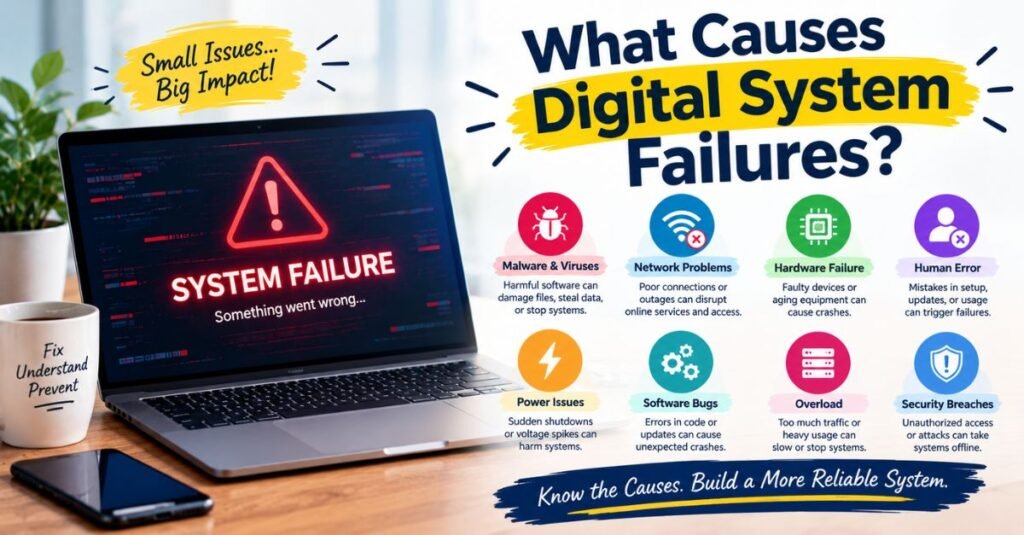
Most digital system failures trace back to seven layers. These are the network, the server, the client device, the data, the software, the hardware, and security. Often two or three layers fail together. That overlap explains why a simple fix sometimes doesn’t work.
Understanding Tubefalire causes starts with these layers. Knowing the common causes of technical failures saves hours of guessing. Each layer leaves its own clues behind. Think of the list as a checklist you can run in your head whenever an app misbehaves.
Network and Connectivity Failures
A steady connection matters more than a fast one. Packet loss forces your device to resend data again and again. High latency makes apps give up too soon. Router glitches and crowded networks add even more delay. Good network and server troubleshooting starts by testing the line before blaming the app.
Server Overload and Performance Bottlenecks
Server overload happens when requests arrive faster than the system can answer. Databases slow down as queries pile up. Queues grow long and some requests simply time out. Even large platforms feel this during sudden demand spikes. A bottleneck is the single slowest part that holds everything else back.
Client-Side and Device Problems
Your own device plays a bigger role than most people expect. Client-side errors include outdated browsers, full storage, and corrupted cache files. Heavy background apps can drain memory too. Clearing the cache and restarting the device often fixes these faults fast.
Read More About: The Flying Elephant: Memoirs of an Olympic Champion – Complete Book Review and Guide (2026)
Data Corruption and File Integrity Issues
Data corruption means a file changed or lost pieces along the way. Systems catch this problem with checksums. A checksum is a short fingerprint built from a file’s contents. If the fingerprints differ before and after a transfer, the file isn’t whole. Practice at identifying data integrity issues early protects your work.
Software Bugs and Compatibility Conflicts
Software bugs hide inside every large program. Software compatibility issues appear when two parts expect different versions of each other. A service may update its backend overnight. Your app then breaks although you changed nothing. Plugins and browser extensions can clash in similar ways.
Hardware and Operating System Failures
Hardware malfunctions are rarer but harder to spot. A dying drive, bad memory, or an overheating chip can freeze a device at random. Their symptoms look just like software trouble. Careful hardware failure diagnosis uses built-in health tools and temperature checks. Diagnosing hardware and software problems together takes patience.
Security, Permissions, and Access Problems
Security tools sometimes block honest traffic. Expired tokens log you out in the middle of a task. Strict firewalls sometimes reject perfectly safe requests. These access control issues look like crashes to the user. Real cybersecurity risks such as malware can cause the very same symptoms.
Early Warning Signs of Digital System Failures
Tubefalire-style failures rarely arrive without a few early hints. Pages may load slower than usual. Errors can come and go without any pattern. Apps sometimes close with no warning at all. You might also log in again and again within one day. Files may open with missing pieces.
These early warning signs of system failure share one trait, and that trait is inconsistency. Something works one minute and breaks the next. That usually means the system hasn’t fully collapsed yet. Acting now can save you from a bigger outage later. If many users report the same trouble, the provider likely owns the problem.
How Digital Failures Affect Users and Businesses
For users, the damage from a Tubefalire-type failure feels personal. Unsaved work can vanish in the middle of a task. Deadlines slip when tools stop responding. A failed payment adds stress to the whole day. Even small glitches steal focus and patience.
Businesses face much bigger bills than individuals. Downtime stops sales and frustrates customers. Data corruption can break important records. Weak security can expose private information. One failing service may also trigger others in a chain. The table compares the main effects.
| Group | Common Impact | Simple Example |
| Individual users | Lost time and lost work | A document fails to save before a deadline |
| Small businesses | Lost sales and unhappy customers | A checkout page freezes on a busy day |
| Large organizations | Financial cost and brand damage | A service outage spreads across many teams |
| Everyone | Privacy and security exposure | A failed login leaves a session half open |
How to Troubleshoot Tubefalire-Type Errors Step by Step
Good Tubefalire troubleshooting moves from simple to complex. Start with the cheapest checks first. Change only one thing at a time. Otherwise you won’t know which action solved the problem.
Change one thing. Test the result. Then change the next thing.
This method sits at the heart of how to troubleshoot digital errors. Write down error messages and times as you go. A short note now saves long guessing later. The six steps below cover most cases.
Step 1: Check Network Stability
Run a speed test and watch for packet loss. Compare results on Wi-Fi and on a wired or mobile connection. High or jumping latency points straight to the network. If another network works fine, the first one is your culprit. This step alone solves many stalled uploads.
Step 2: Restart and Isolate the Client Device
Restart the device first before testing anything else. Then try the same task in another browser or on another device. Clear the cache and switch off extensions for a quick test. If the problem vanishes elsewhere, your original setup holds the fault. That narrows the search a lot.
Step 3: Check Server and Platform Status
Open the service’s status page if one exists. Search for reports from other users. Error codes in the 500 range usually mean the server failed. In that case, waiting and retrying beats changing your own settings.
Step 4: Inspect Logs, Data, and File Integrity
System error logs record what really happened at the moment of failure. Look for timestamps that match your problem. For files, re-transfer them and compare sizes. Advanced users can also compare checksums. These checks reveal hidden data corruption fast.
Step 5: Test Software Updates and Compatibility
Update the app and the operating system. Then test the same task again to compare results. Many failures trace back to known bugs that patches already fix. If trouble began after a recent update, try rolling the change back. Careful software testing and debugging keeps every change safe.
Step 6: Escalate Persistent Issues When Necessary
Some problems need the help of an expert. Contact technical support if the issue survives all five earlier steps. Do the same when many users are affected or data is at risk. Share your notes, logs, and screenshots. Good records help support teams solve problems faster.
Common Digital Errors and Their Possible Solutions
A quick reference table speeds up diagnosis. Match your symptom to the likely cause. Then follow the suggested action in the next column. Keep in mind that several causes can overlap in a single Tubefalire-type error.
| Symptom | Likely Cause | What to Check | Recommended Action | When to Escalate |
| Upload stops midway | Network instability | Connection speed and packet loss | Retry on a stable network | Problem persists across networks |
| App freezes | Memory or CPU overload | Background apps and free RAM | Close extra apps and restart | Freezing continues after restart |
| Page request times out | Server overload or downtime | Status page and error codes | Wait and retry | Timeout lasts for hours |
| File looks corrupted | Interrupted transfer | File size and checksum | Re-upload or re-download | Same file type fails repeatedly |
| Login keeps failing | Expired session or token | Cookies and login behavior | Log out fully and sign in again | Failures continue after clearing cache |
Tables like this turn guesswork into routine. Save a copy for your team. Add new rows whenever you meet a fresh problem. Over time, the table becomes a personal guide to technical errors in your own setup.
Why Technical Problems Keep Coming Back
Quick fixes often hide the real cause. Restarting an app or clearing a cache may end the symptom for a day. The root issue stays untouched and waits to return. That’s why recurring technical errors return on a schedule. Unfixed settings, version clashes, and near-full systems are common reasons for a repeating Tubefalire error.
Consider a hypothetical small online shop as a case study. Its checkout froze every Friday evening. Staff restarted the server each time. A look at the logs showed traffic doubling during weekend sales. The server simply lacked the capacity for weekend traffic. After the team added capacity and alerts, the freezes stopped. Treating the cause beat treating the symptom, and the same lesson applies to any Tubefalire-style problem.
How to Prevent Recurring Digital System Failures

Prevention usually costs far less than repair does. Small habits stop most Tubefalire trouble before it starts. Tubefalire prevention relies on updates, monitoring, backups, and strong security. Each habit takes only a few minutes to set up. Together they form solid digital system failure prevention.
Teams should also schedule regular system maintenance. Maintenance means patching software, cleaning old files, and checking hardware health. It also helps with preventing recurring software errors. Document every problem you solve along with its fix. A written record reveals patterns that memory misses.
Keep Software and Devices Updated
Updates fix known bugs and close security holes. Turn on automatic updates where you can. Avoid unsupported systems that no longer receive patches. A current device handles modern apps with fewer surprises.
Monitor Performance and Network Health
Watch your tools before they break. Home users can run occasional speed tests. Teams should use IT infrastructure monitoring with alerts for slow responses and high memory use. Steady server performance monitoring shows trends over weeks. Early alerts turn emergencies into routine chores.
Read More About: Thealite Keep Safe: Complete Guide to Online Safety, Privacy, and Photo Protection in 2026
Back Up Important Data Regularly
Backups limit the damage of any failure. Follow a simple rule of keeping several copies in different places. Test your restores now and then. Reliable data backup and recovery means a file can truly come back. Untested backups give you a false sense of comfort.
Use Strong Security and Access Controls
Strong passwords and two-step login reduce cybersecurity risks. Review permissions so people only get the access they need. Fix access control issues quickly because they block honest work. Good access rules also keep your accounts safe from strangers.
How Developers Can Build More Reliable Systems
Developers decide how gracefully a system handles a Tubefalire-style failure. Every system breaks at some point. Strong design makes that break small and recoverable. Reliable system design expects trouble and plans for it. That planning builds lasting digital reliability for every user.
Safe software releases matter just as much as design. Teams roll out changes slowly and keep a rollback plan ready. They test in staging before touching live users. Graceful degradation lets a system drop minor features under load. The core service keeps running while the team fixes the rest.
Error Handling and Logging
Good error handling returns clear messages instead of vague failures. Logs record what happened and when. Input checks stop bad data early. Together these habits turn mysteries into short bug reports.
Automated Testing and Performance Monitoring
Automated tests catch mistakes before users do. Performance testing includes load tests, stress tests, and capacity tests. Load tests copy normal traffic to check everyday performance. Stress tests push past the limits to find the breaking point. Live dashboards then watch real behavior day and night.
Backup, Recovery, and Fault-Tolerant Design
Fault-tolerant systems keep working when one part fails. Redundant servers, automatic failover, and clean recovery plans make that possible. Teams should rehearse these plans on a regular schedule. Practice reveals gaps that paper plans hide. Strong system recovery methods shorten any outage.
How Cloud Computing Affects System Reliability
Most modern apps run on shared cloud servers. That setup brings speed and flexibility to every project. It also brings a fresh set of risks. Cloud computing failures can come from regional outages, scaling delays, or a broken third-party service. One outage can hit many unrelated apps at once.
Still, the cloud offers strong recovery tools. Automatic failover and multiple regions raise cloud infrastructure reliability. Smart design improves overall cloud computing reliability even further. The trade-off is added complexity across the whole stack. You must also track every outside service your app depends on.
Security Risks That Can Lead to Digital Failures
Security systems protect you but can also interrupt you. Expired certificates can break trusted connections without any warning. Misconfigured firewalls can block normal traffic for hours. Attacks can flood a service until it slows to a crawl. Each case looks like an ordinary technical fault.
The real challenge here is finding the right balance. Rules that are too loose invite real risk. Rules that are too strict cause false failures. Regular reviews keep that balance healthy. Strong cybersecurity and system protection means testing rules and fixing mistakes quickly.
Advanced Recovery Strategies for Persistent Errors
Basic fixes sometimes fail to solve a stubborn Tubefalire problem. Then it’s time for advanced system recovery strategies. Start by reading logs for specific error details. Check whether a recent update or setting change started the trouble. Test each dependency alone to find the weak one.
Next, restore from a known good backup if data looks damaged. Roll back the last change when it matches the problem’s start. Larger organizations also rely on business continuity planning. That plan names who acts and what gets restored first. Reliable system recovery methods turn panic into process.
How to Verify Unknown Technical Terms Online
Strange terms appear online all the time. Verifying unknown technical terms online protects you from false advice. Check official documentation, vendor sites, and trusted glossaries first. Look for several independent sources instead of copies of one page. Notice the publication date of each source too.
Ask yourself three quick questions about the page. Does a known authority define the term? Do sources agree on the details? Does the page show real evidence? If the answers are no, treat the term with caution. Tubefalire fails this test today on every point. Still, the symptoms behind it deserve real attention.
How AI-Generated Content Can Spread Confusing Definitions
Automated writing tools can produce confident but shaky explanations. Low-quality sites may copy those explanations at scale. A made-up definition then spreads across many pages. Readers see the repetition and assume it’s true. AI-generated content accuracy therefore depends on human review.
Spot weak pages with a few signs. Weak pages often lack named sources or clear authors. They repeat generic phrases instead of giving real detail. They give no concrete examples or steps. Always cross-check with official material before you trust a new term like Tubefalire.
FAQ,s
What does Tubefalire mean?
Tubefalire is an informal label for digital processes that start but fail to finish. The Tubefalire meaning points to a break between your device, the network, and a server.
Is Tubefalire a real technical term?
No, it isn’t a standard term in IT documentation. It’s a loose label used by a few online articles. The failures it describes are real and have precise names.
Is Tubefalire a virus or malware?
No reliable source shows that Tubefalire is a virus. The word describes failures rather than a threat. However, real malware can cause similar symptoms. Run a trusted security scan if your device acts strangely.
Is Tubefalire related to a streaming or video platform?
The name may remind you of video sites. Yet no trustworthy source ties the word to any platform. Endless buffering is one symptom people link to it. Treat any claim about a specific platform with caution.
What are the common causes of digital system failures?
The main causes include network connectivity issues, server overload, device faults, and data integrity problems. Software bugs, hardware malfunctions, and security blocks also play a part. Several of these causes often overlap in real cases.
How can I troubleshoot a Tubefalire-type error?
Check the network first and then isolate your device. Next, look at the service status and inspect files and logs. Finally, test updates and call support when needed.
Can digital system failures cause data loss?
Yes, data loss is possible in several situations. Interrupted transfers and corrupted files can destroy work. Regular backups and integrity checks reduce that risk sharply.
How can businesses prevent recurring technical problems?
Businesses should combine redundancy, monitoring, capacity planning, and clear incident plans. They should also fix root causes instead of repeating quick fixes.
When should I contact an IT professional?
Call for help when basic steps fail. Do the same when many users suffer or when data is at risk. Infrastructure you don’t control also calls for expert help.
conclusion
Tubefalire isn’t an official technical term. Tubefalire is a loose label for a very real group of problems. Understanding Tubefalire causes matters far more than the word itself. Good habits and sound design raise digital reliability for everyone.
Remember the core mindset behind everything above. Hunt for root causes, change one thing at a time, and keep records. Verify every fix and prevent repeats. With that approach, even stubborn digital system failures become manageable.