
Antivirus Reedoor2.4.6.8: Is It Safe or Dangerous? (2026 Guide)
No clear proof shows that Antivirus Reedoor2.4.6.8 is a legitimate security product. No official Microsoft page defines it. No established vendor page backs it either. A few promotional pages call it protection software. Those pages name no developer and offer no verifiable proof. So is Reedoor2.4.6.8 legitimate? The honest answer is unverified. Treat Antivirus Reedoor2.4.6.8 with caution until real evidence appears. Many people first meet Antivirus Reedoor2.4.6.8 through a pop-up or a surprise download. A calm check always beats a quick click.
This Antivirus Reedoor2.4.6.8 review keeps things simple. You’ll learn what the name means, how to check it on Windows and how to handle it safely. The Reedoor2.4.6.8 safety review below also covers removal steps and better options. Read it before you click any download button. A few minutes of checking can save you hours of cleanup. Each section ends with a clear action you can take today. That keeps the advice practical for beginners.
| Question | Short Answer |
| Is it a Microsoft product? | No evidence says so |
| Does it have a verified developer? | None found |
| Is it proven malware? | Not proven either way |
| Should you install it? | No |
What Is Antivirus Reedoor2.4.6.8?
The name looks like an antivirus program. It starts with the word antivirus. It ends with a neat four-part number. Together they sound official. Yet a name alone proves nothing. Search results show only a few thin pages about Antivirus Reedoor2.4.6.8. These pages praise it with generic words like strong security and simple controls. None of them names a company, a team or a support address.
A real antivirus has a clear identity. You can find the publisher, a website, release notes and support pages. You can also find test results from labs like AV-TEST or AV-Comparatives. Those details let you judge antivirus software credibility. This Antivirus Reedoor2.4.6.8 safety analysis looks for exactly those signs. Antivirus Reedoor2.4.6.8 offers none of these basics in a form you can confirm. That gap matters more than any slogan.
Understanding Its Name and Reported Purpose
Pages that mention Antivirus Reedoor2.4.6.8 claim it scans files, watches downloads and offers parental controls. One page even lists a support team and a simple install guide. However, the claims read like copied marketing text. A similar promotional page exists for a lookalike name, Freedoor2.4.6.8. That pattern may point to template content instead of a real product. The reported purpose therefore stays unproven. Always ask who wrote the claim and why. Marketing text without a named author deserves doubt.
What Is Known About Its Developer and Origin?
Very little is known. No company name appears in the pages found. No official website, contact page or release history showed up either. Developers of real software want credit and customers. They publish their names. Silence is therefore a warning sign about Antivirus Reedoor2.4.6.8. Careful readers treat software developer verification as the first test. Without a name to verify, the other claims have nothing solid to stand on. Compare this with trusted vendors that show leadership teams, office addresses and public support forums.
Is Reedoor2.4.6.8 an Official Windows Component?
No. Reedoor2.4.6.8 for Windows isn’t a built-in tool. Microsoft’s own security tools are Windows Security and Microsoft Defender Antivirus. You can read about them at Microsoft Support. Genuine system parts live in expected folders and carry Microsoft signatures. Antivirus Reedoor2.4.6.8 shows none of that proof. If a message claims Windows requires it, treat that message as a red flag. Real Windows updates arrive through Windows Update only. Checking the publisher in file Properties takes less than a minute. It settles the question quickly.
Is Antivirus Reedoor2.4.6.8 Safe to Install?
Short answer: don’t install it. Is Antivirus Reedoor2.4.6.8 safe? Nothing verified says yes. Safety needs proof. Proof needs a known publisher and a trusted source. A Reedoor2.4.6.8 download from a random page offers neither. You’d be trusting a stranger with deep access to your PC. Antivirus programs run with high privileges. That’s why a fake one can do real damage.
Windows already includes strong Windows antivirus protection. Microsoft Defender Antivirus runs by default on most PCs. It updates itself through Windows Update. Adding an unknown tool brings little benefit. It also adds Reedoor2.4.6.8 security risks such as data collection, bundled adware and conflicts with Defender. Think of it like adding a second lock from an unknown locksmith. It might help. It might also copy your keys. Fewer security tools often mean fewer conflicts and fewer surprises. Antivirus Reedoor2.4.6.8 adds complexity without any proof of value.
What Can Be Verified About Its Security Claims?
Almost nothing. Claims of real-time protection, low system use and wide device support appear without evidence. No independent lab has tested Antivirus Reedoor2.4.6.8. No audit report exists. No named engineers stand behind it. A good cybersecurity threat assessment compares each claim with proof. Here every claim fails that comparison. The honest label is unverified. It isn’t safe and it isn’t confirmed to be fake. Until a lab or the developer publishes proof, Antivirus Reedoor2.4.6.8 stays in the unverified column.
Potential Security and Privacy Risks
The biggest worry is data. Security software can read your files, browsing activity and system settings. A bad actor could misuse that access. Other risks include bundled adware, hijacked browser settings, surprise subscriptions and fake scan results that push payments. Learn how to protect personal information by never typing card details or passwords into tools you can’t verify. Privacy policies matter too. Antivirus Reedoor2.4.6.8 shows none. Even a small leak can lead to stolen accounts. Antivirus Reedoor2.4.6.8 gives you no privacy promise to rely on. Strong privacy habits cost little and protect a lot.
Why a Version Number Does Not Prove Authenticity
The 2.4.6.8 part looks like a software version. Developers do use four-part numbers. However, anyone can paste digits onto a name. A real version links to a product page, a changelog and file properties inside Windows. Without those links the number is decoration. This matters for Reedoor2.4.6.8 software authenticity. Numbers feel technical and trustworthy. They aren’t proof. Check the publisher before you trust any number attached to Antivirus Reedoor2.4.6.8. Think of it like a price tag on an empty box. The number looks official while the contents remain unknown.
Warning Signs of Suspicious Antivirus Software
Spotting trouble early helps. Good suspicious software detection starts with a few simple habits. Compare any program you meet against the signs below. If you see two or three together, stop and investigate. Antivirus Reedoor2.4.6.8 already fails the first test because no developer is known. Keep this list handy when you browse download pages.
| Warning Sign | Why It Matters |
| No developer name | You can’t verify who built it |
| Admin rights without reason | It may gain deep system control |
| Payment demanded to remove threats | Classic scareware behavior |
| Requests to turn off Defender | Attackers want your shield down |
| Unwanted browser extensions | It may track or redirect you |
| File returns after removal | It may hide persistent components |
Is Reedoor2.4.6.8 a Virus or Malware?
Nobody can call it malware from the name alone. Nobody can call it safe either. The file decides. A file’s source, location, signature and scan results tell the real story. Reedoor2.4.6.8 malware detection by a trusted scanner is more useful than any web page opinion. Until you hold an actual file, the question stays open for Antivirus Reedoor2.4.6.8.
Still, caution makes sense. Many fake security tools hide behind believable names. They copy the look of trusted security software. Some install adware. Others steal data or demand payment. Treat every unknown installer as risky until your own checks say otherwise. Think verify first and trust later. Antivirus Reedoor2.4.6.8 fits this pattern of vague promises with no identity behind them.
Unknown Software vs. Confirmed Malware
These two labels are very different. Unknown software lacks identity. Confirmed malware has proof. Confusing them leads to bad choices. You might panic over a harmless file. You might also ignore a real threat. A simple table keeps the difference clear. Use it whenever you meet an unknown Windows program like Antivirus Reedoor2.4.6.8. Label things honestly. Unknown means unverified. Malware means proven.
| Aspect | Unknown Software | Confirmed Malware |
| Evidence | Missing or unclear | Named detection or analysis |
| Typical sign | No publisher or signature | Scanner alerts or harmful behavior |
| Right response | Verify and scan | Remove and secure accounts |
Understanding Fake Antivirus Software and Scareware
Fake antivirus software is an old trick. It shows loud alerts about infections that don’t exist. Then it pushes you to buy a full version or install a cleaner. This is scareware. It works by making you afraid. Good fake antivirus and scareware prevention starts with calm. Close the page. Don’t call numbers shown on screen. Check any claim with Windows Security instead. The FTC shares guidance on tech support scams. Antivirus Reedoor2.4.6.8 shares marketing language with many scareware products. That similarity alone justifies extra care.
Common Signs of Fake Security Alerts
Learn to identify fake antivirus alerts quickly. They often appear in a browser tab instead of Windows Security. They show countdown timers, red screens and huge infection counts. They tell you to call a phone number. Some play sirens. A real antivirus warning message comes from software you installed on purpose. It never needs payment through a pop-up. A web page also can’t scan your whole PC. Close the tab and clear notification permissions. Any Antivirus Reedoor2.4.6.8 pop-up that matches these signs deserves an immediate close.
Why Are People Searching for Antivirus Reedoor2.4.6.8?
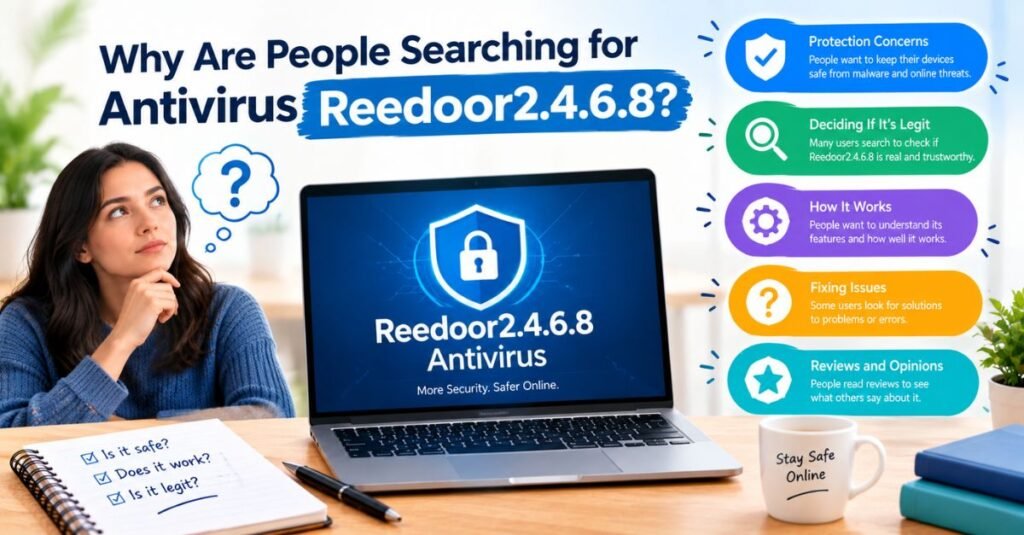
Most people meet the name by surprise. It shows up in a search result, an ad, a downloaded folder or an Installed apps list. Curiosity turns into worry fast. Someone types Antivirus Reedoor2.4.6.8 into a search box hoping for a clear answer. Instead they find vague pages with conflicting claims. That confusion drives more searches. It also gives low-quality sites a chance to publish thin content.
Unknown names trigger caution for good reason. Cybercriminals often reuse believable labels. Some content farms also publish many lookalike pages with only the name changed. Readers then see the same text everywhere. Repetition feels like proof. It isn’t. This Reedoor2.4.6.8 safety review aims for the opposite. It uses slow and careful checking. Anyone can copy a template and swap a name. Real products leave deeper footprints than that.
Reported Features and Advertised Security Benefits
Promotional pages list real-time scanning, web protection, parental controls and quick support. They also promise a light footprint and easy setup. These features sound normal. Every mainstream suite offers them. Nothing here sets Antivirus Reedoor2.4.6.8 apart. Advertised benefits count only when someone can test them. No lab report, user manual or vendor portal exists for this product. All features therefore stay in the marketing language. Ask one simple question: who will fix a bug or answer a support ticket? Antivirus Reedoor2.4.6.8 offers no answer.
Claims vs. Available Evidence
Claims are cheap. Evidence is rare. The table below matches each popular claim with what can actually be found. Every row ends the same way. That pattern is the real story behind Antivirus Reedoor2.4.6.8. It also shows why Reedoor2.4.6.8 legitimacy remains an open question. Treat every unverified row as a reason to wait.
| Claim | Evidence Found | Status |
| Real-time protection | No test results | Unverified |
| Wide device support | No developer platform list | Unverified |
| Parental controls | No official screenshots | Unverified |
| Fast customer support | No company or contact address | Unverified |
| Low price | No official store | Unverified |
How to Verify Official Documentation and Developer Details
Start with the basics. Look for an official website with a company address. Search the business name in a company registry. Check that support emails use a real domain. Look for a privacy policy and terms of use. Then confirm the signer of the installer later in this guide. Cross-check claims against trusted review labs. If any verified software publisher step fails, stop right there. Antivirus Reedoor2.4.6.8 fails at the very first one. Real vendors make these checks easy. They want you to verify them.
Read More About: TheSindi.com Review 2026: Features, Content, Benefits, and Trustworthiness
How to Check Reedoor2.4.6.8 on Windows
Checking is safer than guessing. You can inspect a file without running it. Windows gives you every tool you need. Work through five short steps in order. Take notes as you go. Never double-click an unknown installer just to see what happens. That one click can start an infection. Keep a notepad open. Small details like folder paths and dates often solve the mystery.
This Windows security troubleshooting routine works for any odd program. It combines suspicious application verification with basic Windows malware detection methods. Each step adds one more clue about Antivirus Reedoor2.4.6.8 or any similar name. Together the clues give you a confident answer.
| Step | Where to Look | What to Check |
| 1 | Installed apps | Name, publisher and install date |
| 2 | Task Manager and Startup apps | File location and startup behavior |
| 3 | File Properties | Digital signature and company details |
| 4 | PowerShell | SHA-256 hash value |
| 5 | Windows Security | Scan results and Protection history |
Step 1: Check Installed Apps and Programs
Open Settings and select Apps. Then choose Installed apps. Search the list for Reedoor. Note the exact name, the publisher and the install date. A missing publisher is a warning sign. Also look at other apps installed on the same day. Bundled installers often add extra programs. If you find a match you didn’t install on purpose, move on to the next steps before changing anything. Screenshots of this list can help if you later need expert support.
Step 2: Review Task Manager and Startup Apps
Press Ctrl+Shift+Esc to open the Task Manager. Look under Processes for the name. Right-click the entry and choose Open file location. Then open the Startup apps tab and check whether the item runs at sign-in. Don’t end a process just because the name looks odd. Use the folder path as a clue instead. A suspicious executable file often sits in Downloads, Temp or AppData. If Antivirus Reedoor2.4.6.8 appears in Startup apps, note its impact rating and publisher before any action.
Step 3: Check the File Location and Digital Signature
Right-click the file and select Properties. Open the Digital Signatures tab if it appears. Read the signer name and check that Windows reports the signature as valid. Compare the signer with the publisher the file claims. Proper digital signature verification helps confirm who signed the file. It doesn’t prove safety. A missing or invalid signature on an unfamiliar program adds doubt. The Details tab also shows product name, company and version. If Antivirus Reedoor2.4.6.8 claims to come from a company, the signer should match that name exactly.
Step 4: Calculate and Verify the File Hash
A hash is a unique fingerprint for a file. Open PowerShell and run Get-FileHash -Algorithm SHA256 -Path “C:\full\path\to\file.exe” to calculate it. Microsoft documents the command on Microsoft Learn. Compare your result with an official hash from a verified developer. This file hash analysis works only when an official value exists. A hash alone can’t call a file safe. Malware has hashes too. Keep the result in a note so you can compare files later.
Step 5: Scan the File With a Trusted Security Tool
Run a Windows Security scan on the file. Right-click it and choose Scan with Microsoft Defender. For wider checks run a Full scan from Virus & threat protection. Update security intelligence first. If you suspect a deep infection, use Microsoft Defender Offline. It restarts the PC and scans before Windows loads. Never turn off real-time protection to test an unknown file. That choice removes your best safety net. Save the scan report. It helps you explain events to a technician if needed.
What to Do If You Find Reedoor2.4.6.8 on Your Device
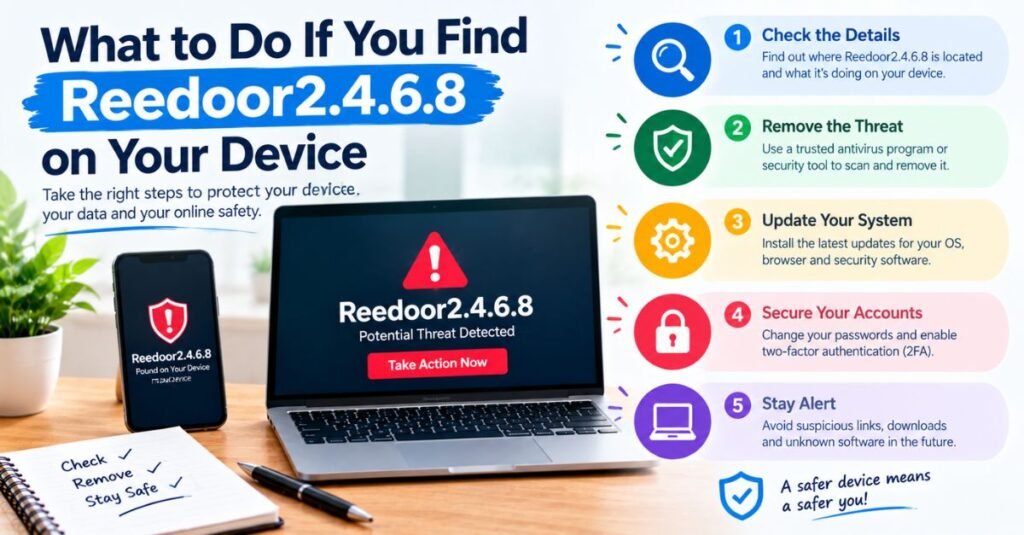
Your next move depends on where you saw the name. A web page needs a different response than an installed program. Stay calm. Avoid quick clicks. Write down the full name, file type and any message on screen. A screenshot helps. Hide passwords, codes and account numbers before you save it.
Think of this as a short triage guide. Each case below has a safe first action. Here’s an illustrative example. Maya, a student, saw a pop-up claiming her PC had 47 viruses. It urged her to install Antivirus Reedoor2.4.6.8. She closed the tab and ran a Windows Security scan. It found nothing. Removing the site’s notification permission stopped the pop-ups.
If You See the Name on a Website
Don’t click Download, Install, Allow, Repair or Scan Now. Close the tab. If you didn’t choose to visit the page, check whether the site has notification permission in your browser settings. Remove it. Fake alerts often use browser notifications to imitate Windows messages. A random ad doesn’t justify a Reedoor2.4.6.8 download. Ignore short links and file-sharing pages promising a free premium version of Antivirus Reedoor2.4.6.8. Close the page and move on with your day.
If You Downloaded the File but Have Not Opened It
Good news: you’re still safe. Don’t open it. Check Properties for publisher and signature details. Scan it with Windows Security. If you can’t identify the source and you didn’t intend to download it, delete it. Empty the Recycle Bin afterward. Removing an unopened file beats running it to see what happens. Curiosity is how most infections begin. That’s true for Antivirus Reedoor2.4.6.8 and every other unknown installer.
If the Program Appears in Installed Apps
First ask whether you installed something around that date. Bundled software often adds extra programs. If the entry looks unwanted, use the normal uninstall button. Don’t download a random remover from a pop-up. Those tools are a common trap. If you can’t tell where Antivirus Reedoor2.4.6.8 came from, scan the PC before touching system files or the Registry. A steady approach protects you from side effects. Note any companion programs that share the same install date.
Read More About: 54+Brasssmile Com Explained: An Honest Guide to the Website, Content, and Credibility
If It Appears in Task Manager
Don’t kill it right away. Right-click and open Properties and file location. Check the publisher, the signature and the folder path. A program running from Temp or Downloads deserves closer review. Location alone isn’t a verdict. Then scan the file. If it proves unwanted, close it and uninstall through Settings. Avoid deleting items inside Windows system folders. One wrong deletion can break your PC. Take a screenshot of the Properties window for your records.
If Windows Security Detects a Threat
Open Windows Security and select Protection history. Read the detection name, the file path, the severity and the action taken. These details beat a filename because names change easily. Follow the recommended action. Don’t restore a quarantined file. Don’t add an exclusion just to make an unknown app run. If you think the detection is wrong, verify the publisher first. Only then consider allowing Antivirus Reedoor2.4.6.8. Write down the threat name for later reference.
If You Have Already Installed or Run the File
Act quickly but calmly. Disconnect from the network to limit further activity. Run a full Windows Security scan and then a Defender Offline scan. Uninstall the program through Settings. Next, change important passwords from a different and clean device. Review bank, email and shopping accounts for odd activity. A clear malware removal guide reduces damage. If problems continue, seek help from a trusted technician.
How to Remove Reedoor2.4.6.8 Safely
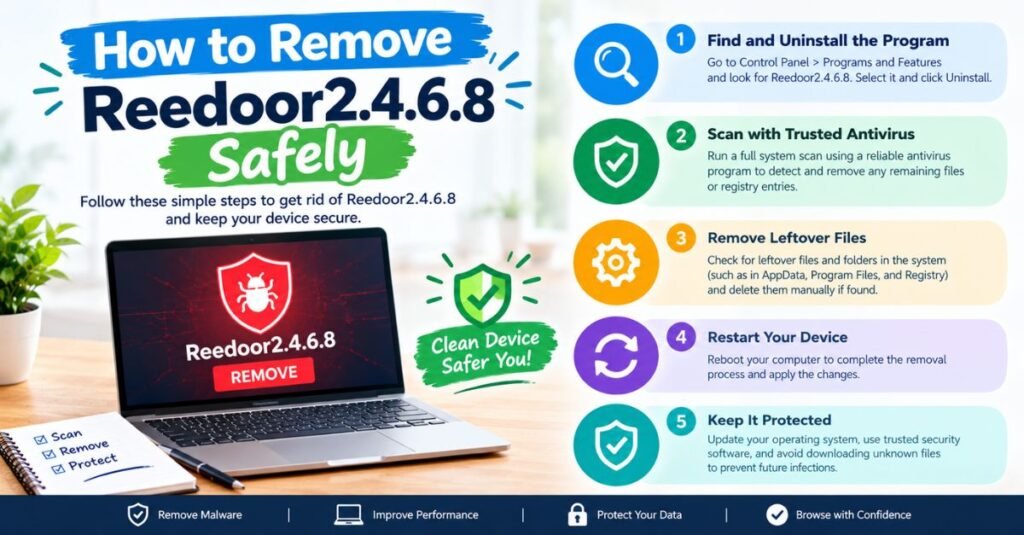
Reedoor2.4.6.8 removal works best in order. Identify the item first. Uninstall it next. Scan the PC after that. Finally secure your accounts. Skipping steps leaves traces behind. Manual deletion often leaves services, scheduled tasks and startup entries alive. Those leftovers can bring Antivirus Reedoor2.4.6.8 back. That is why Antivirus Reedoor2.4.6.8 cleanup should follow a plan.
You want to remove suspicious software without causing new problems. Use built-in Windows tools whenever you can. Avoid free fixers from ads. Combine this section with the earlier checks. A calm routine protects both your files and your sanity.
Uninstall the Program Through Windows Settings
Open Settings, then Apps, then Installed apps. Find the entry. Click the three dots and select Uninstall. Follow the prompts. Restart your PC when asked. Then check Startup apps and browser extensions for related items. This standard path is the cleanest option. It removes registered files and entries the right way. Always prefer it over manual file deletion of Antivirus Reedoor2.4.6.8.
What to Do If the Program Will Not Uninstall
Restart Windows and try again. Next, run Microsoft Defender Offline. It scans outside normal Windows and can catch stubborn items. Check Startup apps and Task Scheduler for related entries. Use Safe Mode if the program keeps restarting. If it still resists, don’t force-delete system files. Ask a trusted technician for help. Stubborn behavior is itself a warning sign worth taking seriously.
Scan for Remaining Files and Potential Threats
After removal run a Full scan with Windows Security. Review Protection history for any detections. Check your browser for unknown extensions, odd search engines and new home pages. Reset them if needed. Look at Installed apps once more for companion programs. Complete Windows application security cleanup means checking every layer. One clean scan is good. Two scans on different days are better. Antivirus Reedoor2.4.6.8 traces, if any, usually hide in startup items or browser add-ons.
How to Protect Your Accounts After a Security Incident
Change passwords from a clean device. Start with email since it controls resets. Then update banking, shopping and social accounts. Turn on two-factor authentication everywhere possible. Review recent logins and sent messages for activity you don’t recognize. Watch bank statements for several weeks. Learn to protect personal information with a password manager and unique passwords. Contact your bank at once if you typed card details into any page tied to Antivirus Reedoor2.4.6.8.
Read More About: fentomagazine.com usa Review 2026: Features, Content, Benefits, and Trustworthiness
What to Avoid When Removing Suspicious Software
Don’t download removal tools from pop-ups. Don’t disable Windows Security or SmartScreen. Don’t edit the Registry unless you know the exact key. Don’t pay anyone who calls you about infections. Don’t delete files from System32 or Program Files without proof. Each shortcut adds risk. Slow and verified action keeps your PC stable. These safe software installation practices also apply when you install anything new later.
Antivirus Reedoor2.4.6.8 vs. Trusted Antivirus Software
Comparing helps you see the gap. Real security products offer identity, evidence and support. Antivirus Reedoor2.4.6.8 offers vague claims. The table below shows the difference at a glance. Use it as a checklist for any security tool you consider.
| Feature | Antivirus Reedoor2.4.6.8 | Trusted Antivirus (Example: Microsoft Defender) |
| Named developer | None found | Yes |
| Official website | Not confirmed | Yes |
| Independent test results | None found | Often available |
| Signed installer | Unknown | Yes |
| Support and updates | Unclear | Documented |
| Privacy policy | Not found | Published |
The result is clear. A trusted tool earns trust through transparency. An unknown one asks for trust first. Choose transparency. Smart choices come from evidence and not from slogans.
Microsoft Defender Antivirus for Windows
Microsoft Defender Antivirus is built into Windows 10 and Windows 11. It provides real-time protection, cloud-based detection, ransomware safeguards and regular updates. It works alongside SmartScreen to check downloads and sites. For most home users it delivers solid Windows antivirus protection without extra cost. Independent labs such as AV-TEST publish results you can read yourself. Keep Windows updated so protection stays current. Many people need nothing more than this. Open Windows Security and check that every protection toggle shows green.
Reputable Third-Party Antivirus Alternatives
Some people want extras such as a VPN, a password manager or family controls. If so choose reliable antivirus alternatives from vendors with a long track record. Look for a real company, public pricing, clear support and strong lab scores. Read results on AV-Comparatives. Download only from the vendor’s official website. These antivirus alternatives compete openly and publish proof. Install only one full security suite at a time to avoid conflicts. Antivirus Reedoor2.4.6.8 meets none of these buying rules.
Essential Features of Reliable Antivirus Software
Strong products share core traits. They offer real-time scanning, frequent updates, ransomware protection, phishing protection and a light impact on performance. They show clear privacy policies. They provide support you can reach. They hold up in independent tests. Together these traits form trusted security software. A tool missing most of them isn’t worth the risk. Use this list as your buying filter. Check each trait before you pay or download. Antivirus Reedoor2.4.6.8 has not shown proof for any of these traits.
Read More About: WiseStudySpot.com Explained: Features, Topics, Safety, and SEO Guide (2026)
Free vs. Paid Antivirus Programs
Free options like Defender give strong baseline protection. Paid suites add extras such as VPNs, identity monitoring and device controls. Price alone doesn’t prove quality. Some free tools are excellent while some cheap paid ones are fake. Choose based on verified features and independent test scores. If you only need core protection, Defender plus smart habits often works. Pay only when the extras solve a real problem for you. Whatever you choose, never pick a product you can’t identify.
| Factor | Free Option (Example: Defender) | Paid Suite |
| Core malware protection | Included | Included |
| VPN and identity alerts | Usually not included | Often included |
| Cost | No extra charge | Yearly fee |
| Best for | Everyday home use | Families and heavy users |
Common Mistakes to Avoid When Checking Unknown Software
Most security trouble starts with small mistakes. Rushing is the biggest one. People click first and think later. Attackers count on that habit. Build a pause into every decision. Ask who made the file and where it came from. Ask what proof exists. Then act on Antivirus Reedoor2.4.6.8 or any unknown name.
Four mistakes show up again and again. Each one is easy to avoid with a little knowledge. Learn them now. You’ll spot them faster later. Good habits are your cheapest defense.
Trusting Unverified Reviews and Security Claims
Many review pages copy each other. They repeat the same praise and the same feature list. Repetition looks like agreement. It isn’t. A real check needs independent proof. Look for named testers, lab data and vendor documentation. Be wary of reviews that read like ads. One verified source beats ten copied pages. Ask where each claim about Antivirus Reedoor2.4.6.8 originates before you believe it.
Clicking Suspicious Download Links or Pop-Ups
Ads, short links, file-sharing sites and pop-ups deliver most fake tools. A pop-up saying your PC is infected is almost always false. Close it from the browser tab and not from the buttons inside it. If the page won’t close, use Task Manager to end the browser. Never click Allow on unfamiliar notification prompts. Download software only from official vendor sites or the Microsoft Store. Antivirus Reedoor2.4.6.8 download prompts often hide inside such pop-ups.
Adding Unknown Files to Antivirus Exclusions
An exclusion tells your scanner to ignore a file or folder. That creates a blind spot. Attackers love blind spots. Add an exclusion only after you’ve verified the publisher, understood the detection and confirmed a false positive. Even then use the narrowest scope possible. Never exclude a whole Downloads folder. Never exclude Antivirus Reedoor2.4.6.8 simply to make an unknown program run. Review your exclusion list every few months and remove old entries.
Deleting System Files Without Verification
Some people delete anything that looks strange. That habit can break Windows. Core files often have unusual names. Removing one may cause crashes or boot trouble. Check the publisher, the signature and the path before deleting. If a file sits in System32 or Windows folders, be extra careful. When unsure, scan and ask for expert help. A restore point or backup adds a useful safety net. Antivirus Reedoor2.4.6.8 doesn’t justify risky manual deletions. Patience costs nothing.
Frequently Asked Questions
These answers cover the questions people ask most. Each one is short and direct. Use them for quick guidance. Then read the full sections above for detail on Antivirus Reedoor2.4.6.8.
Remember the core rule. Unknown means unverified. Verify before you trust.
Is Antivirus Reedoor2.4.6.8 Legitimate?
No proof shows that it is. No verified developer, official website or independent test exists. Promotional pages repeat vague claims. Treat it as unverified. Skip any download and use Microsoft Defender or a known vendor instead. Antivirus Reedoor2.4.6.8 remains unverified until real proof appears.
Is Reedoor2.4.6.8 a Virus or Malware?
The name alone can’t prove it. A file with this name could be harmless or harmful. Check its source, signature, location and scan results. If Windows Security flags it, follow the recommended action. Don’t run or restore it.
Is Reedoor2.4.6.8 Made by Microsoft?
No evidence connects it to Microsoft. Microsoft’s built-in tools are Windows Security and Microsoft Defender Antivirus. A program isn’t Microsoft’s just because it runs on Windows. Check the publisher and signature in the file Properties.
Can Reedoor2.4.6.8 Be Trusted?
Trust needs evidence. Right now none exists. There’s no developer, no documentation and no lab testing. You shouldn’t trust it with system access or personal data. Trust grows from transparency. Choose tools that show theirs. Antivirus Reedoor2.4.6.8 hasn’t earned that trust yet.
How Do I Check Whether Reedoor2.4.6.8 Is Installed?
Open Settings, then Apps, then Installed apps. Search for Reedoor. Next check Task Manager and Startup apps. Also scan your Downloads folder for files with the name. Run a Windows Security scan if anything appears. Note the publisher and install date.
How Do I Remove Reedoor2.4.6.8 From Windows?
Uninstall it through Settings if it appears in Installed apps. Restart and then run a Full scan. If it won’t uninstall, try Microsoft Defender Offline. Avoid third-party removers. Change passwords from a clean device if you ran the file.
Should I Download Reedoor2.4.6.8 to Remove Malware?
No. Using an unverified tool to fight malware is like hiring a stranger to guard your house. Use Windows Security or a reputable vendor. Pop-ups urging you to download a fix are a classic scam. Antivirus Reedoor2.4.6.8 shouldn’t be your cleanup tool.
Should I Add Reedoor2.4.6.8 to Antivirus Exclusions?
No. Exclusions weaken protection. Add one only after you’ve proven the file is safe and the detection is wrong. For an unknown file the safest choice is to leave it blocked.
Do I Need Paid Antivirus Software?
Not always. Microsoft Defender gives solid baseline protection for most home users. Paid suites add extras like VPNs and identity alerts. Pick based on features you’ll actually use and on independent test results.
Conclusion
Here’s the bottom line. Antivirus Reedoor2.4.6.8 lacks a verified developer, an official site and independent testing. It isn’t a Windows component. It isn’t a confirmed virus either. It’s an unverified name. Check the file, the path, the publisher, the signature and the scan result before you decide anything.
Stick with trusted security software such as Microsoft Defender or a respected vendor. Don’t run, install, restore or exclude unknown files. Stay calm and move step by step. A few smart checks keep your PC and your data safe in 2026 and beyond. Share this guide with friends and family who might face the same pop-ups.