
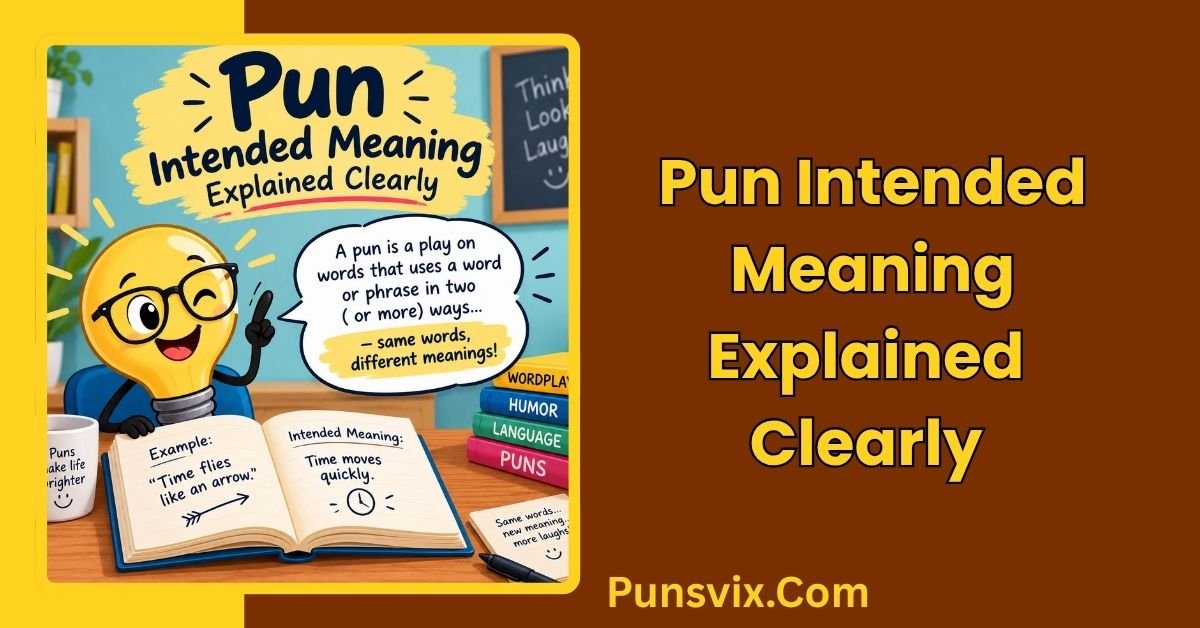
700+Pun Intended Meaning Explained Clearly: Definition & Examples
Ever heard someone crack a joke and add “pun intended” right after? You probably smiled, then wondered why they said it. This guide gives you the pun intended meaning explained clearly, so you’ll never feel lost again.
You’ll learn the pun intended definition, how it differs from “no pun intended,” and when it fits. It’s handy for texts, captions, birthday cards, work emails, and casual chats with friends.
Ready to get the joke every time? Let’s break down this fun English expression step by step. Along the way, you’ll see real examples, easy tables, and simple tips you can use today in texts, cards, and everyday talk, too.
What Does “Pun Intended” Mean?
If you’ve ever asked what does “pun intended” mean, the answer is simple. Here, the pun intended meaning explained clearly starts with one idea: the speaker used a word on purpose to make a joke.
Simple Definition of Pun Intended
The pun intended definition is easy. It tells listeners that a double meaning was chosen deliberately and isn’t a slip. Think of it as a tiny wink in words. Once you grasp the pun intended meaning explained clearly here, the rest of this guide feels easy, and you can spot the phrase anywhere.
- Pun intended = wordplay on purpose
- A wink after a joke
- “That was a joke, folks”
- Meant to be funny
- Not a slip of the tongue
- A friendly heads-up about intentional wordplay
What the Phrase Signals in Conversation
In conversational English, the phrase works like a signpost. It points to the clever phrases you just used and invites a laugh or a groan. The pun intended meaning explained clearly here is “yes, I know that was corny.”
- Get ready to groan
- Did you catch that?
- Yes, it was on purpose
- I planned that one
- A little verbal humor for you
- Hope you enjoyed the twist
Understanding What a Pun Is
Before you use the phrase, you need to know the pun meaning. A pun is a joke that plays with words. This section keeps the pun intended meaning explained clearly by starting with the pun itself.
How Puns Use Multiple Meanings
Puns work through multiple meanings or similar sounds, which is why the pun intended meaning explained clearly always leads back to double meanings. One word can point two ways at once, and that linguistic ambiguity creates the comic effect.
- “I’m reading a book on anti-gravity. It’s impossible to put down.”
- Bank on it
- A bicycle can’t stand alone. It’s two-tired.
- Time flies like an arrow
- Sole survivor (a fish’s fate)
- Lettuce celebrate
Common Types of Puns
The types of puns are easy to spot once you know them. Each one uses word association in its own way, and each gives you fresh pun examples.
- Homophone puns: “Two tired”
- Homonym puns: “Bat” (animal or sports gear)
- Visual puns: a picture with two readings
- Recursive puns: puns about puns
- Compound puns: two puns in one line
- Sound-alike puns: “Wooden you like to know?”
Pun Intended Meaning Explained in Context
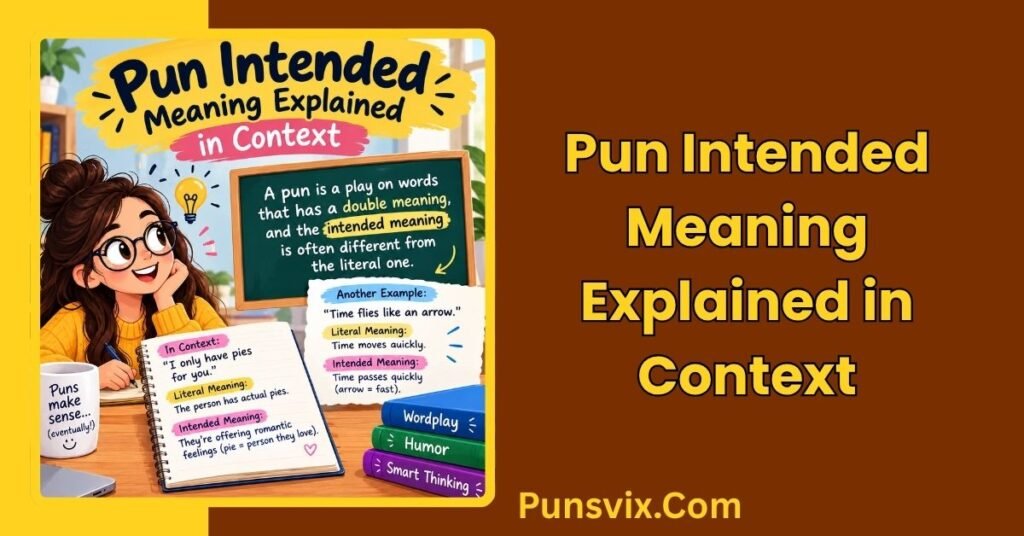
Seeing real use makes everything click. The pun intended meaning explained clearly works best with sentence examples, so this section shows how the phrase sounds in real life.
How “Pun Intended” Is Used in Sentences
Learning how to use pun intended is simple. Place it right after the joke, or set it in brackets. Here you’ll see pun intended in a sentence form.
- “The bakery’s doing well, pun intended. It’s on a roll.”
- “I’m feeling a bit light-headed, pun intended.”
- “We’re over the moon, pun intended.”
- “That’s a bright idea, pun intended.”
- “Great news, pun intended.”
- “Time to hit the books, pun intended.”
Read More About: Funny Bee Puns for Everyday Laughs: 300+ Buzz-Worthy Ideas
Pun Intended in Written English
In written English, people add the phrase to texts, blogs, and captions. It helps readers see the intentional humor when tone can’t be heard. Since the pun intended meaning explained clearly matters most in text, writers often add it to keep the mood light and the message friendly.
- Add it after a period
- Use brackets: (pun intended)
- Try it in a caption
- Use it in a group chat
- Add a smiley if you like
- Keep the pun close to the phrase
- Skip it in formal reports
Pun Intended in Spoken English
In spoken English, tone does much of the work. A pause, a grin, or a raised eyebrow often replaces the words. The pun intended meaning explained clearly aloud is all about delivery.
- Say it with a smile
- Pause before the punchline
- Keep it light
- Say it fast and playful
- Add a small laugh
- Let the joke breathe
- Match your tone to the room
- Don’t rush the ending
10 Clear Examples of Pun Intended
Ten short examples of pun intended show how the phrase works. Each one pairs a play on words with the signal that it was planned.
- “That plane joke flew over my head, pun intended.”
- “I’m on a roll, pun intended.”
- “The cheese shop is grate, pun intended.”
- “Let’s dig into this, pun intended.”
- “He’s a real gem, pun intended.”
- “Sound advice, pun intended.”
- “I’m board, pun intended.”
- “This soup is souper, pun intended.”
- “The band is rocking, pun intended.”
- “Fall in love with autumn, pun intended.”
Pun Intended vs. No Pun Intended
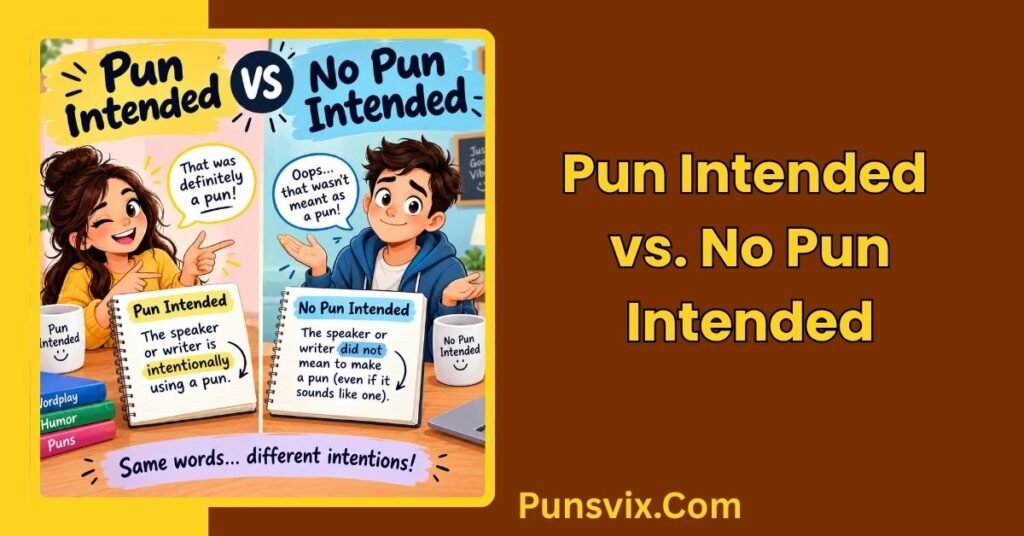
People often mix these two up. Getting the pun intended meaning explained clearly means comparing both phrases side by side. Let’s take each one in turn.
What “Pun Intended” Means
When you say it, you admit the pun was on purpose. You want the wordplay meaning to shine, and you want listeners to notice it.
- I meant it
- I chose the word
- The joke was planned
- Yes, that was a pun
- Enjoy the twist
- Cheeky on purpose
What “No Pun Intended” Means
The no pun intended meaning is a bit different. The speaker says the wordplay just happened. It’s usually a polite apology, or a playful way to pretend innocence.
- It just slipped out
- I didn’t plan that
- Oops, that was a pun
- Sorry, not on purpose
- It sounded funnier than I meant
- Pardon my wording
Key Differences Between the Two Phrases
The pun intended meaning explained clearly is easier in a table. Compare the two phrases below.
| Phrase | Meaning / Twist |
| Pun intended | The joke was planned |
| No pun intended | The joke seems accidental |
| Pun intended | Says “I’m proud of this one” |
| No pun intended | Says “oops, sorry” |
| Pun intended | Invites a laugh |
| No pun intended | Often sounds like a playful excuse |
Why Do People Say “Pun Intended”?
Learning why people say pun intended shows how the phrase connects people. Each reason below adds to the pun intended meaning explained clearly, so pick the one that fits your case.
Read More About: 300+ Fun Trivia Questions and Answers for Every Game Night
Highlighting Deliberate Wordplay
Speakers use it to point at intentional wordplay so nobody misses the joke. It’s a friendly spotlight on witty expressions.
- Look, a pun!
- Spot the twist
- Notice my word choice
- That was clever, right?
- Didn’t miss it, did you?
- Wordplay alert
Adding Humor to a Statement
A little humorous word choice can lift a plain sentence. The phrase turns a normal remark into a comic effect in one breath.
- Serious talk, silly twist
- Small joke, big grin
- Lighten the mood
- Break the ice
- Tiny giggle included
- Fun with a side of wit
Making a Clever Connection Clear
Sometimes the link between words is subtle, and a listener may need a small nudge to catch it. The phrase makes that clever use of language plain, so word association doesn’t get lost.
- Here’s the connection
- See what I did there?
- Two meanings, one word
- Now it clicks
- Follow the wordplay
- Aha, got it
Creating a Friendly Tone
Friendly banter builds warmth, and a light pun shows you’re relaxed and easy to talk to. The pun intended meaning explained clearly shows the phrase is a conversational way to share a smile, not to show off.
- Let’s laugh together
- No pressure, just fun
- Sharing a smile
- Friendly teasing
- Warm and light
- Good vibes only
Can a Pun Be Unintentional?
Yes, it can! The can a pun be unintentional question comes up a lot. Here, the pun intended meaning explained clearly helps you see the line between planned and accidental wordplay.
Intentional vs. Accidental Wordplay
An intentional pun is planned for laughs. An accidental pun simply appears while someone talks. Both count as double entendre-style humor to a listener.
- Planned pun = chosen words
- Accidental pun = lucky words
- Both can make people laugh
- Intent changes the tone
- Timing matters
- Context decides
- Listeners judge the mood
- Laughter tells the story
How to Tell When a Pun Was Unintentional
Clues help you decide. Look at tone, topic, and face, because real reactions often give the answer before any words do. The pun intended meaning explained clearly gives you a few quick checks.
- The speaker looks surprised
- The topic was serious
- They apologize right away
- Nobody smiles at first
- They say “no pun intended”
- They laugh after noticing
Is “Pun Intended” Appropriate to Use?
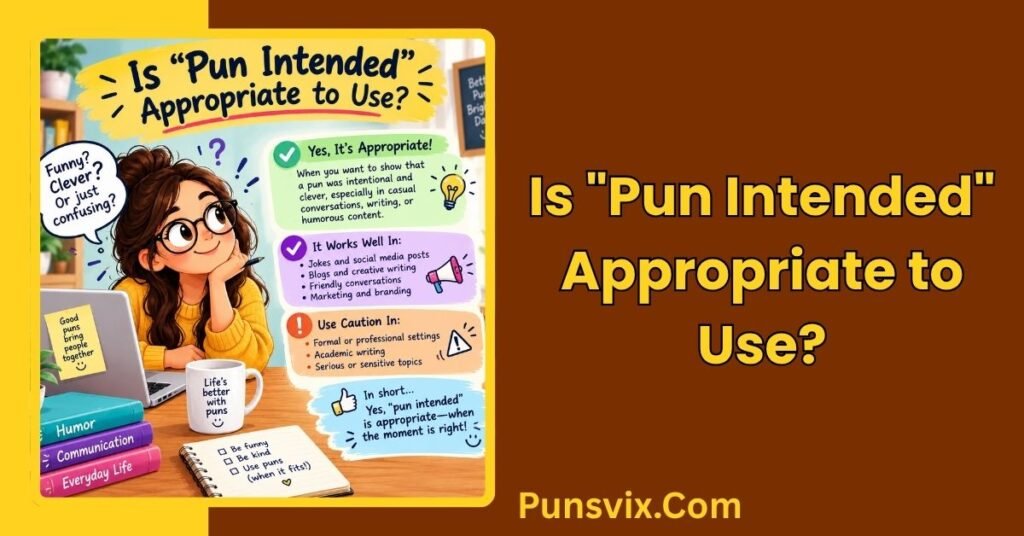
Not always! Is pun intended rude? Rarely, but tone matters. Use these practical tips, since the pun intended meaning explained clearly also covers good manners.
Casual and Social Conversations
With friends, family, and social posts, the phrase is welcome. It fits informal expressions and easy chats.
- Use it in texts
- Add it to captions
- Try it at parties
- Share it in birthday cards
- Keep it playful
- Pair it with a smile
Professional and Formal Writing
At work, choose carefully. In emails or reports, the phrase can feel too casual, so save it for friendly notes. The pun intended meaning explained clearly stays the same, but the setting changes how it lands, so think about who’s reading before you type it.
- Skip it in legal writing
- Avoid it in formal reports
- Try it in team chats
- Keep it short
- Know your reader
- Match the mood
When the Phrase May Sound Awkward
Timing can go wrong. A pun on a sad or serious topic may hurt. When in doubt, leave it out.
- Avoid it after bad news
- Don’t use it in tense meetings
- Skip it if the pun is weak
- Don’t explain the joke twice
- Read the room first
- Keep it kind and short
- Never joke at someone’s pain
Read More About: 150+ Puns About Puns: Funny, Clever & Meta Wordplay to Enjoy
Common Mistakes to Avoid
A few slips are easy to fix. The pun intended meaning explained clearly wraps up with this short checklist.
- Using it without a pun
- Adding it to every sentence
- Mixing it up with “no pun intended”
- Explaining the joke too long
- Using it in serious moments
- Forgetting your audience
Pun Intended Meaning in Other Languages
Wordplay exists everywhere. Looking at pun intended in English next to other languages makes the pun intended meaning explained clearly even richer for global readers.
Similar Expressions in Spanish
Spanish speakers call a pun “juego de palabras.” They also have polite ways to flag wordplay in speech.
- “Juego de palabras” = wordplay
- “Con perdón del juego de palabras” = pardon the pun
- “Sin querer” = not on purpose
- “Fue a propósito” = it was on purpose
- “Perdona el chiste” = pardon the joke
- “Doble sentido” = double meaning
Similar Expressions in Farsi
Farsi has its own fun ways to name wordplay. Writing them here in Latin letters keeps the meaning easy. This gives you the pun intended meaning explained clearly even if you don’t read Persian script, and it shows how playful language works everywhere.
- “Janas” (جناس) = pun or wordplay
- “Shookhi ba kalameh” = joke with words
- “Tadakhol-e ma’na” = overlapping meaning
- “Tafrih-e kalami” = word fun
- “Ma’ni-ye dou-gaaneh” = double meaning
- “Ba ghasd goftam” = I said it on purpose
FAQ,s
What does “pun intended” mean simply?
It means the joke was planned. The pun intended meaning explained clearly is that the speaker chose a word with two meanings on purpose.
Is “no pun intended” the opposite of “pun intended”?
Mostly, yes. “Pun intended” says the wordplay was planned, while “no pun intended” says it was accidental. Both share the same goal, which is to point out a pun.
Is a pun the same as a joke?
Not exactly. A pun is one type of joke that uses double meaning words. The pun intended meaning explained clearly shows puns are wordplay, not every joke.
How do you say “no pun intended”?
You can say “no pun intended,” “pardon the pun,” or “excuse the wordplay.” Each one tells listeners the pun wasn’t planned.
What is a pun-intended example?
“I’m on a roll, pun intended” is a good one, said after mentioning bread. It flags the pun on purpose.
What does “I intend” mean?
“I intend” means “I plan to.” In “pun intended,” it links back to the same idea: the pun was planned.
Conclusion
Now you’ve got the pun’s intended meaning explained clearly from start to finish. You know what a pun is, how the phrase differs from “no pun intended,” and when it fits. Use it with a smile, keep it friendly, and read the room.
ext time you hear “pun intended,” you’ll be in on the joke, and you might even land a great pun of your own.
One Comment