
Truzio Explained: Meaning, Features, Business Solutions, and Digital Transformation (2026 Guide)
Truzio Explained refers to understanding the meaning, features, and purpose of Truzio. It may relate to business solutions and digital transformation. Learning about it helps readers understand its potential uses.
Are you curious about how Truzio works? Many people explore new platforms to find smarter ways to manage tasks. Understanding Truzio can help you learn what it offers.
In this guide, we explore Truzio’s possible features and benefits. You will learn about its role in business and digital tools. We will also discuss what to know before using it
What Is Truzio Explained? Meaning, Purpose, and Overview
Let’s start with the simple answer. Truzio Technologies is most likely a company based in Hyderabad, India. It offers ERP solutions, mobile apps, IT services, and business outsourcing. Public profiles on sites like Crunchbase and LinkedIn describe it this way.
Sadly, the story gets messy after that. Several blog posts present the name as a sweeping AI, IoT, and analytics platform. We found no company documents that back those claims. So this guide treats the small ERP firm as the base case and flags everything else.
Truzio Definition and Core Purpose
The Truzio meaning and purpose come down to helping firms adopt and run ERP and related IT. Think of it as a Truzio technology company that sells both software and services. The company says it wants to align technology with business results. That’s a self-description, so it tells you what Truzio claims. It doesn’t tell you how well Truzio delivers.
| Detail | What sources say | Label |
| Company | Truzio Technologies; Indian entity is Truzio Technologies India Private Limited | Directory-reported |
| Services | ERP, mobile apps, IT services, outsourcing | Documented |
| Location | Hyderabad, Telangana | Documented |
| Founded | 2012 in one source; 2017 incorporation in another | Unconfirmed |
| Status | One tracker says inactive; another says active | Unconfirmed |
How Truzio Relates to Digital Transformation
Digital change sounds huge. In practice it means swapping scattered tools for connected systems. The company lists business transformation among its practice areas. That’s the link to Truzio digital transformation. An ERP suite is one kind of digital transformation tools set. It’s a narrower kind than many blogs suggest. A sound digital transformation strategy starts with a problem. The software comes second.
What Truzio Is and Is Not
Based on the evidence, Truzio looks like an ERP and IT services business. It’s not a documented AI, IoT, or blockchain platform. It’s not a confirmed market leader either. Note the wording here. These are gaps in evidence. They don’t prove the features are absent. If Truzio ever publishes proof of such features, the picture would change.
Why the Truzio Name Can Be Confusing Online
Three things pile up. First, lookalike names exist. Truxio sells fleet software to small trucking firms. TRUX Inc. connects truckers and contractors in North America. Second, blog posts define Truzio in clashing ways. Third, public data on the company is thin. Add the status conflict and an unclear website, and confusion is almost guaranteed.
Truzio Technologies, ERP, and Related Platforms
Picture a toolbox with one brand stamped on every tool. That’s how many people see Truzio Technologies. The firm reportedly offers an ERP product, a platform called UzzMe, and a knowledge system called KES. ERP and UzzMe show up in several places. KES appears in only one directory.
Why does this matter to you? Because a vendor with several products can be hard to judge. You need to know which product you’re really buying. The sections below break the offer into clear parts. They also show you how to verify each part.
Truzio as a Business Transformation Solution
The company positions its services as Truzio business solutions for firms that want better technology. LinkedIn lists consulting, outsourcing, and support. Those are the building blocks of business technology solutions. Still, a listing is a promise. It isn’t proof of results. Read every self-description with that in mind. Then ask for customer references before you trust the pitch.
Truzio ERP and Enterprise Resource Planning
Enterprise resource planning ties core jobs to shared records. Sales, accounts, stock, and HR all read the same data. The Truzio ERP system reportedly includes sales management, CRM, accounts, warehouse management, and HR modules. Truzio describes its ERP as open source and license-free. That makes Truzio ERP software a classic piece of business management software. Support and setup still cost money. UzzMe is separate. IndiaMART describes it as a place where customers find vendors.
Cloud-Based and On-Premise Deployment Options
Hosting comes in three flavors. A vendor can run the system for you. You can run it on your own servers. Or you can mix both. Cloud-based business systems save you from buying hardware. On-premise setups give you tighter control. Truzio’s hosting model isn’t documented. So ask where your data would live. Ask who handles backups too. Open-source ERP can run all three ways.
How to Distinguish Truzio-Related Websites and Services
Be a detective here. Check the company’s LinkedIn page first. Next, look up the registered entity on the Ministry of Corporate Affairs site. Then visit the truzio.in domain yourself. Its current content is unconfirmed. Watch out for blogs that copy each other’s wording. Those posts often share the same vague claims. A real vendor shows contact details and product pages.
How Does Truzio Work? Understanding Its Core Architecture
First, a fair warning. No one has published a design for this product. What follows is a teaching model. It shows how ERP-type tools are usually built. Use it to question any vendor. Don’t read it as Truzio’s blueprint.
The model has four layers. Data sits at the bottom. Processes run on top of it. Reports and analysis come next. Connections to other tools wrap around everything. Here’s how Truzio works looks through that lens, and why Truzio system architecture questions deserve straight answers.
| Layer | Job | Simple example |
| Data | Stores shared records | One customer file used by all teams |
| Process | Runs rules and steps | Order approval and invoicing |
| Intelligence | Reports and analyzes | Stock and sales dashboards |
| Integration | Links other systems | A payment service or web shop |
Data Layer: Building the Foundation
Every system stands on its data. The base holds master records for customers, items, and suppliers. When sales and accounts read one customer file, mismatches shrink. When they don’t, no add-on can fix the gap. The module list suggests data areas for sales, accounts, warehouse, and HR. Whether they share one database isn’t documented. That’s a key question for the vendor.
Process Layer: Automating Business Workflows
Take a basic order. Someone enters it. Stock gets reserved. An invoice is created. Payment is logged against it. Good business workflow automation moves the order along with approvals where needed. Nobody retypes it three times. That’s digital workflow management in action. Which steps Truzio business automation covers isn’t documented. Ask for a live demo of your own workflow.
Intelligence Layer: Supporting Better Decisions
Plain reports tell you what already happened. Forecasts tell you what might happen next. Those are different tools. Vendors sometimes blur the line. Data analytics appears on the company’s list of services. So it’s a service line. No forecasting or predictive business analytics is documented in the product. Treat data-driven decision-making claims with care until you see a working dashboard.
Integration Layer: Connecting Business Systems
Few firms run on one tool. An API is a set of rules that lets programs swap data. It’s how an ERP talks to a web shop or a bank feed. Truzio integration capabilities aren’t published. That makes this a first-round question. What connects out of the box? What needs custom code? Solid enterprise system integration saves you months of pain later.
Key Features and Capabilities of Truzio
Features sell software. Yet feature lists can mislead. The table below shows what sources support and what stays unknown. It gives you a fair view of Truzio software features and Truzio features and benefits without hype.
Keep the gaps in mind. Many cells say “not documented.” That’s not a flaw in this guide. It’s the state of public information. You can close those gaps by asking the company directly.
| Capability | What sources support | Not documented |
| Automation | ERP modules for sales, accounts, warehouse, HR | Which workflows run on their own |
| Analytics | Data analytics listed as a service | Product dashboards and data freshness |
| Cloud scale | Nothing specific | Hosting and capacity limits |
| Customer tools | CRM module; UzzMe platform | Personalization features |
| Integration | Nothing specific | Supported systems and API access |
Business Process Automation
Business process automation means the system does routine steps for you. It can create an invoice from an approved order. It can lower stock when goods ship. It can flag a late payment. This kind of business process optimization cuts retyping and errors. It also leaves a trail of who did what. Results depend on setup. A rushed rollout automates the wrong things.
Real-Time Business Analytics
“Real time” usually means “fresh enough to act on.” A manager sees today’s sales during the day. She doesn’t wait for a month-end report. That’s the heart of real-time data analytics. For Truzio real-time analytics, the only documented piece is the service listing. Whether the ERP ships live dashboards remains unconfirmed. Ask how often the numbers refresh.
Cloud-Based Scalability
The cloud lets you add capacity as you grow. You skip big hardware bills. In return you pay a steady fee. That trade suits fast-growing firms. It may not suit steady ones. Good scalable business infrastructure matches your workload. Nothing we found explains how the ERP scales. So Truzio cloud computing details stay an open question.
Customer Experience Optimization
Happy customers get fast, accurate answers. A CRM helps by keeping orders and history in one place. That’s the core of customer experience optimization. The CRM module and UzzMe point in this direction. No personalization or recommendation tools are documented. Treat any such claim as unverified. Clean, current records matter more than fancy features.
Enterprise System Integration
Before you buy, ask three things. Which systems connect without custom work? Does the product offer an API? How would old data move over? Strong enterprise software solutions answer these in writing. Truzio hasn’t published answers we could find. Email the company and keep the replies. Good vendors respond quickly and clearly.
Technologies Behind Truzio Digital Transformation Solutions
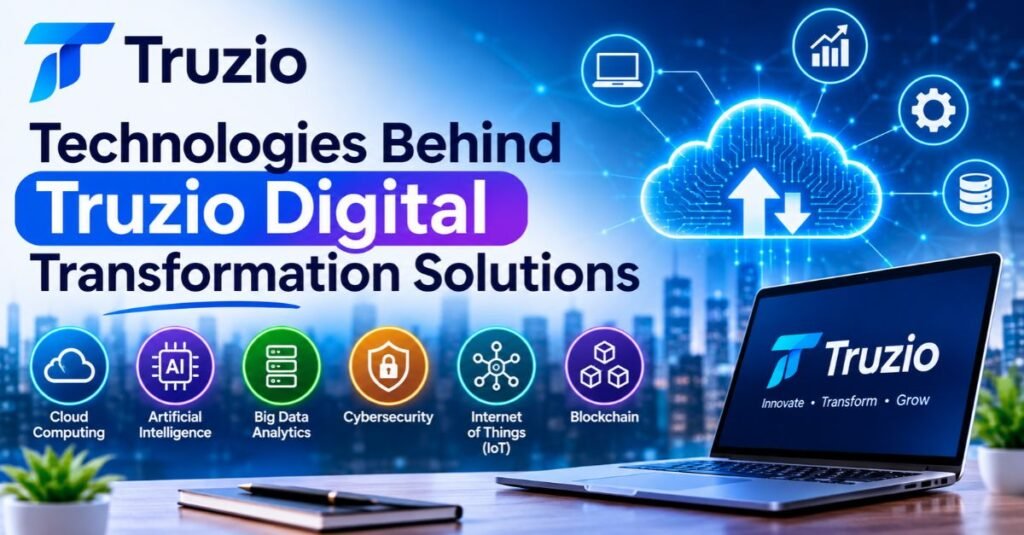
Only one technology fact is solid. The ERP rests on open-source technology. Truzio’s Facebook page and LinkedIn both say so. No source names the exact platform underneath. So treat everything else in this section as background on modern business technology.
Think of this part as a shopping guide. It shows what each technology does and what to ask about it. That helps you judge Truzio digital transformation solutions and rival products on equal terms. It also guards you against buzzwords.
Artificial Intelligence and Machine Learning
Artificial intelligence in business usually means one of three jobs. It forecasts demand. It flags odd transactions. It helps with routine tasks. Machine learning applications learn patterns from your own data. No AI or machine learning feature is documented for Truzio. So be wary of blogs that claim otherwise. Ask for a live demo before you believe any AI promise.
Cloud Computing and Infrastructure
Cloud computing infrastructure means software runs on remote servers. For ERP you can pick vendor-hosted, self-hosted, or mixed setups. Each has costs and risks. Vendor hosting is simple but ties you to one provider. Self-hosting gives control but needs skilled staff. The answer to “is it in the cloud?” needs details. Truzio’s model isn’t documented.
Internet of Things (IoT) Connectivity
The Internet of Things (IoT) links sensors and trackers to business systems. It matters most in factories and fleets. An office-based firm may never need it. No IoT feature is documented for Truzio. Some blogs claim otherwise. Those claims lack support. If IoT matters to you, ask for a working example from a real customer.
Read More : Pappedeckel: Meaning, Uses, Benefits, and Complete Guide (2026)
Cybersecurity and Data Protection
Two tools do much of the heavy lifting. Encryption scrambles data so thieves can’t read it. Access management controls who sees what. Truzio data security practices aren’t documented. We found no certificates either. Strong cybersecurity frameworks leave proof behind. Ask for it. A vendor who says “trust us” without evidence is waving a small red flag.
Mobile Technology and Remote Business Operations
Truzio lists mobile app development as a service. That fits today’s remote work habits. Many teams now approve orders from phones. Good ERP access on mobile lets managers act from anywhere. Still, no Truzio mobile ERP app is documented. Ask whether one exists. Ask about offline use too. Spotty internet is a daily fact in many regions.
Why Digital Transformation Matters in 2026
Here’s some background with no invented numbers. Digital change isn’t one purchase. It’s a string of small fixes to processes, data, and habits. Whether it matters “more” now is a judgment call. Still, pressure on firms keeps growing. That’s why Truzio in 2026 searches often come from curious buyers.
Plenty of firms start with tools and chase a problem later. That’s backward. Start with a pain point. Then pick the tool. These enterprise digital solutions only pay off when they fix something real. The next four sections cover the main pressures.
Increasing Market Competition
Small firms now compete with big ones. Big rivals often have slicker internal systems. That gap shows up in speed and accuracy. Customers notice late deliveries. Banks notice messy books. Smart business solutions can narrow the gap. They won’t close it alone. Skilled people and clear processes still do most of the work.
Growing Demand for Real-Time Decisions
Managers once waited for month-end reports. Now they want current numbers. Much of this is “near real time” and refreshes on a schedule. Do you need minute-by-minute data? Or is a daily update enough? The decision itself answers that. Buying speed you don’t need only adds cost. Match the data speed to the choice at hand.
Managing Increasing Volumes of Business Data
Data comes from shops, payments, devices, and spreadsheets. The real issue isn’t volume. It’s scatter. One customer may live in four places with four versions of the truth. Good data privacy and governance starts with one agreed source per record. Fix that first. Then fancy analytics have something solid to work on.
Why Business Automation Is Becoming Essential
Manual work slows down as orders grow. Errors creep in. Yet “essential” depends on scale. A firm with a few dozen orders a week may not need an ERP at all. A shared spreadsheet might do. The test is simple. Where do mistakes or delays hurt you today? Start there. Intelligent business automation should solve that pain.
Key Business Benefits of Truzio-Style Solutions
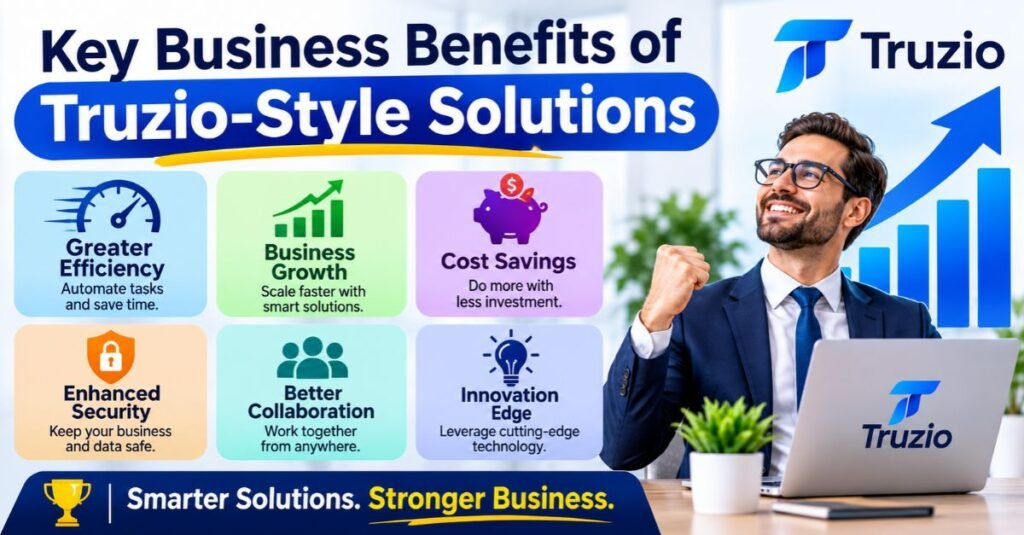
“Truzio-style” here means ERP-based platforms like the ones Truzio Technologies offers. We found no documented Truzio results. So these benefits are conditional. They describe what such systems can offer when set up well. Think of them as possibilities rather than promises.
A good result needs three things. The data must be clean. The staff must use the system. The setup must fit your process. Miss one and the benefits shrink. Keep that in mind as you read about Truzio business efficiency and its limits.
Improved Operational Efficiency
The biggest gain is less retyping. Sales stops promising stock the warehouse doesn’t have. Finance stops chasing mismatched figures. That’s real operational efficiency improvement. Teams spend less time fixing and more time doing. The gain depends on discipline. If people keep side spreadsheets, the old mess survives. Shared records only help when everyone shares them.
Faster and Smarter Decision-Making
Arguments about “whose numbers are right” waste hours. Shared records end most of them. Reports then come from one source. Answers arrive faster. This supports data-driven decision-making across the company. But speed comes from setup. It doesn’t come from the software alone. A messy install gives you fast wrong answers. Clean data comes first.
Reduced Operating Costs
Costs have many parts. You pay for licenses, setup, custom work, hosting, training, and support. Open source can cut the first one. The others stay. Total cost can end up near that of paid software. Truzio doesn’t publish pricing in anything we found. So request a full quote. Ask for a three-year cost estimate. Then compare it fairly.
Better Customer Experiences
Picture a support agent who sees a customer’s full order history at once. She answers in seconds. The customer feels heard. That’s the quiet power of shared records. It only works when the records stay current. Stale data gives confident wrong answers. So build habits around updating records. Treat that as part of the project from day one.
Greater Business Agility and Scalability
Modules let you add functions over time. You might start with sales and accounts. Later you add HR or warehouse tools. That’s flexible growth. It supports smart business operations without a full rebuild. One warning applies. Heavy customization can erode the benefit. Every custom change makes upgrades harder. Keep changes small and well documented.
Industry Applications of Truzio-Style Business Solutions
Here’s the honest picture. We found no sector-specific Truzio deployments. One tracker says the company serves several verticals. Its module list is generic. A database also names some clients. We couldn’t confirm those ties, so we don’t repeat them.
So what follows is general. It shows where ERP-type tools fit in each sector. Think of it as a map for your own research into Truzio industry applications and Truzio business applications. Always test any product against your own daily routines.
Read More : Techtrendery.com USA: Best Technology Trends, AI Tools, and Digital Guides (2026)
Healthcare and Medical Services
Hospitals and clinics use ERP for buying, supplies, finance, and staffing. Patient records usually live in specialist healthcare systems instead. Privacy rules around health data are strict. That makes security questions vital here. Ask every vendor how they protect sensitive data. Ask where the data sits. A weak answer should end the talks.
Financial Services and Banking
Banks and insurers use ERP for internal finance. That means accounting, buying, and audit trails. Core banking and claims run on separate, specialist systems. Compliance reporting often decides the purchase. Auditors want clear logs of who changed what. Check that any platform records this by default. Check data residency rules in your country too.
Retail and E-Commerce
Shops care about stock accuracy. A mismatch between online and store counts costs sales. An ERP can tie channels together. But it must connect to the channels you actually use. Ask whether it links to your web store and payment tools. Test with real orders. A demo using sample data hides many problems.
Manufacturing and Industrial Operations
Factories need production plans and bills of materials. They also need steady buying. This is where ERP depth varies most. Two products may both claim “manufacturing support.” One handles simple builds. The other handles complex ones. Ask for a demo using your own process. Don’t rely on a feature checklist alone.
Logistics and Supply Chain Management
ERPs handle warehouses and shipment records. Specialist tools often go deeper on dispatch and live tracking. Truxio’s fleet software for small carriers is one example, although it’s an unrelated company. Many firms pair an ERP with a niche tool. That combo needs good integration. Plan for it early. Late fixes cost far more.
Truzio Digital Transformation Case Study: Before and After
No verified Truzio customer case study exists that we could find. So this story is hypothetical. It shows how a business might use an ERP-type system. It isn’t a Truzio client story. It reports no real results. Consider it a thought exercise.
Our imaginary firm is a small wholesale distributor. It sells goods to local shops. Orders arrive by phone and email. The owner feels buried in paperwork. Her story follows three steps. It shows the pain, the change, and how to measure success.
Business Challenges Before Implementation
Staff copy each order into a spreadsheet. Someone else retypes it into accounting software. The warehouse works from a printed pick list. Stock counts drift from the sheet. So sales sometimes promises goods that aren’t on the shelf. Month-end means pulling figures from three places. Then the team reconciles them by hand. It takes days. Everyone dreads it.
Digital Transformation After Implementation
Now each order becomes one record at entry. Stock gets reserved automatically. The warehouse sees what sales sees. The invoice comes from the order, not from retyping. Finance and operations read the same figures. None of this happens by magic. First the firm cleans its customer and product data. Then it sets approval rules. Staff get trained. For a few weeks the old and new methods run side by side. That’s the Truzio implementation process idea in miniature.
Key Performance Indicators and Results
Because the story is hypothetical, there’s no real result to report. A real project would compare outcomes against a baseline taken before the change. Measure first. Then measure again. Here are sample measures.
| Measure | Why it matters |
| Time from order to invoice | Shows speed of the sales-to-cash flow |
| Stock count accuracy | Shows whether records match the shelf |
| Month-end close time | Shows reporting effort |
| Order fulfillment time | Shows customer-facing speed |
| Corrections after entry | Shows data quality |
A number without a baseline is just a story. Capture the “before” first.
How to Implement a Truzio-Style Digital Transformation Strategy
Truzio’s own method isn’t documented. So this is general practice. It applies to any ERP rollout. A good roadmap doesn’t need to be fancy. It needs to be clear. Five habits cover most of the value.
Treat the Truzio implementation process as a team project. It’s not an IT task alone. Business leaders must own the goals. Staff must shape the daily steps. When both sides care, adoption comes easier. When only IT cares, the system gathers dust.
Start With Clear Business Goals
Name one specific problem. Maybe stock counts keep drifting. Maybe month-end takes too long. Then decide how you’ll know it’s fixed. “Modernize operations” is too vague to steer any choice. A sharp goal helps you pick modules and set a budget. It also helps you say no to extras that don’t serve the goal.
Prioritize High-Impact Processes
Begin with one or two modules that solve the named problem. Expand later. A phased rollout limits disruption. It also gives you room to fix mistakes before the whole firm depends on the system. This is business process optimization at a human pace. Resist the urge to switch everything on at once. Big-bang launches often end badly.
Prepare and Train Employees Early
Train people by role. Use real examples from their own work. Pick a few staff as pilot users before launch. They become the go-to helpers afterward. That eases adoption more than any manual could. Start early. Rushed training breeds workarounds. Workarounds breed bad data. So give people time to practice before go-live day.
Integrate Existing Systems Carefully
Plan data moves with care. List every old tool and file that holds key records. Decide what to move, what to link, and what to retire. This is legacy system modernization in real life. Test migrations on small batches first. Keep backups. Running old and new systems side by side costs extra effort. It also cuts risk sharply.
Read More : FRABOC Explained: Ultimate Guide to Meaning, History, Risk Categories & iPrevent Alternatives (2026)
Monitor Results and Optimize Continuously
Pick a small set of measures. Review them monthly at least. The sample list from the case study works well. Add the share of transactions actually entered in the system. Also track support requests. If numbers stall, find out why. Often the cause is training or process, not software. Adjust and measure again.
Common Challenges of Digital Transformation
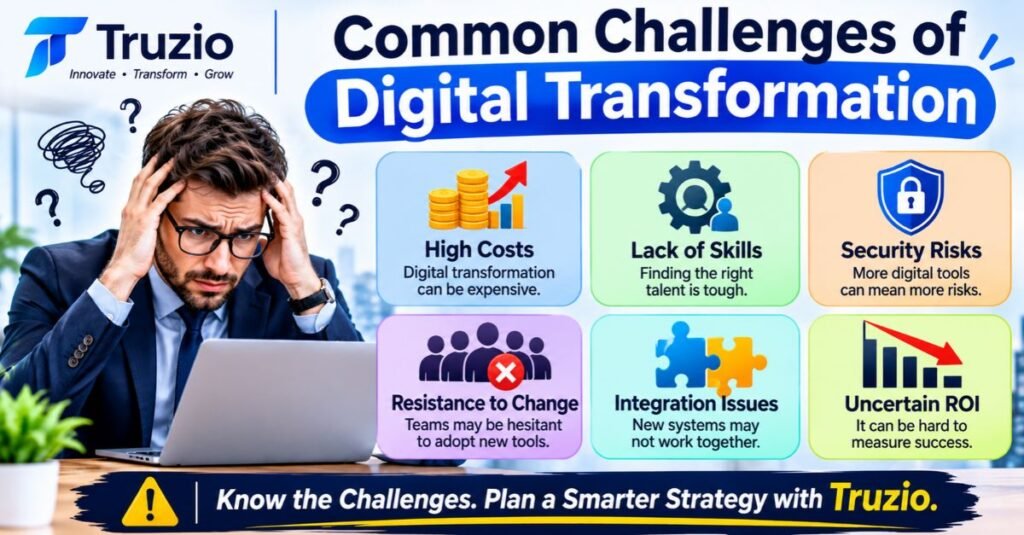
Most digital transformation challenges come from people and data. Software is rarely the culprit. No reliable failure-rate statistic is cited here. We haven’t verified a trustworthy source. Still, the same problems appear in project after project.
Knowing them early helps. You can budget for them and plan around them. Think of this section as a weather forecast for your project. You can’t stop the rain. You can pack an umbrella.
Legacy System Integration
Old systems bring odd data formats and duplicate records. Some carry custom tweaks nobody wrote down. You can replace them, connect them, or retire them in phases. The right choice depends on how vital the old tool is. It also depends on who still understands it. Running both for a while lowers risk. It also adds workload for your team.
Employee Resistance to Change
Resistance rarely looks like open refusal. It looks like shadow spreadsheets and late data entry. People worry about extra work or job changes. Some just don’t see the benefit. Talk to them early. Explain what changes and what doesn’t. Ignoring these worries hurts data quality later. Quiet resistance can sink a project as surely as a loud protest.
Data Privacy and Security Risks
Migration creates risks that daily work doesn’t. Temporary data copies pile up. Wide access gets granted to speed things along. Settings get misconfigured. Plan for these. Limit who can export data. Delete temporary files promptly. Review access after launch. A short, careful checklist beats a long cleanup after a leak.
Implementation Costs and Technical Complexity
Budgets often forget the extras. Training, setup, custom work, and hosting add up fast. Complexity grows with every module and link. Ask for a written scope. Add a buffer for surprises. A cheap license with a huge setup bill isn’t cheap. Compare total cost over three years. That view keeps you honest.
Security and Governance in Digital Business Platforms
No Truzio security practices are documented. So this section covers what to look for in any platform. Treat it as a buyer’s checklist in prose form. Security isn’t a feature you add at the end. It’s a habit that runs through the whole project.
Good governance means clear rules and clear owners. Tools alone don’t protect you. People must decide who gets access and who checks the logs. Strong Truzio data security claims should come with proof. The four areas below show what that proof looks like.
Data Security and Access Controls
Start with role-based permissions. Each person should see only what their job needs. Next, demand audit logs. They record who did what and when. Finally, check backups. How often do they run? How fast can you restore? These three basics block many common problems. Test them during the trial, not after you sign.
Privacy and Regulatory Compliance
Privacy laws vary by region. The GDPR covers Europe. India has its own data-protection law. Your customers’ locations may trigger rules too. Check current requirements with a qualified adviser. Laws change. Ask the vendor where your data sits and how they handle breach notices. Get the answers in writing. Strong data privacy and governance protects you and your customers.
Read More : 67+GrammarVista.com USA: Features, Grammar Tools, Benefits & Complete Guide
Cybersecurity Risk Management
Open-source software still needs security patches. Someone must apply them. Is it the vendor or you? Settle that before launch. Also plan for attacks. Ask how the vendor responds to a breach. Ask how fast. Mature cybersecurity frameworks include a tested response plan. A plan nobody has practiced is just a document.
Governance, Monitoring, and Accountability
Governance answers simple questions. Who approves new access? Who reviews logs each month? Who signs off on changes? Ask for independent proof of good habits. An ISO/IEC 27001 certificate is one example. A SOC 2 report is another. Neither is documented for Truzio. Written backup and breach terms matter too. Assurances alone aren’t enough.
Is Truzio Right for Your Organization?
Begin with one step. Confirm the company is operating and reachable. Sources conflict on its status. The website’s current state is unconfirmed. So check before you evaluate anything else. This guide doesn’t call Truzio good or bad. The public evidence doesn’t support either verdict. That’s the point of Truzio legitimacy checks.
If the company is active, fit comes next. It depends on your size, needs, and skills. The tables and questions below help you decide. Use them with any vendor, not just this one. A good process protects you from shiny pitches.
When Truzio-Style Solutions Make Sense
An ERP fits when manual work causes real errors. Maybe you juggle many orders or several warehouses. Maybe teams argue over whose numbers are right. You also need sales, CRM, accounts, warehouse, or HR modules. And you should feel fine with open-source tools. If none of that applies, simpler tools may serve you better. Don’t buy a bus when you need a bicycle.
Small Businesses vs. Large Enterprises
Small firms need low cost and fast setup. They often lack in-house IT. So vendor support matters a lot. Large firms need depth, control, and strict security. They usually have IT teams and long approval chains. A small vendor may stretch thin on a big job. Match the vendor’s size to yours. Ask about similar customers.
Factors to Evaluate Before Choosing a Platform
Ask the company these questions in writing. Then compare answers with rival vendors.
| Question | Why it matters |
| Are you taking new customers today? | Confirms the company is active |
| Which ERP platform and version is it built on? | Shows what you’re really buying |
| Where and how is it hosted? | Affects cost, speed, and data rules |
| What is the full pricing, including support? | Reveals true cost |
| What are your support terms and response times? | Sets expectations |
| Can I speak with current customers? | Tests real-world results |
| What security practices and certificates do you hold? | Checks protection |
| How do I export my data if I leave? | Avoids lock-in |
Compare categories too, not just names.
| Option | Typically suits | Watch out for |
| Packaged commercial ERP | Firms wanting vendor-backed features | Higher license costs, less flexibility |
| Open-source ERP with a partner | Firms wanting flexibility and lower license fees | Partner dependence, update duties |
| Custom-built system | Unusual processes | High cost, long upkeep |
Limitations and Considerations of Truzio-Style Platforms
Every tool has limits. Two kinds apply here. The first kind hits any ERP-based platform. The second is about how little we can verify on Truzio. Both matter. Together they shape the Truzio platform limitations you should weigh.
On the Truzio side, public documentation is thin. Details come from directories and profiles. A tracker listed about 25 employees as of July 2024. That suggests a small team, though we couldn’t verify it. We also found no independent user reviews. So this guide can’t speak to customer satisfaction either way.
Integration and Compatibility Limitations
Linking an ERP to older tools can be hard. File formats clash. APIs may be missing. Custom connectors cost time and money. Truzio’s integration options aren’t documented. So treat compatibility as unproven. Ask for a list of tools it already connects to. Request a small pilot link before you commit to the full project.
Cost and Resource Requirements
Open source lowers license fees. It doesn’t lower the need for skilled people. Someone must install, tune, and update the system. Training takes hours from busy staff. Hosting has a monthly bill. Add them up before you decide. Many projects look cheap on paper and costly in real life. A frank budget talk early saves pain later.
Data Quality and Reliability Challenges
Bad data in means bad reports out. It’s that simple. Duplicate customers and wrong item codes poison every dashboard. Clean your data before migration. Then set rules to keep it clean. Assign owners for key records. Reliable output needs steady care. No ERP can fix careless entry.
Dependence on Digital Infrastructure
An ERP needs power, internet, and working devices. Outages stop work. Poor connections slow it down. Relying on one vendor adds another risk. What if the company closes or stops support? That question is fair for any vendor and sharper for one with unclear status. Plan backups and an exit route. Keep your data exportable at all times.
Digital Transformation Trends Shaping Business in 2026
These are general terms that come up often in software talks. We describe them. We don’t measure how many firms use them. No 2026 adoption statistics appear here. Treat this as a trend glossary for business technology trends in 2026.
Don’t chase every trend. Trends fade. Problems stay. Pick a trend only when it fixes a real pain in your firm. These ideas also show up in Truzio digital transformation solutions pitches and blog posts. Knowing them helps you spot hype.
AI-Driven Business Operations
AI now appears in business software as helpers. They draft text, flag odd transactions, and forecast demand. Their value depends on data quality. Their output still needs human checks. That’s especially true where money or compliance is involved. Ask any vendor how its AI was tested. Ask what happens when it’s wrong.
Hyperautomation and Intelligent Workflows
Hyperautomation technology combines several tools. Robotic process automation mimics clicks and keystrokes. AI adds judgment. Workflow engines tie it together. The goal is end-to-end automation. Here’s the catch. Automating a broken process just makes it fail faster. Fix the process first. Then automate. Intelligent workflows reward patience.
Low-Code and No-Code Development
Low-code development platforms let people build apps with visual tools. Little programming is needed. For ERP users, that can speed up custom screens and reports. The trade-off is control. Apps built outside IT’s view can skip security checks. Set simple rules. Who may build? Who reviews? Where does the data go? Freedom needs guardrails.
Real-Time Data and Predictive Analytics
Real-time systems process data as events happen. Predictive tools look ahead and estimate what comes next. Both add cost and complexity. They’re worth it only when a decision truly needs them. A shop that restocks weekly doesn’t need second-by-second data. Match the tool to the decision. Otherwise you pay for speed you never use.
The Future of Smart Business Platforms Beyond 2026
This section is an informed outlook, not fact. Business software seems likely to add more built-in AI. It may become more modular, too. Firms could then swap parts instead of replacing everything. Rules on data use may tighten as AI spreads. How fast any of this happens is uncertain.
For Truzio itself, we can’t say. Three things would clear the fog. The company needs a confirmed operating status. It needs a working website. And it needs current product documents. Until then, any forecast about the Truzio platform is guesswork.
More Intelligent Automation
Automation may shift from fixed rules to flexible helpers. Systems could suggest next steps instead of waiting for clicks. That frees people for harder work. Yet trust must be earned. Humans should still approve high-stakes steps. Expect smarter workflows. Also expect more questions about who is responsible when an automated choice goes wrong.
Connected and Data-Driven Operations
Devices, apps, and ERPs may link more tightly. A shelf sensor could trigger a reorder. A delivery update could adjust a promise date. This is the promise of connected, smart business operations. The catch is plumbing. Links break. Data clashes. Firms with clean records will gain most. Those with messy data will just move the mess faster.
AI-Powered Decision Support
Dashboards may soon explain themselves in plain language. They might point out odd trends and suggest actions. That could help small teams punch above their weight. Still, a suggestion isn’t a decision. Leaders must understand the “why” behind it. Ask vendors how their tools show their reasoning. A black box is a poor advisor.
Greater Focus on Security and Governance
As systems connect more, risks grow. Regulators are paying closer attention to data use. Buyers will likely demand more proof from vendors. Certificates, audits, and clear policies will matter more. Firms that build good habits now will adapt more easily. Security won’t be a bonus feature. It will be table stakes.
FAQ’s
People ask the same questions again and again. The answers below keep to the evidence. Where facts are missing, we say so. Use them as a quick reference before you dig deeper.
Each answer is short on purpose. For more detail, see the matching section above. And always verify key facts yourself. Company details can change fast.
What Is Truzio?
What is Truzio? Most likely it’s Truzio Technologies, a Hyderabad-based ERP and IT services company. It appears to offer ERP software, mobile apps, outsourcing, and IT support. Some blogs describe a broader AI platform. We found no documents that support that. Confirm any detail with the company before you rely on it.
What Does Truzio Do for Businesses?
Based on public profiles, it supplies ERP modules and IT services. Those cover sales, CRM, accounts, warehouse, and HR. It also lists mobile apps and outsourcing. Its UzzMe platform helps customers find vendors. How well these work in daily use isn’t documented. Ask for references and a live demo.
Is Truzio a Software Platform or a Technology Company?
It looks like both. It’s a services business that also sells an ERP product. That mix is common among small IT firms. The label matters less than the support you get. Ask who builds, hosts, and fixes the product. Clear answers show a mature vendor.
What Is Truzio ERP?
The Truzio ERP system is described as a license-free, open-source-based product. Reported modules include sales management, CRM, accounts, warehouse management, and HR. The exact underlying platform isn’t named in the sources. Ask which platform and version it uses. That tells you about updates, support, and community help.
Does Truzio Support Cloud-Based Operations?
That isn’t documented. Nothing we found explains hosting or capacity. Open-source ERP can run in the cloud, on your servers, or both. So the real answer depends on the deal you strike. Ask where your data would live. Ask who handles backups and updates.
Is Truzio Suitable for Small Businesses?
Possibly. It could fit a small firm that needs core ERP functions and accepts open-source tools. Check the company’s current status first. Confirm support terms in writing. If you only handle a few dozen orders a week, simpler tools may work better. Don’t buy more system than you need.
How Can Businesses Evaluate Truzio’s Legitimacy?
Check the registry record on the MCA website. Review the company’s LinkedIn page. Visit the website and test the contact details. Ask for customer references. Request support and data-export terms in writing. Public evidence doesn’t give a verdict, so these steps let you reach your own.
What Should Businesses Consider Before Adopting Truzio?
Confirm the company is active. Ask about hosting, pricing, security, and support. Check how you’d export your data. Test the system with your own workflow. Compare it with at least two rivals. Take your time. A careful choice now saves months of regret.
conclusion
Here’s the short version. Truzio most likely means Truzio Technologies, a Hyderabad-based ERP and IT services firm. Its status is disputed. Its product details are thin. The bigger claims in many blogs lack support. That’s why we used three labels: documented, directory-reported, and unconfirmed.
So what now? Verify the company first. Then ask the eight vendor questions from earlier. Run a small pilot with your own data. The general advice here on ERP, rollout, and security applies to any platform. Use it well. Whether Truzio fits you or not, you’ll choose with open eyes.