Crackstube Explained (2026): Meaning, Website Features, Safety, and Legitimacy
What is Crackstube? The name confuses many people. It sounds like a place for free software or free videos. The real CracksTube.com looks very different. It works like an online publishing website with articles and paid guest posts. This guide covers the Crackstube meaning, the Crackstube platform, and the Crackstube safety questions that matter most.
Here’s the honest picture. The pages checked in late September 2026 showed written content. They didn’t show a video player or a software catalog. That isn’t a security clearance though. Other sites with similar names may carry cracked software risks and unsafe downloads. You’ll learn how to tell them apart and how to stay safe. Think of it as a CracksTube.com review 2026 and a Crackstube website review in one place.
What Is Crackstube?
Crackstube is a name. It isn’t one proven brand with a known owner. The clearest match is CracksTube.com. That site presents itself as a digital publishing platform for articles and guest posts. Its pages look like a blog with many topics.
The name also hints at other things. Some readers expect free tools or free movies. Others think of pirated files. The next sections sort fact from guesswork. You’ll see what the Crackstube website shows and what stays unknown.
What Does the Name Crackstube Mean?
The Crackstube meaning comes from two common words. A “crack” is slang for software that’s been altered to skip licensing checks. “Tube” became a popular ending for video sites after YouTube grew famous. Put together, the name suggests free software or free video. That’s only an interpretation of the words. A name can’t tell you what a site really does. Only the pages themselves can do that. Look at what a site actually shows before you decide anything.
Why Crackstube Has Different Meanings Online
Several things blur the picture. Anyone can register a similar domain. Many ranking pages repeat the same claims with promotional wording. Readers also land on sites from ads, pop-ups, or shared links with no context. Spelling changes and endings like .net or .org add more confusion. Search engines try to understand meaning. A shared name still produces mixed results. That confusion says more about the name than about you.
Is Crackstube a Publishing Platform or a Software Website?
The pages checked point to a Crackstube publishing platform for written articles. The homepage listed posts. It showed no video player and no software downloads. The site also calls itself official. That’s self-description. It isn’t independent proof. No owner is named on the pages reviewed. So the safest description is simple. CracksTube.com looks like a small site for online article publishing that sells guest posts.
What Does CracksTube.com Offer?
CracksTube.com offers articles on many topics. Posts sit in categories like Technology and Finance. Outside writers can also pitch paid guest posts. That makes it a mix of blog and advertising space. The Crackstube features stay basic and familiar.
Some details are confirmed and others aren’t. The site lists policy pages and a contact email. It doesn’t name the company owner. Its archive claims posts back to late 2019. Archives can be backfilled though. Treat that date as the site’s own claim.
Main Content Categories and Topics
The Crackstube content categories include Technology, Finance, Business, Education, Health, Lifestyle, Travel, Home Improvement, Law, and Real Estate. That’s a wide range for one small site. The homepage also mixed in posts about travel, gaming, online casinos, branding, and local businesses. Posts like these often appear in paid placements. The listing showed no sponsored labels. So you can’t tell which posts are paid. Always check the date before you rely on any article, because freshness differs from one category to the next.
Website Features and Reading Experience
The Crackstube website features look like those of a standard blog. You’ll see top navigation by category, a search box, a recent posts list, and a monthly archive. Pop-ups, ads, and redirects can vary by device and location. They couldn’t be judged from the pages reviewed. So watch for them yourself. A page that forces a download, asks for notification permission right away, or sends you elsewhere is a reason to leave. Close it and move on.
How Articles Are Organized and Published
Posts are filed by category and listed by date. A monthly archive helps you browse older pieces. Most recent posts credit one author name with an occasional different one. A byline alone doesn’t show who wrote a piece. The guest-post rules describe a review step before publication. Edits or revision requests may follow. That’s the site’s own description. Nothing reviewed confirms how strictly it’s applied. Strong content authenticity depends on named authors and clear sources.
Who Can Benefit From CracksTube.com?
Casual readers can enjoy free articles with no login or paywall. Writers and marketers might see a place to publish. The catch is that placements are paid. That makes the site work more like advertising than an open contributor platform. Business owners can use it for brand mentions. Still, the value depends on the site’s reputation. Read recent posts first. Then decide if the quality matches your goals. Good digital content discovery starts with that kind of judgment.
How Does CracksTube.com Work?
The site works like a conventional article website. Readers browse by topic. Writers submit pieces for review. Everything about internal steps comes from the site’s own statements.
You can’t verify those steps from outside. So read them as claims. Compare them with what you can see on the live pages. That habit supports a sound website credibility assessment.
How Readers Find and Explore Articles
Readers start from the homepage or a category menu. The search box helps you find a topic fast. The archive lets you move month by month. Freshness varies by category. Check each article’s date. For Finance, Health, and Law topics, look for named sources and an identifiable author. Treat what you read as general information. It isn’t professional advice. Free access never makes an article reliable on its own.
How Writers and Contributors Can Submit Content
The Crackstube article submission process is paid. First, read the guest-post rules on the site. Second, ask about pricing before you write anything. The site says costs and turnaround come after you submit. Third, prepare an original article of at least 500 words. The guidelines suggest 1,000 to 1,500 words and reject spun or purely promotional content. Fourth, assemble the title, category, and any target links. Fifth, send everything through the contact or guest-post page. Expect a review. Publication isn’t guaranteed. These content contribution guidelines stood as described in late September 2026. Recheck them before you act.
SEO Exposure and Online Visibility for Contributors
Links sit at the center of this deal. The guidelines ask for a target URL and anchor text. Google’s spam policies treat paid links meant to boost rankings as a violation unless they’re marked properly. A sponsored or nofollow tag is the usual fix. Ask how links are marked before you pay. Authority scores from SEO tools are only estimates. No single guest post guarantees visibility or better rankings. Get the labeling terms in writing.
Is Crackstube Safe and Legitimate?
Is Crackstube safe? The answer depends on which site you mean. For CracksTube.com, no obvious problem showed up in the pages reviewed. That’s not the same as proof of safety.
Is Crackstube legitimate? Ownership isn’t established and no independent scan results were included. So Crackstube’s legitimacy stays an open question. Run your own checks. The sections below show how.
Is CracksTube.com Safe to Visit?
The homepage loaded over HTTPS. Privacy, Terms, DMCA, and editorial pages were linked. No downloads or software listings appeared. Still, no antivirus or Safe Browsing scan results were included. Ad and redirect behavior on your device is also unknown. A sensible plan is simple. Read articles if you like. Type the exact address yourself. Skip downloads. Don’t enter personal or payment details. Good safe browsing tips start with those habits.
How to Verify a Website’s Identity and Ownership
Website ownership verification starts with the full address. Check the spelling and the ending after the dot. Then run a WHOIS or RDAP search on the ICANN lookup tool to see the registration date. A young domain deserves extra caution. An old one isn’t automatically safe because expired domains get bought and reused. Private registration is common and isn’t a warning sign alone. Add domain verification by searching the domain name with words like “reports”. Read results carefully. Review pages can be written for SEO too.
What to Check in the About, Contact, and Privacy Pages
Privacy policy checks matter. Look for a named company or person, a working contact method, and policies that fit the site. These signals are easy to fake. So look for consistency. Does the named company exist? Do the address and email match? Does the privacy policy describe the data the site really collects? Good website transparency shows up as clear answers to these questions. Thin or copied pages should raise your guard.
Does HTTPS Mean a Website Is Completely Safe?
No. HTTPS website security only means the connection is encrypted. Phishing and malicious sites use HTTPS too. Treat the padlock as a baseline. A full-page warning from your browser is a strong signal. Those browser security warnings deserve respect. Don’t click through just to reach the content. Go back instead and pick a source you can verify.
Read More About: 34+Results SFFareBoxing SportsFanFare: Complete Guide to Boxing Results, Scores, and Fighter Records
Are Crackstube.com and CrackstubeUS.com Connected?
People often ask about CrackstubeUS.com. No confirmed link between it and CracksTube.com appears in the public pages reviewed. Similar names alone neither prove nor rule out a connection. Treat each domain as separate. Check each one’s ownership, policies, and content on its own. Don’t assume that trust in one carries over to the other. Run the same website trust checks on both.
Crackstube Security Risks You Should Know
These Crackstube security risks apply mainly to the crack and free-stream category. They aren’t a confirmed finding about CracksTube.com. Still, you may meet them if a search sends you elsewhere. Knowing them builds real cybersecurity awareness.
The table below sums up the most common threats. Each one tries to get you to run something you wouldn’t run otherwise. Read it before you click anything unfamiliar.
| Risk | How it happens | What it can cost you |
| Bundled malware | Malware hides in the installer, keygen, or patch | Stolen passwords, files, or banking details |
| Disabled protection | The page tells you to turn off antivirus | Your device is open to other threats |
| Fake download buttons | Ads styled like the real link | Unwanted software or scams |
| Network spread | An infected device reaches others at home | Other devices and accounts exposed |
| No recourse | Operators are usually anonymous | Nobody to contact when things go wrong |
Rule of thumb: If a download page tells you to turn off your antivirus, close the tab.
Fake Download Buttons and Suspicious Redirects
Fake download buttons are ads dressed as the real link. You click one. Then you land on a scam or start an unwanted install. Suspicious website redirects work the same way. They send you to pages you never chose. Fake “player update” or “codec” prompts are common too. A site that needs an install just to read or watch is a problem. These are classic phishing and malicious redirects. Close the tab right away.
Malware Risks From Unverified Software Downloads
Malware from software downloads often hides inside cracked installers. The FTC warns that pirated streaming apps and add-ons often bring malware. That malware can try to reach other devices on the same network. An older Microsoft-commissioned study in Asia Pacific found that about a third of pirated software came bundled with malware. The numbers are dated and regional. The pattern still holds. Strong malware prevention methods begin with avoiding such files.
Privacy Risks and Personal Information Exposure
Unsafe sites can quietly collect data. Fake forms ask for emails, passwords, or card numbers. Notification prompts can flood your device with ads later. Malware can steal saved logins from your browser. Weak online privacy protection makes all of this easier. Strong personal data protection means sharing less. Use unique passwords and two-factor authentication. Use a virtual card for unfamiliar shops. Keep payment details off sites you can’t vouch for.
Warning Signs of Unsafe Streaming and Crack Websites
Some signs show up again and again on free streaming websites and software download websites that cut corners. A page tells you to disable antivirus or add exclusions. An archive comes with its password printed on the page. An installer suddenly wants administrator rights. A forced download manager appears. Domains and mirrors keep changing. Layers of pop-ups all look like the download link. Comment sections show identical praise. Each sign exists to make you run something risky. Treat them as strong suspicious file detection cues.
Official CracksTube.com vs. Unofficial Crackstube Websites
Here, official Crackstube website only means the site at the CracksTube.com domain. It isn’t an endorsement. The label comes from the site’s own claim.
Unofficial Crackstube domains may exist. No specific example could be confirmed. So the table compares the confirmed domain with the typical pattern of the crack and free-stream category. No named site is linked.
| Factor | CracksTube.com (late Sept 2026) | Typical crack or free-stream site |
| What you receive | Written articles | Downloads, keys, or streams |
| Policy pages | Privacy, Terms, DMCA, and editorial policy linked | Often missing or copied |
| Ownership | No named operator on pages reviewed | Frequently anonymous |
| Business model | Ads and paid guest posts, per the site | Ads, bundled software, or scams |
| Independent scan results | Not included here | Often flagged by security tools |
| Downloads on page | None seen | Central to the site |
Differences in Website Purpose and Content
The purpose gap is big. CracksTube.com presents itself as an article publication that sells guest posts. Crack and free-stream sites exist to hand out software or video. They usually act without the rights holder’s permission. That raises copyright infringement risks for you. Those sites rarely offer quality control or support. A publisher at least gives you readable pages and policy links to question.
How to Evaluate Software and Streaming Claims
Look for evidence instead of repeated claims. Many pages say a site is legitimate. Most just repeat each other. Check who published the page and why. Ask whether the claim names real proof such as a scan result or a company record. Good website reputation analysis compares several independent sources. For software, trust only legitimate software sources like the developer’s own page. For video, prefer trusted entertainment services with clear licensing.
Read More About: TheJavaSea.me Leaks AIO-TLP371: Facts, Risks, and Safety Guide (2026)
How to Identify Suspicious Domains and Fake Websites
Start with the address bar. Odd endings like .net or .org can signal a lookalike. Extra words or swapped letters are red flags. Be wary of links from ads, pop-ups, and messages. Compare the address with links from official social accounts. Look at the registration date too. Finally, search the exact domain name for reports. A short online safety checklist like this stops many fake sites. Remember that professional design proves little.
What Should You Do If You Visit or Download Something From a Suspicious Site?
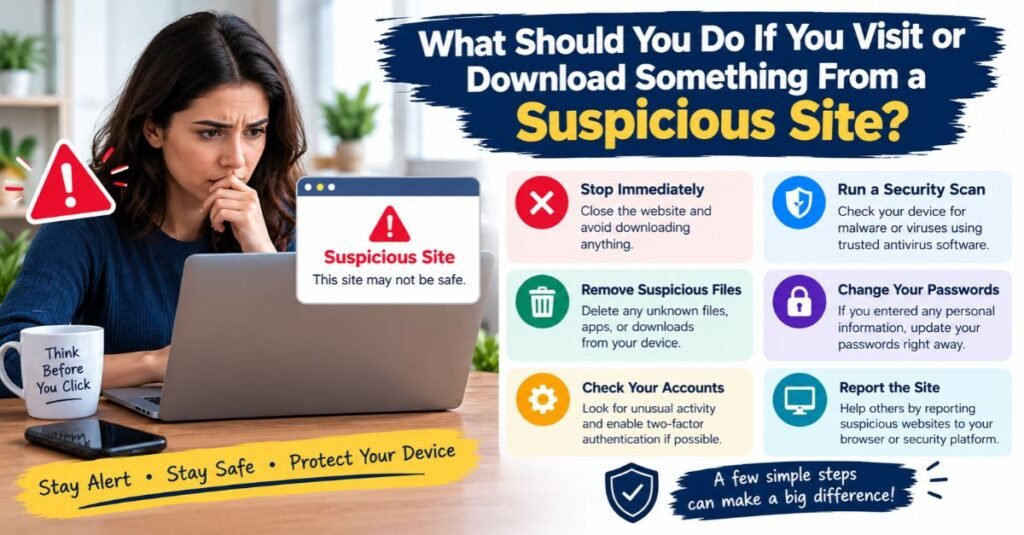
Stay calm. Most visits cause no harm. Downloads and shared passwords are the real concern. Quick action limits the damage.
Take a short illustrative case. Maya searches for a free photo editor and lands on an unknown site. She downloads an installer and sees her antivirus warning. She stops. She deletes the file and runs a full scan. She then changes her email password. Nothing was stolen. Her fast steps made the difference.
What to Do After Visiting a Website
Close the tab first. Don’t allow notifications if a prompt appeared. Open your browser settings and review notification permissions and extensions. Remove anything you don’t recognize. Clear cookies for that site if you wish. Then keep browsing normally. If a page tried to install something, treat it as a download. Move to the next steps. Quick checks like these support safe internet browsing.
Steps to Take After Downloading or Opening a Suspicious File
Don’t open the file. If you already did, disconnect from the internet for a moment. Delete the download and empty the trash. Update your security software. Then run a full scan. The FTC advises this order when malware lands on a computer. Check extensions and startup items afterward. Good software download safety includes these habits. Strong suspicious file detection also comes from letting your scanner check every new file before you run it.
What to Do If You Shared Passwords or Payment Details
Act fast. Change the affected passwords from a clean device. Turn on two-factor authentication where possible. Call your bank or card issuer and ask about blocking or replacing the card. Watch your accounts for unfamiliar activity. Report scams or malware sites at ReportFraud.ftc.gov if you’re in the US. Other countries have similar agencies. Use them. Good cybersecurity threat prevention continues after the incident. Change any reused passwords too.
Can Antivirus Software Protect You From Every Threat?
No tool catches everything. Antivirus protection blocks many known threats. It can miss brand-new ones. It can’t help if you turn it off or add exclusions for a crack. It also can’t stop you from typing a password into a fake page. Think of it as one layer. Pair it with updates, careful clicking, and secure software downloads from official pages. Layers work better than any single shield.
Do Ad Blockers Make Unfamiliar Websites Safer?
They help a little. Ad blocker security features can hide many pop-ups and malicious ads. That cuts one common path for fake download buttons. Still, an ad blocker doesn’t verify a site. It doesn’t stop a download you choose to run. Some scams sit inside the page itself. Use a trusted blocker from an official store. Keep your other website security best practices in place.
Safer Alternatives to Unverified Crackstube Websites
Wanting free access is understandable. Subscriptions add up fast. The trade isn’t worth the risk though. Legal routes cover more ground than most people expect.
Availability varies by country. Check that any service is legitimate in your region. The sections below name well-known options. These legal streaming alternatives and tools protect your devices and your wallet.
Trusted Sources for Software and Digital Tools
Start with free tiers and trials of the paid tools you want. Open-source programs fill many gaps. LibreOffice handles office work. GIMP edits images. Blender covers 3D. Students and nonprofits often get special pricing. Always download from the developer’s own site. These are the legitimate software sources that keep your system clean and your online privacy protection intact.
Legal Video Streaming and Entertainment Platforms
Ad-supported services give free legal viewing in some regions. Tubi and Pluto TV are two examples. Public libraries also lend movies and shows digitally in many places. Check regional availability first. These services avoid the risks of unauthorized streaming platforms. They also keep creators paid. Pick trusted entertainment services with clear terms, real contact details, and proper licensing.
Reliable Websites for Technology Guides and Reviews
Good guides show named authors, dates, cited sources, and clear editorial policies. They label sponsored posts. They correct mistakes in public. Established tech outlets and official documentation fit this pattern. Use them as reliable technology resources. Compare at least two sources before you trust a verdict. Be cautious with pages that only praise a product. A trustworthy review also lists drawbacks.
Read More About: 76+Afextop com Review: What It Is, What It Offers, and Is It Safe to Use?
Best Practices for Checking an Unfamiliar Website
No single check proves a site is honest. Layer several checks instead. Each one catches a different problem. Together they give a clearer picture.
The table below turns the sections above into a quick routine. Use it whenever a new address appears in an ad or message. Doing so builds lasting website trust checks habits.
| Check | What to look for | Why it matters |
| Domain | Exact spelling and registration date | Spots lookalikes and recycled domains |
| Reputation | Independent reports and reviews | Shows past problems |
| Contact and policies | Named owner, working email, matching policies | Shows transparency |
| Downloads and prompts | Unrequested files, notification requests | Signals malware or ad abuse |
| Browser and security tools | Updated browser, active scanner | Blocks known threats |
Verify the Domain and Website Reputation
Read the address in full. Run a registration lookup. Search the domain with words like “scam” or “reports”. Then weigh what you find. Treat review pages carefully because many are written to rank. Look for repeated details from independent sources. Use Google’s Safe Browsing site status as one more data point. It isn’t a guarantee. This blend of domain verification and website reputation analysis builds a fuller picture.
Review Contact Details and Website Policies
Open the About, Contact, Privacy, and Terms pages. Check that names, addresses, and emails agree. Look for plain language about data collection. Missing or copied pages deserve doubt. Send a short test email if you’re about to pay. A real operator usually replies. Slow or missing answers tell you something too. Keep notes of what you find before you spend money.
Avoid Unexpected Downloads and Permission Requests
Say no to anything you didn’t ask for. That includes downloads, extensions, and notification prompts. Don’t install a “codec” or “player update” from a pop-up. Stop if a site asks for administrator rights. Leave if it demands you disable security software. A legitimate article site never needs any of that. Closing the tab costs you nothing.
Read More About: How to Fix xud3.g5-fo9z Python: Easy & Safe Solutions
Use Updated Browsers and Security Software
Updates close known holes. Turn on automatic updates for your browser and operating system. Keep your scanner active and current. Use a password manager so no password repeats. Add two-factor authentication on important accounts. Try a virtual or single-purpose card for shops you can’t vouch for. Together these steps make most attacks harder. They also support lasting cybersecurity awareness.
Common Misconceptions About Crackstube
Ambiguous names invite myths. A few of them keep repeating across the web. Sorting them out saves you time and worry.
Evidence beats repetition. Look for proof you can check yourself. The three myths below come up most often.
Does the Name Crackstube Prove It Offers Cracked Software?
No. A name is a guess about content. It isn’t proof. The pages checked for CracksTube.com showed articles and no software catalog. Still, that doesn’t clear every site with the name. Judge each address by what it actually shows. Look for downloads, keys, and install prompts. Those details matter far more than the word in the domain.
Are All Websites Using the Crackstube Name Related?
Don’t assume either way. Similar names don’t prove one owner. They don’t prove separate owners either. No connection between CracksTube.com and any crack or streaming site has been confirmed. That isn’t proof that none exists. Check each domain on its own. Use ownership data, policy pages, and content as your guide.
Does a Professional Website Design Guarantee Trustworthiness?
No. Templates are cheap. AI graphics are easy to make. A polished look proves very little. Scam sites often copy trusted layouts. Real trust comes from clear ownership, honest policies, and consistent behavior over time. Look past the design. Ask who runs the site and how you’d reach them. That mindset also protects you from fake pages.
FAQ,s
These quick answers sum up the guide. Each one points back to a fuller section above. Use them for a fast refresher.
If you’re short on time, read the first and last answers. They cover the core idea and the best next step.
What Is Crackstube in Simple Terms?
What is Crackstube in simple words? It’s an unclear name. It most clearly points to CracksTube.com, an article site that sells guest posts. It also reminds people of cracked software and free streams. Always check the exact domain.
Is Crackstube a Video Streaming Website?
The pages reviewed showed written articles. They had no video player and no download catalog. Only the homepage and guest-post rules were checked. Some third-party pages describe it differently. Look at the site yourself before drawing a conclusion.
Is CracksTube.com a Verified Publishing Platform?
No standard verification badge exists for a site like this. The site calls itself official and posts a notice saying so. That’s self-description. Ownership hasn’t been independently established. Treat it as a small Crackstube publishing platform with open questions.
Is the Content on CracksTube.com Free to Read?
The pages reviewed had no paywall or login. You can read articles freely. The site earns money from what it calls paid guest posts and likely from ads. Free access doesn’t make an article accurate. Always check dates and sources.
Can Outside Writers Submit Articles to CracksTube.com?
Yes. The site describes a paid guest-post process. Ask about pricing and link labeling before you pay. Prepare an original article that follows the posted rules. Expect a review. Publication isn’t guaranteed.
Is It Illegal to Visit a Website Offering Cracked Software?
Visiting a site is generally treated differently from downloading or streaming infringing material. Laws differ by country. Using or sharing cracked software and pirated streams infringes copyright in most places. Security risks exist either way. This isn’t legal advice.
What Should I Do If I Downloaded a Suspicious File?
Don’t open it. Delete it and update your security software. Run a full scan. Check extensions and permissions. Change passwords from a clean device if you shared any details. Report scams at your national agency. Watch your accounts for odd activity.
How Can I Find Reliable Information About Crackstube?
Use primary sources first. Check the site’s own pages. Then look at independent security tools and registration records. Compare several unrelated sources. Be cautious with pages that repeat the same promotional claims. Use an online safety checklist before trusting any verdict.
conclusion
Crackstube points mainly to one confirmed article site and loosely to a risky category. CracksTube.com looks like an ad-supported site with paid guest posts. Its ownership, history, and security record aren’t established. Reading its articles seems low-risk when you take basic care. It isn’t a proven safe choice.
Before you download anything, share details, or pay to publish, check the exact domain yourself. Choose licensed or open-source options for software and streaming. Follow solid safe browsing tips every time. That habit protects you far beyond this one name.