

94+Dreamwithjeff.com Review: Features, Benefits, and Practical Personal Growth Strategies
You start a new routine on Monday. You feel unstoppable. By Thursday, real life walks in and your plan falls apart. Sound familiar? Most people know this cycle well. The problem is rarely a lack of effort. The problem is advice that ignores how busy, tired humans actually live.
This Dreamwithjeff.com review looks at a platform that takes a calmer path. Dreamwithjeff.com focuses on personal growth, habit formation, and sustainable productivity instead of hype. You will learn what it covers, who it suits, and where its limits sit. You will also pick up practical self-improvement tips you can use today.
What Is Dreamwithjeff.com?
Ever saved a pile of motivational videos and changed nothing? Many of us have. Dreamwithjeff.com is a personal growth platform built to break that pattern. It shares ideas on habit-building strategies, mindfulness practices, and focus improvement. The tone stays grounded. You won’t find shouting or fake overnight miracles.
This Dreamwithjeff.com review is based on the platform’s published content and stated approach. The big theme is simple. Small, steady actions beat dramatic bursts. Below, you’ll see the purpose, the main topics, and the audience. Think of this section as a quick map before the deeper trip.
The Purpose and Core Focus of Dreamwithjeff.com
The core purpose of Dreamwithjeff.com is practical self-improvement. It aims to help you build routines that fit real life. Instead of pushing perfection, it supports consistent improvement. That focus on action over inspiration is what sets it apart from many personal development sites, which often sell excitement but skip the follow-through.
Key Topics Covered on the Platform
The platform covers a wide but connected set of themes. Here is a quick summary of the main ones and why each matters.
| Topic | Why It Matters |
| Habit formation | Builds routines that last |
| Productivity improvement | Gets more done with less stress |
| Self-awareness | Helps you choose better actions |
| Goal achievement | Turns wishes into plans |
| Mental clarity | Reduces mental noise |
| Burnout prevention | Protects your energy |
| Attention management | Keeps you focused |
| Sustainable routines | Keeps progress alive over time |
Who Is Dreamwithjeff.com Designed For?
The platform speaks to ordinary people who feel stretched thin. Students, workers, creators, and beginners all fit. If hustle culture leaves you tired, the calm style may feel like a relief. If you want a strict course with live coaching, you may need more. You’ll find the full audience breakdown later in this guide.
Why Personal Growth Platforms Are Becoming More Popular
Modern life is loud. Apps ping. Emails pile up. Videos autoplay. By noon, many people feel mentally drained. That constant switching drains mental clarity and makes stress management harder. So people look for calmer, clearer guidance. This is one big reason a personal growth platform like Dreamwithjeff.com gets attention.
Traditional advice often adds pressure on top of the chaos. It tells you to wake earlier, grind harder, and never rest. However, those tips often backfire. The table below shows how common advice can lead to the opposite of what you want.
| Traditional Advice | Real-Life Result |
| Wake up earlier | Sleep loss |
| Hustle constantly | Burnout |
| Optimize every minute | Anxiety |
| Never stop grinding | Emotional exhaustion |
| Stay motivated daily | Guilt when motivation fades |
Why People Struggle to Achieve Personal Goals
Most people don’t fail because they’re lazy. They fail because the plan doesn’t match their life. A schedule built for a perfect week breaks during a messy one. Without self-awareness, you copy someone else’s routine and wonder why it won’t stick. Real goal achievement starts with a plan that bends. That’s the heart of how to achieve personal growth without burning out along the way.
The Problem With Relying on Motivation Alone
Motivation acts like the weather. It’s sunny on Monday and stormy on Wednesday. If your plan needs good weather, it will fail often. Compare two promises. “I’ll work out two hours every day” sounds bold. “I’ll walk fifteen minutes after dinner” sounds small. Yet the small plan wins. Among the best motivation techniques is needing less of it. Learning how to stay motivated consistently really means building habits that run without a pep talk.
How Information Overload and Perfectionism Slow Progress
Learning feels like progress. It isn’t always. Podcasts, books, and courses can create an illusion of movement while your behavior stays the same. Experts sometimes call this productive procrastination. Perfectionism makes it worse. Thoughts like “I missed a day so I failed” turn small slips into quitting. Overcoming perfectionism in personal growth means accepting messy days. It also helps with how to overcome procrastination, since waiting for the perfect moment is just delay in disguise.
The Core Principles Behind Dreamwithjeff.com
Three ideas sit at the center of the platform. First, progress beats perfection. Second, systems beat motivation. Third, self-awareness leads to better choices. Each one is simple. Together they form a practical base for personal development strategies that survive real life.
These ideas work as a team. Awareness shows you what fits. Systems make the right action easy. Small progress keeps you going when results are slow. Remove one and the others wobble. Keep all three and you get sustainable success rather than short bursts of effort.
Progress Over Perfection
Small actions look weak until you add them up. Consider reading ten pages a day. In a year that’s about 3,650 pages, or roughly a dozen books. Now picture waiting months for the perfect mood to read. You’d finish nothing. This is the logic behind small steps toward self-improvement. Consistent improvement may feel boring. Still, it quietly reshapes who you are.
Building Systems Instead of Depending on Motivation
Motivation starts action. Systems keep it going. A system can be as simple as laying out workout clothes the night before. It might be a fixed work block, a clean desk, or a habit stacked onto coffee. These tools cut decision fatigue and support daily routine optimization. People follow the easiest path. Smart systems use that fact instead of fighting it, which is the secret behind building a consistent daily routine.
How Self-Awareness Supports Better Decisions
You can’t fix what you don’t understand. A night owl forcing a 5 AM routine will struggle. An introvert forcing a packed social plan will drain fast. Self-awareness shows your energy patterns, triggers, and limits. These self-discovery methods help you design a plan that fits. Better awareness leads to better choices. Better choices lead to less friction and more mental clarity each day.
How to Set and Achieve Goals More Effectively
Goals feel exciting. They give direction. However, a goal alone rarely changes anything. Two people can want the same result. The one with a repeatable routine usually wins. Strong goal-setting techniques pair a clear target with a simple plan. That mix is the basis of strategies for achieving long-term goals.
Vague goals produce vague results. Clear goals give your brain a job to do. The table below shows how a small change in wording makes a big difference. Use it as a quick rewrite guide for your own long-term goals.
| Weak Goal | Better Goal |
| Save money | Save $200 (or €200 or £200) each month |
| Get healthier | Walk 30 minutes daily |
| Read more | Read 15 pages nightly |
| Be productive | Finish priority tasks before noon |
Why Goals Need Practical Systems
A goal answers “what do I want?” A system answers “how will I move toward it?” The second question matters more. Goals are exciting on day one. Systems carry you through day forty. Good effective goal-setting methods always include the daily routine behind the dream. Without it, even a great goal turns into a wish that fades with your mood.
Breaking Big Goals Into Manageable Steps
Big goals can freeze you. “Write a book” or “get financially stable” feels enormous. The brain reacts to overwhelm by putting things off. So shrink the goal into daily actions, weekly milestones, and measurable behaviors. Instead of “become healthier,” try drinking more water, walking daily, and sleeping on a steady schedule. This productivity improvement trick makes the first step feel light.
Tracking Progress to Maintain Momentum
People love seeing proof. That’s why habit trackers, fitness apps, and savings charts work so well. Strong progress tracking turns invisible effort into visible wins. Learning how to track personal progress can be easy. A paper calendar with checkmarks is enough. Even simple streaks build personal accountability, because most of us hate breaking a chain once it starts.
Process Goals vs. Outcome Goals
An outcome goal names the result. A process goal names the action. For example, “lose 20 pounds (about 9 kg)” is an outcome. “Exercise four times a week” is a process. You control the process every day. You only influence the outcome. Focus on the actions and results often follow. This shift is a core part of goal achievement that lasts.
Habit Building Strategies for Long-Term Success
Habits run your day more than choices do. Research from University College London found that forming a new habit took 66 days on average, with a range from 18 to 254 days. You can read the details in the original habit formation study. The lesson is clear. Be patient and keep going.
Repetition beats intensity. A fifteen-minute daily habit usually outperforms a three-hour weekend sprint. These habit-building strategies work because they cut the effort needed to start. Below, you’ll see how habits shape identity and how the four stages of habit formation work in real life.
How Habits Shape Identity and Daily Behavior
Every repeated action sends a message to your brain. It says, “This is who I am.” Readers become people who read. Runners become people who move. Writers become people who write. This is the psychology of lasting behavior change. Your daily habits slowly shape your self-image. Over time, positive habits feel less like effort and more like identity, which is how to build better daily habits really works.
The Four Stages of Habit Formation
Think of habits as a loop with four steps. First, spot the cue. Second, make the action simple. Third, repeat it. Fourth, track it. The flow looks like this: Cue → Simplify → Repeat → Track. Each stage supports the next. Skip one and the loop weakens. Master all four and you gain real habit formation power.
Recognizing Cues and Triggers
Every habit starts with a trigger. Boredom often leads to phone scrolling. Stress may lead to snacking. Anxiety can lead to procrastination. Notice your triggers and you gain control over the response.
Making Actions Simple and Achievable
Make the good habit easy. Put a book by your bed. Keep fruit on the counter. Lay out gym clothes early. Less friction means more action.
Building Consistency Through Repetition
Repeat the action often rather than hard. Fifteen minutes a day beats three hours once a week. Repetition makes the behavior feel automatic over time.
Tracking Habits and Celebrating Progress
Track your wins with a journal, an app, or a weekly review. Then celebrate them. A small reward makes your brain want to return tomorrow.
Mindfulness and Self-Discovery for Personal Growth
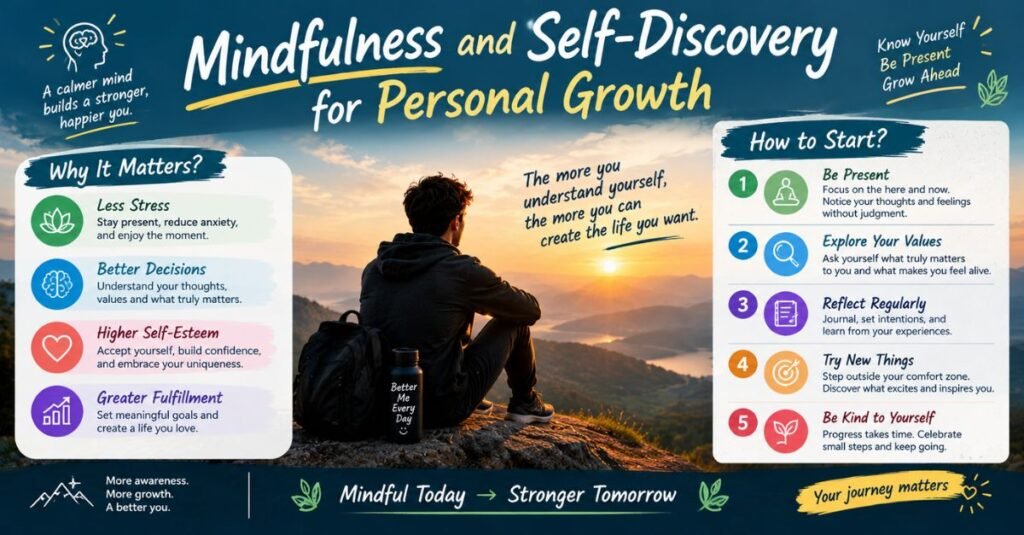
Many people live on autopilot. Notifications, news, and deadlines pull attention in every direction. That reactive state blurs mental clarity. Mindfulness practices break the cycle. They help you pause, notice, and choose. This pause is where real emotional well-being begins, and it supports the benefits of mindfulness for personal development.
Self-discovery goes hand in hand with mindfulness. When you notice your patterns, you can change them. Doomscrolling, avoidance, and harsh self-talk often run in the background. Self-reflection brings them into the light. From there, improving emotional awareness through self-reflection becomes a practical daily skill.
How Mindfulness Improves Focus and Emotional Awareness
Mindfulness is more than meditation. It includes awareness, presence, and intentional attention. According to the National Center for Complementary and Integrative Health, mindfulness practices may help with stress, anxiety, and mood. In daily life, that means a better pause before you react. Stronger attention management and calmer stress management often follow.
Simple Mindfulness Practices for Everyday Life
You don’t need a mountain retreat. Tiny resets work well. The table below lists easy practices and what each one offers.
| Mindfulness Practice | Benefit |
| Deep breathing for 2 minutes | Calms the stress response |
| Morning reflection | Builds clarity for the day |
| Phone-free walk | Increases presence |
| Journaling emotions | Builds awareness |
| Silent breaks between tasks | Resets mental energy |
How Self-Reflection Helps Identify Limiting Patterns
Many habits run without permission. Emotional eating, avoidance, and negative self-talk are common examples. Without self-awareness, they repeat forever. Self-reflection works like a flashlight in a dark room. It shows what’s already there. Once you see a pattern, you can plan a better response. This is one of the most useful self-discovery methods for lasting behavior change.
Questions to Ask for Better Self-Understanding
Good questions open doors. Ask yourself a few honest ones each week. What drains my energy fastest? When do I put things off most? Which places help me focus? What do I do when stressed? Which habits give me momentum? Write short answers. Over a month, you’ll spot patterns that guide smarter personal development strategies.
Improving Focus and Managing Digital Distractions
Attention is now a rare skill. Phones buzz all day. Tabs multiply. Deep thinking gets interrupted before it starts. Yet deep focus drives better work, better ideas, and better relationships. Strong focus improvement is quickly becoming a real advantage, and it supports ways to improve focus and concentration in any job.
The good news is that focus is trainable. You don’t need superhuman willpower. You need a smarter setup. Small changes to your space, your schedule, and your phone can make a big difference. This is the heart of managing distractions in the digital age and strong time management skills.
Read More About: What Is Young18gye? Meaning, Online Context, Safety, and Everything You Should Know
Why Multitasking Can Reduce Productivity
Multitasking feels efficient. It usually isn’t. The brain doesn’t truly do two hard things at once. It switches back and forth. According to the American Psychological Association, those switches can cost time and raise mistakes. Result: more fatigue, slower thinking, and weaker memory. Single-tasking is a simple fix that boosts productivity right away.
Practical Strategies to Improve Concentration
Three changes help most. First, shape your space. Second, plan your time. Third, set limits on your devices. Together they form a simple toolkit for sustainable productivity strategies. Try one at a time. Pick the one that feels easiest and build from there.
Creating a Distraction-Free Environment
Clear your desk and close extra tabs. Silence notifications. Use a dedicated workspace if you can. Your environment shapes your focus more than willpower does.
Using Time Blocking to Structure Your Day
Time blocking gives your attention a plan. You assign tasks to set slots. Here’s a simple example.
| Time | Activity |
| 8:00 – 9:00 AM | Deep work |
| 9:00 – 9:15 AM | Break |
| 9:15 – 10:00 AM | Emails |
| 10:00 – 11:30 AM | Project work |
Setting Healthy Digital Boundaries
Set app limits and phone-free hours. Keep your phone out of the bedroom. Cut back on short videos, which train your brain to crave constant novelty.
Preventing Burnout While Pursuing Personal Goals
Ambition is great. Ambition without rest is risky. Many driven people ignore early warning signs. Then energy crashes, joy fades, and work suffers. Real burnout prevention means treating rest as part of the plan. It also supports how to prevent burnout and a healthier work-life balance.
The better path is steady effort with planned recovery. Athletes train this way. They push, then rest. Your mind needs the same rhythm. This approach protects emotional well-being and keeps long-term progress alive. It’s the essence of balancing ambition and personal well-being.
Recognizing the Signs of Burnout
Burnout is more than tiredness. The World Health Organization describes it as an occupational phenomenon linked to chronic workplace stress. Common signs include exhaustion, mental distance or cynicism, and lower performance. You may also notice brain fog and irritability. If these sound familiar, start burnout recovery early and consider talking with a health professional.
Why Sustainable Progress Is Better Than Hustle Culture
Hustle culture says “sleep less and grind more.” It sounds bold. However, it often ends in crashed energy and poor decisions. Sustainable progress is quieter. It values sleep, breaks, and realistic goals. Over months, the steady person usually outruns the sprinter who quits. That’s why sustainable success beats a short burst of heroic effort every time.
Energy Management vs. Time Management
Time is fixed. Energy isn’t. Two focused hours can beat eight foggy ones. So smart time management skills include protecting your best energy for your hardest work. Guard sleep, food, movement, and calm. Plan demanding tasks for your peak hours. Save easy tasks for low-energy moments. This is a practical form of sustainable productivity.
Building Rest and Recovery Into Your Routine
Rest isn’t laziness. It’s maintenance. Add short breaks between tasks and a steady bedtime. Take a full day off each week when you can. Plan lighter periods after heavy ones. These habits support burnout recovery and keep your mind sharp. They also make daily routine optimization far more realistic.
Financial Goal Planning and Personal Development
Money and mood are closely linked. Worry about bills can follow you into every part of the day. That is why financial planning belongs in any serious personal growth plan. Clear money habits lower stress and free mental space for other goals.
The same rules apply here as everywhere else. Clear targets beat vague wishes. Small, repeatable actions beat rare big efforts. Whether you earn in dollars, euros, pounds, or rupees, the method holds. This section covers creating realistic financial goals you can actually keep.
How Financial Stress Can Affect Well-Being
Money stress spreads. It can hurt sleep, focus, and relationships. It can make long-term thinking harder. When your mind is busy with worry, little energy remains for growth. Good stress management therefore includes money habits. A simple plan can bring calm. Even a small emergency fund can make your emotional well-being feel steadier.
Setting Clear and Realistic Financial Goals
A good money goal is specific and sized to your life. “Save more” is vague. “Save 10 percent of each paycheck” is clear. Pick a number you can keep during a tough month. This is a core part of financial goal planning. You can raise the amount later. Starting small helps you avoid giving up.
Read More About: Connectivity HSSGamepad: 10 Proven Fixes for Frustrating Connection Issues and Input Lag
Creating Consistent Habits for Financial Progress
Automate where possible. Set up an automatic transfer to savings on payday. Do a quick weekly money check-in. Track your savings with a simple chart. These daily habits make financial planning feel routine rather than scary. Over time, small deposits grow into real security and real peace of mind.
Dreamwithjeff.com vs. Traditional Productivity Platforms

Many productivity systems chase intensity. They push strict schedules, constant optimization, and extreme routines. This can work for a short time. However, many people eventually burn out. Dreamwithjeff.com leans toward a gentler style built on sustainable productivity and steady habits.
A fair Dreamwithjeff.com review should stay honest. A content platform can inspire and teach. It can’t replace one-to-one coaching or medical help. The comparison below uses the platform’s stated approach. Check the site yourself for current features, access, and any costs before you decide.
Key Differences in Goal Setting and Habit Tracking
Traditional tools often push big targets and tight tracking. They reward streaks and speed. Dreamwithjeff.com stresses small actions and flexible plans. It treats missed days as normal. For many readers, this kinder view of goal-setting techniques and progress tracking makes it easier to continue after a slip.
Motivation-Focused Methods vs. Sustainable Growth
Motivation-first programs rely on excitement. Excitement fades. Sustainable growth relies on systems, rest, and awareness. The message shifts from “push harder” to “build smarter.” That small change matters. It supports how to stay motivated consistently by needing less raw motivation. It also supports practical strategies for a balanced life.
Comparing Features, Benefits, and Limitations
Here is a side-by-side view based on the platform’s stated approach. This table covers Dreamwithjeff.com benefits and limitations at a glance.
| Area | Dreamwithjeff.com | Traditional Platforms |
| Productivity style | Sustainable and gradual | Often aggressive |
| Mental wellness | Strong focus | Often overlooked |
| Habit building | Small steps | Often intense |
| Burnout prevention | Prioritized | Rarely discussed |
| Simplicity | Encouraged | Sometimes complex |
| Possible limitations | Content-based, so no personal coaching is implied | May offer apps, coaches, or structured courses |
How to Use Dreamwithjeff.com Effectively
The best way to start is small. Most people begin too big. They try to fix sleep, diet, work, and money all at once. Then they quit. A calmer plan wins. Use the platform’s ideas one step at a time and let results build slowly.
Four steps keep things simple. Pick one goal. Choose tiny actions. Track and review. Then adjust to real life. The table below gives a quick view. Following it will make these personal growth tools work for you instead of against you.
| Step | What to Do |
| 1 | Choose one clear goal |
| 2 | Pick small repeatable actions |
| 3 | Track and review weekly |
| 4 | Adapt to your daily routine |
Start With One Clear Personal Goal
Choose one area. It could be sleep, focus, fitness, or money. Trying to change everything at once overloads your brain. Stabilize one habit before adding another. This is one of the best personal development resources for beginners. One win builds confidence, and confidence feeds the next step.
Choose Small Actions You Can Repeat
Make the action almost too easy. Read one page. Walk five minutes. Write one paragraph. Small actions are easy to repeat on bad days. They also build positive habits without drama. When the habit feels natural, raise the bar a little. This slow climb is how how to build better daily habits actually works.
Read More About: 88+Is BrumeBlog.com Safe and Legit? An Honest Review and Security Guide
Track Your Progress and Review Results
Use a journal, a calendar, or an app. Mark each win. Once a week, review what worked and what didn’t. Ask what to keep, change, or drop. This small review loop sharpens self-awareness and strengthens personal accountability. It also shows how to track personal progress without extra stress.
Adapt Your Plan to Your Daily Routine
Perfect plans crack under pressure. Flexible plans survive. Adjust for busy weeks, stressful periods, travel, and low-energy days. Move your habit time if needed. Shrink the task when life gets heavy. Smart daily routine optimization bends without breaking, and that keeps your consistent improvement alive.
The Psychology Behind Lasting Personal Change
Change often feels slow at first. That’s normal. Early effort can look invisible. Many people quit right before results appear. Understanding the psychology of lasting behavior change helps you stay patient during that quiet stretch.
Think about heating water. At 30°F (about -1°C) nothing seems to happen. At 50°F (10°C) still nothing. At 90°F (32°C) the water is still liquid. Then at 212°F (100°C) it boils. Effort builds below the surface until a threshold is crossed. Personal change often works the same way.
Why People Often Quit Before Seeing Results
We expect fast rewards. Real progress hides for weeks. When nothing seems to change, doubt grows. People then switch plans or give up. Long-term goals need patience and proof. That’s why progress tracking matters. It shows small gains that your eyes might miss. Those gains remind you that the effort is working.
How Small Wins Build Confidence and Momentum
Tiny victories matter. Finishing a small task builds confidence. It also gives a little reward feeling that nudges you to continue. Over time, wins stack up and reshape how you see yourself. This is why small steps toward self-improvement are so powerful. Momentum starts small and then grows on its own.
How Your Environment Influences Behavior
Willpower is limited. Environment is steady. Junk food on the counter invites snacking. A phone by the bed invites late scrolling. A messy desk invites distraction. Flip these cues. Put fruit in sight. Charge your phone in another room. Clear your desk. Smart spaces support developing healthy lifestyle habits with less struggle.
Common Personal Growth Mistakes to Avoid
Most stalled progress follows a few repeated patterns. People learn without acting. They lean on motivation. They skip rest. They expect too much too soon. Spotting these traps early saves months of frustration and supports steady personal development.
Here’s a quick self-check. Do you read more than you practice? Do you wait to feel ready? Do you rarely rest? Do you expect fast results? If you said yes to any, you’re in good company. Each mistake has a simple fix, covered below.
Consuming Advice Without Taking Action
Reading twenty books without acting changes little. Applying one idea daily changes a lot. Pick a single tip from this article and test it for two weeks. Then review. This habit shifts you from watching to doing, and that shift is the core of practical self-improvement techniques.
Depending Entirely on Motivation
Motivation moves up and down. Systems stay steady. Build routines that work even on flat days. Use cues, prepared spaces, and tiny actions. When your plan doesn’t need a mood, it keeps running. That’s the real answer to how to stay motivated consistently.
Ignoring Rest and Recovery
Rest feeds creativity, memory, and emotional balance. Without it, decisions get worse and stress climbs. Treat sleep and breaks as part of your plan. They aren’t rewards for finishing. Strong burnout prevention begins with this mindset, and it protects your work-life balance for the long haul.
Setting Unrealistic Expectations
Big promises feel good for a day. Then reality arrives. Set goals you can meet even in a bad week. Expect slow, bumpy progress. Done consistently beats perfect occasionally. This approach to overcoming perfectionism in personal growth keeps you in the game long enough to win.
Practical Personal Growth Lessons You Can Apply Today
Ideas only help when you use them. So let’s turn this guide into action. The four lessons below take minutes to start. None need special tools or big budgets. They are simple life improvement strategies that fit almost any schedule.
Pick just one lesson today. Don’t try all four. Use it for a week and notice the change. Then add another. This slow build is the best way to grow, and it reflects the heart of practical strategies for a balanced life.
Reduce Friction Around Important Tasks
Make good actions easy to start. Put a water bottle on your desk. Prep meals ahead. Delete apps that steal your time. Keep your workspace clean. Every bit of friction you remove raises the odds you’ll act. Less resistance means more consistent improvement with far less effort.
Make Daily Progress Easy to Measure
Track what matters. Habits, work sessions, savings, reading, and exercise all count. Use a simple checkmark if you like. Visible progress boosts consistency and trust in yourself. This is a plain but powerful form of progress tracking that supports goal achievement all year.
Create Backup Routines for Low-Energy Days
Hard days will come. Plan for them. Build a “minimum viable habit” for each routine. Read one page. Walk five minutes. Write one paragraph. These tiny actions protect your streak and your identity. They keep daily habits alive when energy dips, which is key to sustainable success.
Protect Your Time and Attention
Attention drives results. Limit extra notifications. Reduce endless scrolling. Avoid constant task switching. Block time for deep work and guard it. Strong attention management improves every area of life. It also boosts productivity and leaves more room for the things you truly value.
Who Can Benefit Most From Dreamwithjeff.com?
The platform suits people who want realistic, steady improvement. It’s built for readers tired of hype and pressure. If you value calm, clear guidance, you’ll likely feel at home. The gentle tone also helps people who feel intimidated by loud self-help culture.
Still, no single resource fits everyone. If you want live coaching, graded courses, or clinical support, you may need extra help. Use Dreamwithjeff.com as a practical starting point and a steady source of self-improvement tips. Add other support when your situation calls for it.
Students Who Want to Improve Study Habits
Students face constant distractions and tight deadlines. Small study blocks, phone-free sessions, and weekly reviews can help a lot. The focus on time blocking and focus improvement fits student life well. Simple routines also reduce exam stress and help you build time management skills early.
Professionals Managing Stress and Burnout
Many workers feel drained by nonstop pressure. Balanced systems can restore energy and clarity. The platform’s stress on rest, energy, and realistic goals fits this group. It supports burnout recovery, healthier boundaries, and better work-life balance. Remember that serious burnout may also need professional support.
Entrepreneurs and Creative Professionals
Creative work needs clear thinking, deep focus, and steady moods. Burnout quickly kills ideas. Flexible routines work better than rigid ones for most creators. The platform’s ideas on attention management and sustainable productivity can help founders and artists protect their best hours without losing their spark.
Beginners Exploring Personal Development
Some self-help spaces feel loud and confusing. A practical tone feels friendlier. Beginners can start with one habit and one small goal. This makes Dreamwithjeff.com a gentle entry among personal development resources for beginners. You can learn at your own pace and grow your skills step by step.
FAQ,s
What Is Dreamwithjeff.com Mainly About?
Dreamwithjeff.com is about practical personal growth. It covers habits, productivity, mindfulness, focus, and sustainable routines. The goal is steady change that fits real life. It avoids hype and promotes small, repeatable actions that build lasting results over time.
Is Dreamwithjeff.com Suitable for Beginners?
Yes, it looks beginner-friendly. The platform favors simple systems over complicated methods. You can start with one small habit and build from there. That gentle pace helps new readers avoid overwhelm and enjoy steady wins without needing prior knowledge of self-help.
Does Dreamwithjeff.com Focus Only on Motivation?
No. The platform stresses systems, routines, and behavior science more than short bursts of motivation. Motivation is treated as unreliable. So the advice centers on making good actions easy. This approach helps you keep going when your mood dips or your schedule gets busy.
Can Dreamwithjeff.com Help Improve Focus and Productivity?
It can offer useful ideas. Topics like time blocking, fewer distractions, and single-tasking support better focus. These are well-known methods that many people find helpful. Results depend on how consistently you apply them, so start small and test what suits your work style.
Does Dreamwithjeff.com Cover Habit Building and Goal Setting?
Yes. Habit formation and goal setting are central themes. The platform explains cues, small actions, repetition, and tracking. It also favors process goals and clear targets. Together these ideas give readers a practical path from vague wishes to repeatable daily actions.
Does Dreamwithjeff.com Include Mindfulness Advice?
Yes. Mindfulness is part of the approach. Simple practices like short breathing breaks, reflective journaling, and phone-free walks improve awareness and calm. These small resets support focus, emotional balance, and better decisions. They aren’t a substitute for professional mental health care when you need it.
What Are the Main Benefits and Limitations of Dreamwithjeff.com?
Benefits include a practical tone, a focus on sustainability, and beginner-friendly ideas. Limitations are that it’s a content platform. It doesn’t appear to offer personal coaching or clinical care. Check the site for current features, access options, and costs before relying on it fully.
conclusion
So, is it worth your time? For many readers, yes. Dreamwithjeff.com offers a calm, practical take on personal development. It favors small steps, steady routines, and honest rest. Its strengths are a grounded tone, a beginner-friendly style, and a clear focus on sustainable success over hype.
The honest caveat is simple. It’s a content-based resource. It won’t replace a coach, a therapist, or a doctor. Treat it as a friendly guide, not a magic fix. Pick one idea today. Try it for two weeks. Remember this: small, consistent actions reshape lives faster than rare bursts of extreme effort.