
Geometry Learn V3: The Easy Guide to Shapes, Angles, and Geometry Basics (2026)
Geometry feels hard until someone shows you the pattern. Then everything suddenly clicks into place. Geometry Learn V3 gives you that moment. It turns shapes and angles into simple steps that you can see, draw, and test. You won’t have to memorize a pile of random rules. You’ll build real understanding from the ground up.
This Geometry Learn V3 guide 2026 works as a complete geometry learning guide for beginners. You will learn geometry step by step, from points and lines to circles and symmetry. Along the way you’ll meet clear tables, worked examples, and quick memory tricks. Legend says Euclid once told a king that there is no royal road to geometry. Luckily, Geometry Learn V3 builds a friendly path anyway.
What Is Geometry Learn V3?
Geometry Learn V3 is a structured, visual-first way to study geometry. It starts with things you can actually see. Then it adds angles, measurements, and formulas one layer at a time. Each Geometry Learn V3 lesson builds on the one before it. That order keeps confusion low and confidence high.
Think of Geometry Learn V3 as a geometry education resource built on fundamental geometric principles. Instead of jumping into proofs, you meet shapes first. You draw them, measure them, and compare them. Soon geometry feels like a visual language you already speak.
What Geometry Learn V3 Helps You Understand
Geometry Learn V3 helps you understand shape, space, distance, and angle. It also trains your spatial reasoning skills. You learn how objects fit together and why bridges rely on triangles. Over time, geometry becomes a tool for reading the world around you.
How Geometry Learn V3 Makes Learning Easier
The method follows four small moves in a fixed order. First, you look at the shape closely. Next, you measure its sides and angles. Then you spot the pattern and apply the formula. This order makes basic geometry concepts feel natural. Geometry Learn V3 keeps every lesson small enough to finish in one sitting.
Who Can Benefit From Geometry Learn V3?
Students get the most value from this approach. Parents can use it to help with homework. Self-learners enjoy the clear order and steady pace. DIY builders use it for measuring and cutting. Designers use it for balanced layouts. Anyone who wants geometry basics for beginners can start with Geometry Learn V3 today.
Geometry Basics Every Beginner Should Know
Every big idea in geometry grows from a few tiny ones. Master these first, because they form the base of all geometry basics for beginners. Skip them and later topics feel shaky. Learn them well and advanced topics feel easy. Geometry Learn V3 treats this foundation as step one.
Good beginner geometry tutorials always begin here. You’ll meet points, lines, planes, and key terms. Each one comes with a clear picture and a real example. Study the pictures closely, since visual memory lasts longer than memorized words. These geometric shapes and their properties all start from the same few building blocks. Geometry Learn V3 keeps those building blocks simple and visual.
Points, Lines, Line Segments, and Rays
A point marks a location and has no size. A line runs forever in both directions. A line segment has two fixed endpoints. A ray starts at one point and never ends. The table shows each idea with a simple example. Lines build every shape you’ll study later in Geometry Learn V3.
| Concept | Meaning | Everyday Example |
| Point | A single location with no size | A dot on a map |
| Line | Extends forever in both directions | The horizon |
| Line segment | Has a fixed start and end | The edge of a table |
| Ray | Starts at one point and extends forever | A beam of sunlight |
Planes and Flat Surfaces
A plane is a flat surface with no thickness. It stretches forever in every direction. A sheet of paper models a plane but only shows a small piece of it. A wall or a tablet screen works the same way. Planes help you picture two-dimensional space clearly. Every triangle, square, and circle you draw lives on a plane. Geometry Learn V3 uses this idea to introduce flat shapes first.
Basic Geometry Terms and Definitions
Learn the basic geometry definitions early. A vertex is a corner where two sides meet. Parallel lines never meet, no matter how far they extend. Perpendicular lines cross at exactly 90 degrees. Intersecting lines cross at one point. The table lists these terms in plain words. Geometry Learn V3 repeats them often so they stay fresh.
| Term | Plain Meaning |
| Vertex | The corner where two sides meet |
| Parallel | Lines that stay the same distance apart |
| Perpendicular | Lines that cross at 90 degrees |
| Intersect | To cross at a shared point |
| Congruent | Exactly equal in size and shape |
| Closed shape | A figure with no gaps in its boundary |
Understanding Shapes and Angles
Shapes and angles sit at the heart of geometry. Once you see them, you can’t unsee them. Doors, clocks, ramps, and roofs all depend on angles. Geometry Learn V3 teaches how to understand shapes and angles before it asks you to calculate anything.
This section covers angle measurement techniques and common types of geometric shapes. You will define an angle, name its types, measure it, and spot it in daily life. Take your time here because everything else builds on it. Strong skills with shapes and angles make every later topic easier.
What Is an Angle?
An angle forms when two rays share a starting point. That shared point is called the vertex. The two rays are called the arms. You measure the opening between them in degrees. A wider opening means a larger angle. Open a door slowly and you’ll watch an angle grow. Geometry Learn V3 starts every angle lesson with this picture.
Types of Angles and Their Measurements
Each angle type has a clear range. Memorize the table once and you’ll use it forever. A full turn equals 360 degrees. A half turn equals 180 degrees. A quarter turn equals 90 degrees. Geometry Learn V3 suggests drawing each type once by hand.
| Angle Type | Measure | Quick Picture |
| Acute | Less than 90° | A sharp slice of pizza |
| Right | Exactly 90° | The corner of a book |
| Obtuse | More than 90° and less than 180° | A reclining chair back |
| Straight | Exactly 180° | A flat line |
| Reflex | More than 180° and less than 360° | The big side of an open pair of scissors |
| Full rotation | Exactly 360° | A complete spin |
How to Measure Angles Using a Protractor
A protractor makes angle measurement techniques simple. First, place the center mark exactly on the vertex. Next, line up one arm with the zero line. Then follow the other arm to the curved scale. Read the number where the arm crosses it. Geometry Learn V3 teaches you to estimate first, because a sharp-looking angle should read below 90 degrees.
Real-Life Examples of Angles
Angles show up everywhere you look. Skateboard ramps often use acute angles. Building corners rely on right angles. A half-open door forms an obtuse angle. Clock hands form a new angle every minute. Try spotting three angles on your next walk. This habit trains your eye quickly. Geometry Learn V3 turns these daily sightings into real practice.
Angle Relationships Explained With Examples
Angles rarely work alone because they connect in predictable ways. Knowing those links lets you find missing values without a protractor. These angle relationships make geometry predictable. They also appear in almost every exam.
In this section you will learn four key ideas. You’ll study complementary and supplementary angles, adjacent angles, and vertical angles. Then you’ll solve problems with all of them. Together they unlock relationships between intersecting lines. Geometry Learn V3 introduces them one pair at a time.
Complementary and Supplementary Angles
Complementary and supplementary angles are pairs that add to fixed totals. Complementary angles add up to 90 degrees. Supplementary angles add up to 180 degrees. For example, 30 plus 60 makes 90. Likewise, 110 plus 70 makes 180. Think of a Corner and a Straight line. Complementary angles together make a corner. Supplementary angles together make a straight line. Builders use these sums when they cut corners and set layouts. Geometry Learn V3 pairs each rule with a quick sketch.
Adjacent Angles
Adjacent angles share a vertex and one common side. They sit side by side and never overlap. Picture two pizza slices that touch along one cut. Together they form a larger angle. When adjacent angles sit on a straight line they add up to 180 degrees. This idea helps you split big angles into smaller parts. Geometry Learn V3 often uses pizza slices to make it stick.
Vertical Angles
Vertical angles sit opposite each other where two lines cross. They are always equal in size. Draw a big X and you’ll see two matching pairs. If one angle measures 50 degrees, the angle across from it also measures 50 degrees. Each of the two side angles measures 130 degrees. This rule is one of the strongest shortcuts in geometry. Geometry Learn V3 treats it as an early and easy win.
How to Solve Angle Relationship Problems
Three simple moves solve most problems of this kind. First, name the relationship between the angles. Next, write an equation that matches it. Then solve for x and check your answer. Suppose two supplementary angles measure x and x plus 40 degrees. The equation is 2x plus 40 equals 180. That gives x equal to 70 degrees. The other angle measures 110 degrees. Adding them returns 180, which confirms the answer. Geometry Learn V3 practice sets repeat this routine often.
Parallel Lines and Their Angle Relationships
Parallel lines never meet, which sounds rather dull. Yet they create some of the most useful patterns in geometry. A third line, called a transversal, crosses them. It forms eight angles that follow strict rules.
Understanding parallel lines and transversals lets you find unknown angles fast. You only need to know one angle. The rest follow from simple rules. Geometry Learn V3 teaches these patterns with diagrams first and formulas second. Soon you’ll spot them instantly.
Corresponding Angles
Corresponding angles sit in matching positions at each crossing. They are equal when the lines are parallel. Say the top-left angle at the first crossing measures 65 degrees. Then the top-left angle at the second crossing also measures 65 degrees. Picture sliding one crossing along the transversal until it lands on the other. Geometry Learn V3 works best when you sketch each crossing.
Alternate Interior and Exterior Angles
Alternate interior angles lie between the parallel lines on opposite sides of the transversal. Alternate exterior angles lie outside the lines on opposite sides. Both pairs are equal when the lines are parallel. A hidden Z shape often marks the alternate interior pair. Spotting that shape is a core Geometry Learn V3 habit.
Same-Side Interior Angles
Same-side interior angles lie between the parallel lines on the same side of the transversal. They add up to 180 degrees. If one measures 65 degrees, the other measures 115 degrees. A C-shaped or U-shaped path often connects the pair.
Real-World Applications of Parallel Lines
Parallel lines organize the built world. Railway tracks stay parallel so train wheels fit. Road markings use parallel lines to guide drivers. Window frames and shelves use parallel edges. Even ruled notebook paper relies on them. When a crossing path cuts these lines, you can predict every angle. Geometry Learn V3 links each rule to a real object like this.
Polygons and Their Properties

A polygon is a closed shape made of straight sides. Polygons fill your world, from stop signs to floor tiles. Learning polygon properties helps you sort shapes and predict their angles. Geometry Learn V3 makes that sorting feel quick and easy.
This section covers types of geometric shapes known as polygons. You will see how sides, vertices, and angles connect. You will also learn the formula for interior angles of polygons. It works for every polygon with straight sides. Geometry Learn V3 builds this skill with simple drawings.
What Is a Polygon?
A polygon is a closed figure with three or more straight sides. The sides meet only at their endpoints. Curves are not allowed in a polygon, which is why a circle doesn’t count. Every polygon has the same number of sides and vertices. Count one and you know the other.
Common Types of Polygons
Polygons get their names from the number of sides. The table lists the most common ones with everyday examples. Notice the Greek-style prefixes, such as penta for five and hexa for six.
| Polygon | Number of Sides | Everyday Example |
| Triangle | 3 | A yield sign |
| Quadrilateral | 4 | A window |
| Pentagon | 5 | A baseball home plate |
| Hexagon | 6 | A honeycomb cell |
| Octagon | 8 | A stop sign |
| Decagon | 10 | Some decorative tiles |
Regular vs. Irregular Polygons
A regular polygon has equal sides and equal angles. A square and an equilateral triangle both qualify. An irregular polygon breaks at least one of those rules. Case study: honeycomb cells are regular hexagons. Hexagons tile a surface with no gaps and a short total boundary. Mathematician Thomas Hales proved this honeycomb idea in 1999.
How to Calculate the Sum of Interior Angles
Use the formula (n − 2) × 180 degrees, where n is the number of sides. A triangle gives a total of 180 degrees. A quadrilateral gives 360 degrees in total. A pentagon gives 540 and a hexagon gives 720. For a regular polygon, divide the total by n to find each angle. A regular hexagon therefore has angles of 120 degrees each. The table below shows the pattern clearly.
| Polygon | Sides (n) | Sum of Interior Angles | Each Angle (Regular) |
| Triangle | 3 | 180° | 60° |
| Quadrilateral | 4 | 360° | 90° |
| Pentagon | 5 | 540° | 108° |
| Hexagon | 6 | 720° | 120° |
| Octagon | 8 | 1080° | 135° |
Triangles Explained for Beginners
Triangles are the simplest polygons you can draw. They are also among the toughest shapes. A triangle keeps its form under load because its sides cannot bend without changing length. Engineers call this useful quality rigidity. That quality explains why roofs and bridges rely on triangles. Geometry Learn V3 introduces triangles early for this reason.
In this section you’ll study triangle properties and triangle classification. You’ll learn the types of triangles by sides and angles. Then you’ll apply the triangle angle sum theorem to find missing values. Each skill takes only a few minutes to practice.
Read More About: Stay Updated Always TXEPC (2026): The Ultimate Guide to Tracking Important Updates
Types of Triangles by Side Length
Side lengths give triangles three names. An equilateral triangle has three equal sides. An isosceles triangle has two equal sides. A scalene triangle has no equal sides. In an isosceles triangle, the angles opposite the equal sides also match. This clue helps you solve many problems.
| Triangle | Equal Sides | Angle Clue |
| Equilateral | 3 | All angles equal 60° |
| Isosceles | 2 | Two angles are equal |
| Scalene | 0 | All angles differ |
Types of Triangles by Angles
Angles give triangles three more names. A right triangle has one 90 degree angle. An acute triangle has three angles below 90 degrees. An obtuse triangle has one angle above 90 degrees. No triangle can have two right angles or two obtuse angles. The sum would pass 180 degrees. You can combine both lists to name a shape, such as a right isosceles triangle.
The Triangle Angle Sum Rule
The triangle angle sum theorem says the three interior angles always add up to 180 degrees. A quick proof shows why this works. Draw a line through one vertex that runs parallel to the opposite side. The alternate interior angles match the other two triangle angles. Together with the top angle, they form a straight line. A straight line measures 180 degrees. Geometry Learn V3 shows this proof with a simple sketch.
How to Find a Missing Triangle Angle
Subtract the known angles from 180 degrees. Suppose a triangle has angles of 50 and 70 degrees. Add those two angles to get 120 degrees. Then subtract that total from 180. The missing angle measures 60 degrees. In a right triangle, one angle already equals 90 degrees. So the other two angles must add up to 90. Geometry Learn V3 practice questions use this skill often.
Real-Life Applications of Triangles
Triangles carry heavy loads without bending. Roof trusses spread weight across the walls. Bridge frameworks share force through triangular sections. Cranes and bicycle frames work the same way. The Eiffel Tower’s iron lattice contains many triangular sections too. Its curved profile also helps it resist wind. Designers trust triangles because they hold their shape.
Quadrilaterals and Their Properties

Quadrilaterals are four-sided polygons found almost everywhere. Tables, screens, doors, and floor tiles all use them. Yet each type follows its own rules. Knowing those rules helps you name a shape quickly. Geometry Learn V3 sorts them into clear families.
Studying quadrilateral shapes builds on triangles because any quadrilateral splits into two triangles. That fact explains the 360 degree angle sum. Here you’ll learn the properties of quadrilaterals, including the properties of squares and rectangles. You’ll also compare four main families.
Squares vs. Rectangles
A square has four equal sides and four right angles. A rectangle has four right angles and equal opposite sides. So every square is also a rectangle. However, not every rectangle is a square. Both shapes have equal diagonals that cut each other in half. Square area is side times side. Rectangle area is length times width.
Parallelograms and Their Properties
A parallelogram has two pairs of parallel sides. Its opposite sides are equal in length. Its opposite angles are equal too. Neighboring angles add up to 180 degrees. The diagonals cut each other in half. Sliding doors and scissor lifts use this shape. Area equals base times perpendicular height.
Rhombuses and Their Properties
A rhombus has four equal sides. Its opposite angles match each other. Its diagonals cross at right angles and cut each other in half. Think of a square that someone pushed over. Diamond-shaped road signs and kite designs use rhombus patterns. Area equals half the product of the two diagonals.
Trapezoids and Their Properties
A trapezoid has exactly one pair of parallel sides. Those parallel sides are called the bases. British English calls the same shape a trapezium. Area equals half the sum of the bases times the height. Bridge supports, handbags, and some tables use trapezoid shapes. Check which name your textbook prefers.
How to Identify Different Quadrilaterals
Use a short checklist to identify any quadrilateral. First, check how many pairs of sides are parallel. Next, compare the lengths of all four sides. Finally, test the angles and the diagonals. The table shows how the main families differ.
| Shape | Parallel Pairs | Equal Sides | Right Angles |
| Square | 2 | All 4 | 4 |
| Rectangle | 2 | Opposite pairs | 4 |
| Parallelogram | 2 | Opposite pairs | Not required |
| Rhombus | 2 | All 4 | Not required |
| Trapezoid | 1 | Not required | Not required |
Circles and Their Essential Properties
A circle has no corners at all. Every point on it sits the same distance from the center. That single rule creates a shape of perfect balance. Wheels, coins, and clocks all depend on it. Geometry Learn V3 starts circles with this one idea.
Circle geometry uses a small set of terms. Learn them once and the formulas make sense. This section covers the radius and diameter of a circle and the circle circumference and area formulas. You’ll also see where circles appear in daily life.
Radius, Diameter, Chord, and Circumference
The radius runs from the center to the edge. The diameter crosses the whole circle through the center and equals twice the radius. A chord joins any two points on the circle. The diameter is the longest possible chord. The circumference is the distance around the circle. An arc is a part of that boundary. A sector is a slice, like a piece of pizza.
Understanding the Area and Circumference of a Circle
Circumference equals 2πr and area equals πr². The value of pi is about 3.14. Take a circle with a radius of 7 centimeters. Its circumference is about 44 centimeters. Its area is about 154 square centimeters. Notice how the units change between the two answers. Lengths use centimeters while areas use square centimeters. Geometry Learn V3 recommends checking every answer for sensible units.
Read More About: Best Wireless Presentation Clickers in 2026: Top Picks for Every Presenter
Real-World Examples of Circles
Wheels roll smoothly because every point on the rim sits the same distance from the axle. Coins use circles for easy handling and stacking. Clock faces split a circle into 12 equal parts. Each hour mark spans 30 degrees. Ripples, pizzas, and satellite orbits also follow circular patterns.
Perimeter, Area, and Geometry Measurements
Measurement turns geometry into a practical skill. You use it to buy paint, fence a yard, or lay tiles. The key is to separate two ideas. Perimeter and area answer very different questions. Geometry Learn V3 keeps these two ideas apart from day one.
This section shows you how to calculate perimeter and area with confidence. You’ll also review common mistakes and geometric measurement units. Strong measurement habits prevent most lost marks.
How to Calculate Perimeter
Perimeter is the distance around a shape. Add all the side lengths together. A rectangle measuring 8 meters by 5 meters has a perimeter of 26 meters. A handy shortcut is 2 times the sum of length and width. Fencing a field is a perfect example. You measure the edge and not the space inside.
How to Calculate Area
Area is the space inside a shape, measured in square units. A rectangle measuring 8 meters by 5 meters has an area of 40 square meters. A triangle uses half the base times the height. A triangle with a base of 10 centimeters and a height of 6 centimeters has an area of 30 square centimeters. The table lists the main area formulas.
| Shape | Area Formula |
| Square | side × side |
| Rectangle | length × width |
| Triangle | ½ × base × height |
| Parallelogram | base × height |
| Trapezoid | ½ × (a + b) × height |
| Circle | πr² |
Common Perimeter and Area Mistakes
Students often mix up the two ideas. Perimeter adds lengths while area multiplies them. Another slip is forgetting the half in the triangle formula. Some learners use the slanted side instead of the true height. Others forget to match their units. The table pairs each mistake with a quick fix.
| Mistake | Quick Fix |
| Adding sides when asked for area | Remember that area means the space inside |
| Forgetting the ½ in a triangle | Picture a rectangle cut in half |
| Using the slanted side as height | Use the straight, perpendicular height |
| Writing cm instead of cm² for area | Square the unit every time |
Understanding Geometry Units and Measurements
Geometric measurement units must match the quantity you measure. Use centimeters and meters for lengths and perimeter. Use square centimeters and square meters for area. The same rules apply when you work in inches and feet. Remember that one inch equals exactly 2.54 centimeters. One meter equals about 3.28 feet. Convert everything to one unit before you calculate.
Symmetry, Congruence, and Similarity
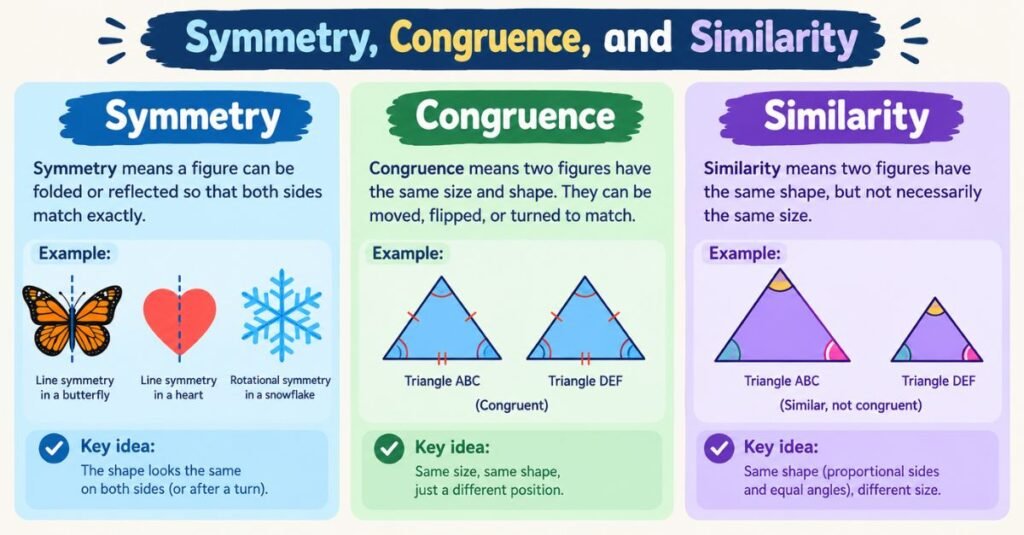
Some shapes match themselves, while others match each other. These ideas let you compare figures without measuring everything. Artists, mapmakers, and engineers use them daily. Geometry Learn V3 uses them to connect shapes.
This section explains line and rotational symmetry. It also covers congruence and similarity in geometry and congruent and similar figures. A table at the end separates the two ideas clearly.
Line Symmetry and Rotational Symmetry
A shape has line symmetry when a fold makes both halves match. Butterfly wings and the letter A show it clearly. A shape has rotational symmetry when it looks the same after a turn. A square matches itself after every 90 degree turn. A regular hexagon matches after every 60 degrees. A snowflake shows both types of symmetry.
Congruent Shapes Explained
Congruent shapes have the same size and the same shape. You can slide, flip, or turn one to fit exactly over the other. Matching sides and matching angles prove it. Triangles also use shortcuts such as side-side-side and side-angle-side. Factories rely on congruent parts so pieces fit every time.
Similar Shapes and Their Properties
Similar shapes have the same form but different sizes. Their angles match and their sides stay in the same ratio. A photo and its enlarged print are similar. So are a map and the land it shows. If one triangle’s sides are twice as long as another’s, its area is four times larger.
Differences Between Congruent and Similar Shapes
Both ideas compare shapes in different ways. However, congruence demands equal size while similarity allows scaling. The table sums up the key differences.
| Feature | Congruent Shapes | Similar Shapes |
| Shape | Identical | Identical |
| Size | Equal | Can differ |
| Angles | Equal | Equal |
| Sides | Equal | Proportional |
| Example | Two identical coins | A photo and its enlargement |
How Geometry Is Used in Nature and Everyday Life
Look around right now and you’ll spot geometry within seconds. Screens form rectangles while cups look like circles from above and roof lines form triangles. Nature uses the same ideas with surprising precision.
These real-world applications of geometry make lessons stick. When you link a rule to an object, you remember it longer. Geometry Learn V3 encourages this habit in every topic.
Geometry in Architecture and Construction
Builders use right angles for walls and corners. They use triangles for trusses and parallel beams for floors. Arches and domes rely on circle geometry. Surveyors measure angles to set property lines and road slopes. Without these tools, very little would stand straight.
Geometric Patterns in Nature
Snowflakes show six-fold symmetry in their branching arms. Honeycomb cells form tidy regular hexagons. Spider webs mix radial lines with spirals. Tree rings grow as near-perfect circles over time. Sunflower seeds follow spiral patterns that often match Fibonacci numbers such as 34 and 55. This arrangement packs many seeds into a small space. Geometry Learn V3 treats nature as a free geometry lab.
Read More About: Playing Games Blog PlayBattleSquare: The Best Guide to Gaming Tips and Minecraft Strategies (2026)
Geometry in Art, Design, and Technology
Designers use grids, symmetry, and ratios to balance a layout. Animators build 3D characters from triangles and polygons. GPS uses geometry to fix your position from satellite distances. Athletes use launch angles for throws and kicks. Geometry quietly powers the tools you use every day.
How to Learn Geometry Faster With Geometry Learn V3
Speed comes from smart habits and not from longer hours. Good geometry learning strategies save time and boost memory. Geometry Learn V3 supports every one of them.
Pair these habits with a reliable geometry study guide. Free resources such as Khan Academy’s geometry course add extra videos and drills. Mix visual geometry learning tools with paper practice. Fifteen focused minutes beat a long and tired session.
Use Diagrams and Visual Examples
Draw every idea as soon as you learn it. Label the vertices and mark any equal sides. Color matching angles with the same pen. Sketching forces your brain to process the shape. A good diagram also reveals relationships that words hide. Keep a notebook of your best sketches.
Practice Geometry Formulas and Problems
Formulas stick best through repeated use. Write each one down, then solve two quick problems with it. Start with easy numbers and increase the difficulty slowly. Use geometry practice problems from textbooks or free online sets. Explain each step out loud as you work. If you can teach a step, you know it.
Learn One Concept at a Time
Master angles before polygons and triangles before circles. Each topic leans on the one before it. Jumping ahead creates gaps that grow over time. Finish a short quiz before you move on. Slow progress now saves hours later. This pace matches the geometry problem-solving techniques that strong students use.
Use Interactive Geometry Tools When Available
Interactive tools let you drag points and watch angles change. Free apps such as GeoGebra work well. Try interactive geometry exercises to test rules like the triangle angle sum. Features differ from platform to platform, which means you should check your course. Even a simple online protractor helps a lot.
Common Geometry Mistakes and How to Avoid Them
Small slips can cost big marks in geometry. Most common geometry mistakes are easy to prevent. Students misread diagrams and mix up parallel and perpendicular lines. They forget units and trust drawings that aren’t drawn to scale.
Build a quick checking habit for every problem. Reread the question and mark the given facts on the diagram. Estimate the answer before you calculate. Check the units one final time. Geometry Learn V3 builds this checking habit into every lesson. The table below lists frequent errors with fixes.
| Mistake | Why It Happens | Quick Fix |
| Trusting the drawing | Diagrams aren’t always to scale | Use only the facts stated |
| Mixing parallel and perpendicular | The words sound alike | Perpendicular means a right angle |
| Forgetting units | Rushing through steps | Write units on every line |
| Confusing perimeter and area | Both use side lengths | Perimeter is around and area is inside |
| Mixing similar and congruent | Both compare shapes | Ask whether the sizes are equal |
Geometry Learn V3 Practice Guide
Practice turns knowledge into lasting skill. A simple plan beats a heavy one. A good Geometry Learn V3 practice routine fits into a busy day. It also tracks progress so you can see real growth.
You’ll need paper, a pencil, a ruler, and a protractor. Add a notebook for recording mistakes. These tools support geometry practice questions and answers and keep each session focused.
A Simple Daily Geometry Study Routine
Spend 15 minutes a day on geometry. Use five minutes to draw shapes. Use five minutes for angle practice. Use five minutes to solve one or two problems. Consistency beats long and irregular study sessions. Pick the same time each day so the habit sticks. Geometry Learn V3 fits neatly into this routine.
Beginner-Friendly Geometry Practice Questions
Try these eight questions without help. Cover the answer column before you start. Then check your work against the key. These items work as simple geometry practice problems for new learners.
| # | Question | Answer |
| 1 | One of two complementary angles measures 35°. Find the other. | 55° |
| 2 | Find the sum of the interior angles of a pentagon. | 540° |
| 3 | A triangle has angles of 48° and 82°. Find the third angle. | 50° |
| 4 | A circle has a radius of 5 cm. Find its diameter. | 10 cm |
| 5 | A rectangle measures 12 m by 4 m. Find its perimeter and area. | 32 m and 48 m² |
| 6 | Two parallel lines meet a transversal. One corresponding angle is 72°. Find its partner. | 72° |
| 7 | Two same-side interior angles sit between parallel lines. One is 105°. Find the other. | 75° |
| 8 | A circle has a radius of 3 cm. Find its circumference using π ≈ 3.14. | About 18.84 cm |
How to Check Your Answers and Track Progress
Compare each answer with the answer key. Record every miss in an error log. Write what went wrong and how to fix it. Review the whole log every weekend. Retry missed questions after three days. Chart your scores on a simple graph. Rising scores prove that your geometry learning strategies work. Geometry Learn V3 learners often keep this log in a notebook.
Geometry Formulas and Quick Reference Sheet
A tidy reference sheet saves a lot of time. Keep it near your desk and add one new rule at a time. Over a few weeks, it becomes a personal geometry study guide.
The tables below gather the key geometry formulas in one place. They cover angle rules, triangle and polygon formulas, and circle and measurement formulas. Check them again after each new lesson. Geometry Learn V3 works best when you review often.
Essential Angle Rules
These rules solve most questions about angle relationships. Learn them in the order shown and practice each one. Geometry Learn V3 practice leans on them constantly.
| Rule | Value or Result |
| Right angle | 90° |
| Straight line | 180° |
| Full circle | 360° |
| Complementary pair | Adds to 90° |
| Supplementary pair | Adds to 180° |
| Vertical angles | Equal |
| Corresponding and alternate angles (parallel lines) | Equal |
| Same-side interior angles (parallel lines) | Add to 180° |
Triangle and Polygon Formulas
These formulas cover triangle and polygon problems. The Pythagorean theorem applies to right triangles only.
| Concept | Formula |
| Triangle angle sum | 180° |
| Triangle area | ½ × base × height |
| Pythagorean theorem | a² + b² = c² |
| Sum of polygon interior angles | (n − 2) × 180° |
| Each angle of a regular polygon | (n − 2) × 180° ÷ n |
| Sum of polygon exterior angles | 360° |
Perimeter, Area, and Circle Formulas
Keep this last table beside your homework. It gathers every perimeter, area, and circle formula you need.
| Shape | Perimeter or Circumference | Area |
| Square | 4s | s² |
| Rectangle | 2(l + w) | l × w |
| Circle | 2πr | πr² |
| Diameter | d = 2r | Not applicable |
Geometry Learn V3 vs. Other Geometry Learning Resources
No single resource suits every learner perfectly. Textbooks, videos, apps, and structured methods all help. The best choice depends on how you learn. Geometry Learn V3 stands out for its step-by-step, visual-first order.
A fair comparison helps you decide. Each option has strengths and limits. Compare them on pace, practice, and feedback. Then pick the mix that keeps you motivated.
Learning Approach and Available Features
The table compares four common options side by side. Use it as a starting point and adjust it to your needs.
| Resource | Approach | Main Strength | Main Limit |
| Textbooks | Formal and detailed | Full topic coverage | Can feel dry |
| Video lessons | Visual explanation | Easy to follow | Passive learning |
| Practice apps | Drills and quizzes | Instant feedback | Light on explanation |
| Geometry Learn V3 | Step-by-step and visual-first | Clear order for beginners | Works best with extra practice sets |
Advantages and Limitations
Geometry Learn V3 shines for beginners. Its clear order lowers stress. Its visual style builds spatial reasoning skills. It’s less ideal as your only source for advanced proofs or heavy exam drills. Add textbook problems and timed practice for those goals. Honest limits help you plan better.
How to Choose the Right Geometry Learning Resource
Start by clearly naming your learning goal. If you need homework help, choose a method with worked examples. If you’re preparing for an exam, add past papers. If you’re learning for fun, pick the most visual option. Test a free lesson before you commit. Switch if you still feel lost after a week. The right resource keeps you coming back. Geometry Learn V3 suits learners who like clear steps.
FAQ,s
What Is Geometry Learn V3 Used For?
Geometry Learn V3 is used to learn shapes, angles, and spatial reasoning step by step. Students use it for homework help and exam preparation. Self-learners use it to build confidence from scratch.
Is Geometry Learn V3 Suitable for Beginners?
Yes, it suits complete beginners very well. Geometry Learn V3 starts with points, lines, and simple shapes. It then adds complexity slowly and steadily. Beginners get clear pictures and examples before formulas.
Does Geometry Learn V3 Offer Interactive Geometry Tools?
Interactive features depend on the platform you use. Check your course page for current options. If none exist, free tools such as GeoGebra fill the gap nicely. Geometry Learn V3 works well alongside them.
What Is the Fastest Way to Learn Angles?
Practice with real objects such as clocks, doors, and book corners. Sketch each angle type and estimate before you measure. Ten focused minutes a day works well. Geometry Learn V3 supports this with short daily drills.
Why Do the Interior Angles of a Triangle Add Up to 180 Degrees?
A line drawn through one vertex parallel to the opposite side creates matching alternate interior angles. The three angles then form a straight line. A straight line measures 180 degrees.
Do Circles Have Angles?
Circles have no corners like polygons do. Angles still matter inside them, though. A central angle sits at the center. An inscribed angle sits on the circle itself. A full turn around the center measures 360 degrees.
Is Geometry Only About Flat Shapes?
No, geometry also includes three-dimensional shapes. Plane geometry deals with flat shapes on a surface. Solid geometry covers cubes, spheres, cylinders, and cones. These solids add volume and surface area to your toolkit.
Why Are Parallel Lines Important in Geometry?
Parallel lines create predictable angle patterns. Those patterns let you find unknown angles fast. They also guide design in roads, railways, and buildings. Geometry Learn V3 highlights them for this reason.
Final Thoughts
Geometry Learn V3 makes geometry easier by focusing on understanding. You start with simple points and lines. Then you move through angles, polygons, circles, and measurement. Each step supports the next one. Clear patterns soon replace guesswork and confusion.
Now put the plan to work today. Take 15 minutes to draw three shapes, measure two angles, and solve one problem. Repeat the same routine tomorrow. With steady practice, Geometry Learn V3 turns a confusing subject into a skill you own.