

Droven.io Best Tech Tools for Developers (2026): Top Picks and Complete Guide
Ever opened a tool list and felt your brain freeze? There are editors, pipelines, dashboards, bots, and scanners. Every one of them claims to save you time. Few of them tell you what they cost in setup and upkeep.
This guide cuts through the noise. It looks at Droven.io best tech tools for developers as a search phrase and answers the real question behind it. Which tools do developers actually use, and how do you pick the right ones? We’ll also be upfront about one thing. Droven.io is a publication, not a product. It doesn’t rank or endorse the tools below. You can jump straight to the quick comparison table if you want the shortlist first.
What Is Droven.io Best Tech Tools?
Droven.io is an editorial website. It publishes articles and guides on AI, software development, cloud computing, and cybersecurity. You won’t find an app to install or a service to subscribe to. It reads like a general technology publication, and its homepage also carries unrelated topics such as home and garden pieces.
So what can’t we confirm? We couldn’t verify who owns the site or how it handles sponsored content. We also didn’t see an About page in its navigation. That doesn’t make it good or bad. It just means you should read a few posts yourself and check for named authors and cited sources. Treat Droven.io developer resources as overview reading, and you’ll set the right expectations.
How Droven.io Helps Developers Discover Technology Tools
Think of Droven.io as a friendly bookshop window. It helps you spot topics and trends. Its software development category includes pieces on AI in coding and web frameworks. That makes it handy when you’re new to a subject and want a quick sense of the landscape.
However, a bookshop window isn’t a manual. When you’re ready to install something, switch to the official documentation. The same goes for benchmarks and step-by-step setup guides. Those need clear methods and sources. Use the site to get oriented, then go to the vendor to get it done.
Key Features and Resources Available on Droven.io
The site organizes content into sections such as AI, technology, digital transformation, and reviews. Inside those, you’ll find categories like software development, web development, and cloud computing. Some pages are guides. Others are roundups or reviews. This variety makes browsing easy, though quality can vary from page to page.
Here’s a simple habit for judging any roundup. First, check who wrote it. Second, look for sources you can click. Third, see whether sponsored placements are disclosed. A list of companies or agencies is a different thing from a tested comparison. Reading with those three questions in mind protects you from weak advice on any website.
Who Should Use Droven.io?
Beginners will probably get the most from it. If you’re learning to code, broad overviews help you see how the pieces fit. Curious generalists and managers can also use it for a quick briefing. It’s a fast way to learn what “CI/CD” or “observability” means before a meeting.
Senior engineers and DevOps teams need more. They want tested claims, version details, and real configuration examples. For that, the official docs, vendor changelogs, and community discussions work better. Still, even experts can skim an overview now and then to spot a trend they’ve missed.
Why Choosing the Right Developer Tools Matters in 2026
A single app now touches an editor, a Git host, a build pipeline, cloud servers, a database, monitoring, and security scans. Each choice shapes the others. That’s why picking the best developer tools 2026 has become a real engineering decision. Three forces raise the stakes. AI assistants now sit inside editors and pipelines. Tools pile up over time. And your tools themselves are part of your attack surface.
The goal isn’t more tools. It’s less friction between writing code and shipping it safely. We haven’t quoted adoption statistics here because they change every year. For fresh numbers, check the Stack Overflow Developer Survey and DORA’s software delivery research. Both are well-known, and both update regularly. Use them to back up your own choices.
How the Right Tools Improve Developer Productivity
Good tools shorten the loop between “I wrote it” and “I know it works.” Fast tests, quick builds, and clear error messages keep you in flow. Strong developer productivity tools also cut interruptions, so you stop hopping between five dashboards to answer one question. That’s the heart of developer workflow optimization.
Picture a tidy workshop. Every wrench hangs where you expect it. Now picture a cluttered garage. You spend ten minutes hunting for a screwdriver before you start. Your tool stack works the same way. Fewer, better-chosen tools mean you spend your hours building. These are the tools to improve coding productivity that matter most.
The Hidden Costs of Poor Tool Selection
Most of a tool’s price never shows up on an invoice. Context switching drains focus. New hires lose days learning odd setups. Someone has to patch servers and update plugins. Scripts that glue tools together break quietly. Extra accounts and tokens widen your security exposure. And proprietary formats can make leaving painfully expensive.
You can estimate the damage with one formula. Multiply people affected by hours lost per week, then by weeks per year, then by loaded hourly cost. Here’s an invented example. Ten developers lose two hours a week for 50 weeks at $70 an hour. That’s 10 × 2 × 50 × $70, or $70,000 a year. These numbers are illustrative only. Your own data will tell you far more.
How to Evaluate the Best Developer Tools
Droven.io doesn’t publish a formal evaluation framework that we could verify. So the five checks below are this guide’s own. They come from common industry practice. Treat them like a trial checklist. Score each from 1 to 5, then weight them by what matters to your team. A startup might weight cost heavily. A bank might weight security.
Run every trial on real work. Demos always look smooth. Real repositories are messy. Give each tool to the people who’ll use it daily, and give them a few weeks. Then compare notes. This simple routine is the best answer to how to choose the right developer tools, because it replaces guesswork with evidence.
Performance and Reliability
Test the tool on your largest real repository, not a toy project. Watch startup time, responsiveness, and memory use. Check the vendor’s status page and past incidents. For paid services, read what the service-level agreement actually promises. Then ask a tough question. If this tool goes down, can your team still commit, build, and deploy? A tool that blocks all work during an outage carries hidden risk.
Ease of Use and Integration
Look at how the tool fits what you already run. Does it connect to your Git host, editor, CI system, and chat app? Does it offer an API or webhooks for gaps? Does it support single sign-on? Open standards like Git, OpenAPI, and OpenTelemetry make switching easier later. Finally, confirm you can export your data. Good developer tool integration and compatibility saves you from fragile glue scripts.
Automation and Productivity Benefits
A tool you can only operate by clicking is hard to repeat. Look for a command-line interface, an API, and settings you can keep in version control. It should also run without a screen inside a pipeline. Still, remember that automation isn’t free. Every script needs an owner. Strong automation tools for developers save time only when someone maintains them. Automate what’s truly repetitive, and leave the rest alone.
Security and Privacy Standards
Ask vendors directly, and read their trust pages. Which access controls exist, such as single sign-on, role-based permissions, and audit logs? How do they encrypt data, and where do they store it? For AI tools, ask whether your code is kept and whether it can train models. Answers often depend on the plan. Also check which certifications the vendor holds and how fast they patch flaws.
Scalability and Pricing
A tool that suits three people may strain at thirty. Check how it behaves on large repositories and busy pipelines. Learn whether pricing grows by seat or by usage, because that changes your bill fast. Look at limits and quotas too. Then ask how hard it would be to leave. Ignore “future-proof” slogans. Limits tell you more than promises do.
Best Developer Tools in 2026: Quick Comparison
Here’s the shortlist. The table groups example tools by the job they do across the software development lifecycle. No single tool wins every category. Use it to find candidates, then trial two or three per job. These are some of the best software development tools for 2026, chosen for wide use and not for any ranking by Droven.io.
Plans and features change often. Always confirm current pricing on the vendor’s site before you commit. Also remember that “example tools” means examples, not endorsements. Your language, team size, and budget will change which row matters most.
| Category | Example tools | Best for | Main trade-off |
| AI coding assistants | GitHub Copilot, Cursor, Claude Code | Writing, refactoring, explaining code | Output needs review; check data handling |
| Editors and IDEs | VS Code, JetBrains IDEs | Almost any stack | Extensions versus bundled tooling |
| Remote development | GitHub Codespaces, Dev Containers, Coder | Consistent team setups | Latency and ongoing cost |
| Version control tools | GitHub, GitLab | Nearly every team | Built-in features deepen lock-in |
| API development tools | Postman, Bruno, OpenAPI tooling | Designing, testing, documenting APIs | Sync features vary |
| Databases and backend | DBeaver, Supabase, Prisma | Data access and fast backends | Speed versus portability |
| DevOps tools (CI/CD) | GitHub Actions, GitLab CI/CD, Jenkins | Automated builds and releases | Hosted ease versus self-hosted control |
| Infrastructure as code | Terraform or OpenTofu, Pulumi | Repeatable cloud setups | State handling and learning curve |
| Containers and orchestration | Docker, Kubernetes | Consistent environments | Kubernetes is often overkill |
| Software testing tools | Vitest or pytest, Playwright, k6 | Unit, browser, and load tests | End-to-end tests need upkeep |
| Monitoring and errors | Grafana with Prometheus, Datadog, Sentry | Production visibility | Cost and alert noise grow |
| Security | Semgrep, Dependabot, gitleaks | Code, dependency, and secret checks | False positives |
| Automation | n8n, Zapier, GitHub Actions | Repetitive non-pipeline tasks | Needs maintenance |
Top Tools by Category, Use Case, and Budget
Start with your use case. A solo developer building a side project needs a different mix than a bank’s platform team. Beginners should lean on free, well-documented options. Teams with compliance needs should lean on tools with audit logs and single sign-on. Matching the tool to the job beats chasing whatever’s trending.
Budget matters just as much. Many excellent top coding tools cost nothing at the entry level. Paid tiers usually add collaboration, support, and governance. The table below shows a rough split. Free plans and licenses change, so verify limits before you rely on them.
| Category | Free or open-source starting points | Paid or commercial options |
| Editor | VS Code, Neovim, Zed | JetBrains IDEs, Visual Studio (some editions) |
| AI assistance | Limited free tiers on some assistants | Copilot, Cursor, Claude Code (paid plans) |
| API work | Bruno, Hoppscotch | Postman paid plans |
| CI/CD | GitHub Actions free tier, Jenkins | CircleCI, larger hosted plans |
| Infrastructure | OpenTofu, Ansible | Pulumi and Terraform paid features |
| Monitoring | Grafana, Prometheus, Loki | Datadog, New Relic, Dynatrace |
| Security | Semgrep (open-source rules), gitleaks, OWASP ZAP | Snyk, GitGuardian, Burp Suite Professional |
Best AI Coding Tools for Developers
AI-assisted software development shows up in a few forms. Inline completion suggests code as you type. Chat tools answer questions about your code. Agentic tools carry out multi-step tasks in a repository. All of them can speed up routine work. None of them replace your judgment.
Before you choose, weigh five things. How much of your repository can the tool see? What does it do with your code? Which editors does it support? Does it charge by seat or by usage? And how much review will its output need? Product names change fast in this space, so confirm current plans before you buy.
AI Code Assistants and Code Generators
AI coding assistants and AI code generators now sit in most editors. GitHub Copilot works across several editors and ties into pull requests. Cursor is an AI-first editor built on the VS Code foundation, so it’s a separate app to adopt. Claude Code is Anthropic’s agentic tool that works from the terminal and other interfaces. JetBrains AI Assistant fits teams already on JetBrains. Amazon Q Developer and Gemini Code Assist align with AWS and Google Cloud. Review everything these tools write as you’d review a colleague’s pull request.
AI-Powered Code Review Tools
AI-powered code review tools comment on pull requests. They summarize changes and flag likely bugs, style slips, and some security issues. Examples include Copilot’s review features, CodeRabbit, and Qodo. Verify current offerings, since this market shifts quickly. Their limits are real. They produce false positives and often miss your architecture’s context. To pilot one, turn it on for a few repositories. Then count how many comments your team acts on. If people ignore most of them, it’s noise.
AI Debugging and Error Detection Tools
The most common form of automated debugging tools is simple. You paste a stack trace or failing test into an assistant and ask for an explanation. Some error-tracking and observability platforms also summarize incidents and suggest likely causes. The danger is a confident but wrong fix. Reproduce the bug first. Then verify any proposed change with a test. These are handy tools for debugging and testing code, but they work best as a second pair of eyes.
Benefits and Limitations of AI Coding Tools
The benefits are clear. You get faster boilerplate, quicker explanations of unfamiliar code, and useful first drafts. The limits matter too. Output can be wrong yet sound sure of itself. Review time can eat the gains. Data handling raises questions about retention and training, and answers often depend on your plan. Treat these tools as helpful assistants. Run your tests, check what leaves your machine, and keep a human in charge.
Best IDEs and Development Environments
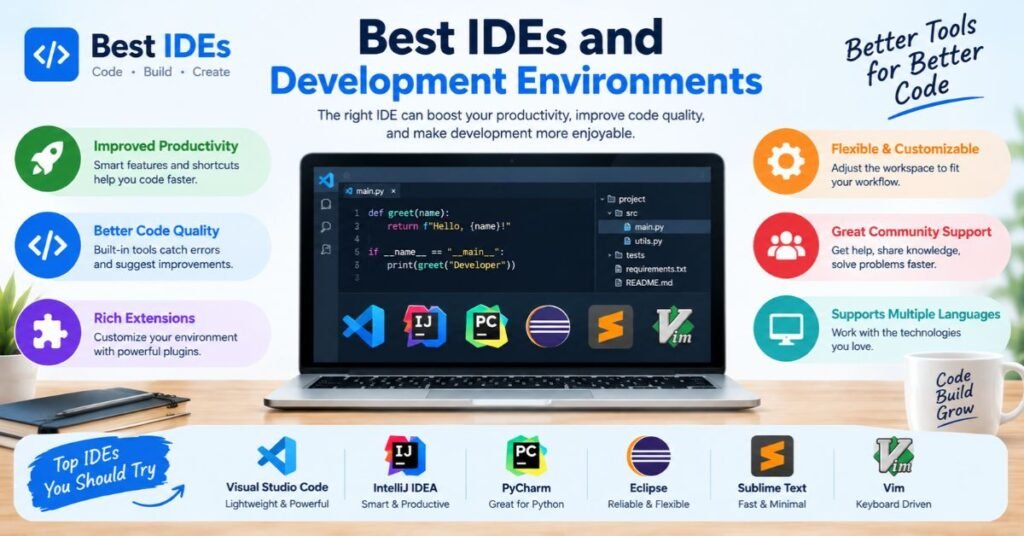
An editor focuses on writing text, with extensions layered on top. An integrated development environment (IDE) bundles debugging, refactoring, build tools, and language support out of the box. Neither is “better.” Your language, platform, and team standards usually matter more than popularity. Picking by scenario works better than hunting for a single winner.
Most editors now include AI features, which the section above covers. Beyond the editor itself, think about where it runs. Some teams want identical setups on every machine. Others want to pair on code live. Those needs point to cloud-based coding environments and code collaboration platforms, which we’ll cover below.
Modern Integrated Development Environments (IDEs)
Here are the best IDEs for coding, grouped by scenario. VS Code is free, widely used, and has a huge extension ecosystem. JetBrains IDEs like IntelliJ IDEA, PyCharm, and WebStorm offer deep refactoring and inspections, though you should check licensing. Visual Studio suits .NET and Windows-centered work. Xcode covers Apple platforms and Android Studio covers Android. Neovim and Zed appeal to people who love speed and keyboard control. These are strong programming tools for developers across many stacks.
Cloud-Based and Remote Development Platforms
Remote setups shine when you want fast onboarding and identical environments for everyone. They also help when builds outgrow laptops. GitHub Codespaces, Dev Containers, and Coder are common options. Dev Containers define an environment in a file inside your repository. The trade-offs are latency, ongoing compute costs, and weaker offline work. Ask yourself one question first. Is your pain setup time or raw computing power? Your answer decides whether these cloud development tools are worth it.
Read More About: Deshoptec.com Review 2026: Is It Legit, Safe, or Just a Blog?
Collaborative Coding Environments
Real-time pairing lets two people edit the same session. VS Code Live Share and Tuple are well-known examples, though you should check current product status. These tools shine for mentoring and tricky design talks. For everyday work, though, asynchronous pull request review is usually more efficient. Think of live pairing as a power tool. Use it when the job calls for it, and don’t make it your default.
Best Version Control and Collaboration Tools
People often mix up two things. Git version control is the system that tracks changes to source code. GitHub, GitLab, Bitbucket, and Azure DevOps are hosting platforms built around Git. They add pull requests, issue tracking, and automation. So choosing version control tools mostly means choosing a host.
Good code repository management goes beyond picking a platform. Habits matter just as much as features. Small changes, clear reviews, and consistent commit messages keep a codebase healthy. The sections below cover the platforms first and the practices second. Together they make up the tools for managing code repositories that most teams need.
Git-Based Version Control Platforms
GitHub has a huge open-source community and built-in CI through GitHub Actions. It also offers code scanning, secret scanning, and Dependabot. GitLab bundles repositories, CI/CD, issue tracking, and security scanning in one product, with a self-managed option. Bitbucket links tightly with Jira. Azure DevOps combines repos, pipelines, and boards for Microsoft-centered teams. Features and plan limits change, so verify what your tier includes.
Code Review and Team Collaboration Tools
Pull requests are the standard unit of review. GitLab calls them merge requests. Keep changes small enough to review in one sitting. Use a CODEOWNERS file so the right people get asked automatically. Turn on branch protection, so nothing merges without approvals and passing checks. Set a norm for review turnaround too. These code collaboration platforms feature lift quality more reliably than any single add-on.
Best Practices for Managing Code Repositories
Conventions help more than tools here. Agree on a commit format. Conventional Commits is popular and enables automatic changelogs. Trunk-based development, with short-lived branches, suits teams that deploy often. Longer-lived branches such as Git Flow suit slower, scheduled releases. Keep a clear README, contribution notes, and short architecture decision records in the repo. Add issue templates to cut back-and-forth over missing details.
Best API Development and Testing Tools
A typical API moves through design, building, testing, and documentation. Different tools cover different stages. Picking API development tools gets easier when you know which stage hurts most. Early on, you’ll explore requests by hand. Later, you’ll automate checks inside CI.
The smartest move is to design first. Describe your API in an OpenAPI file, and you can generate docs, mocks, and client code from one source. That keeps everyone aligned. The sections below walk through design, testing, and documentation. Together they cover the best tools for API testing and documentation.
API Design and Development Platforms
Postman is a widely used platform for building requests, organizing collections, and sharing work. Insomnia, Bruno, and Hoppscotch are alternatives. Bruno stores collections as plain files, which fit neatly into Git. OpenAPI is the specification for describing APIs. Swagger is a set of tools from SmartBear and the origin of that spec. Compare cloud-synced workspaces with local-first tools based on your team’s privacy and collaboration needs.
API Testing and Automation Tools
Start by deciding what you need. Manual exploration suits early development. Automated checks belong in CI. Contract testing with tools like Pact verifies that services agree on request and response shapes without running everything together. Collection runners, such as Postman’s command-line tools, execute saved tests in a pipeline. Mock servers help when a dependency isn’t ready. Browser-level flows belong to end-to-end testing, which we cover later.
API Documentation and Collaboration
An OpenAPI file can drive interactive docs through Swagger UI or Redoc. Treat documentation as code. Keep it in the repository and update it in the same pull request as the change. Some API platforms also publish hosted docs. The failure to avoid is documentation that drifts from reality. Generate docs from the spec wherever you can, and your readers will trust them.
Best Database and Backend Development Tools
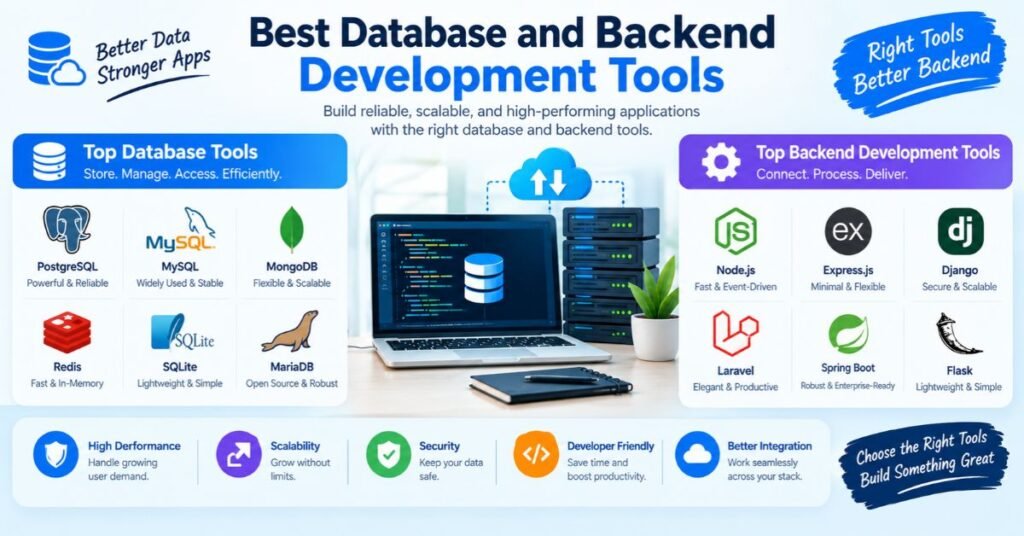
The right database depends on your workload and data model. So this section focuses on the tooling around databases and backends, not engine comparisons. Good database management tools help you explore schemas and run queries. Backend platforms help you skip repetitive setup. ORMs help your code talk to data.
Speed and control pull in opposite directions here. A hosted backend gets you moving fast. A custom backend gives you freedom. Neither is wrong. Just know what you’re trading, and think about portability before you grow.
Database Management and Administration Tools
Graphical clients make it easier to inspect schemas and data. DBeaver supports many databases. DataGrip comes from JetBrains. TablePlus is a lightweight native client. pgAdmin is built for PostgreSQL and MongoDB Compass targets MongoDB. Check which databases each tool supports and which edition you’d need, since some have free and paid tiers. Many developers also rely on the command line for scripted work.
Backend Development Frameworks and Platforms
Backend-as-a-service products trade control for speed. Supabase is built on Postgres and is open source. Firebase is Google’s platform with authentication, hosting, and databases. Appwrite is open source and self-hostable. AWS Amplify ties into the AWS ecosystem. They let you skip building login and storage from scratch. Still, weigh portability, cost at scale, data location, and self-hosting before you commit.
Read More About: MiloMagazine.co.uk USA: Complete Guide to Milo Magazine (2026)
ORMs and Database Integration Tools
Object-relational mappers let you work with data through your language’s objects instead of raw SQL. Common choices include Prisma and Drizzle for TypeScript, SQLAlchemy for Python, Hibernate for Java, and Entity Framework for .NET. Migration tools such as Flyway, Liquibase, and Alembic version your schema changes. Watch for the N+1 problem, where one query per row slows everything down. Keep the ability to drop to raw SQL for hard cases.
Best DevOps and CI/CD Tools for Developers
Three terms often blur together. Continuous integration builds and tests every change automatically. Continuous deployment releases changes that pass. Infrastructure as code defines servers and cloud resources in files instead of manual setup. Together they form the delivery pipeline at the heart of a modern DevOps workflow.
The tool matters less than the process behind it. Honest talk about tools for faster software releases starts with good tests, small changes, and dependable rollbacks. A fancy pipeline can’t rescue a weak test suite. Fix the basics first, and then pick the platform.
Continuous Integration and Continuous Deployment Platforms
Should you pick GitHub Actions or Jenkins? If your code lives on GitHub, Actions is the simpler start. Workflows live as files in the repository and run on hosted or self-hosted runners. Jenkins is an open-source server you host yourself. It offers deep customization but demands upkeep. GitLab CI/CD, CircleCI, and Azure Pipelines are other options. A good rule is to use the continuous integration and continuous deployment (CI/CD) features built into your Git host unless you have a clear reason not to.
Build Automation and Release Management
Deployment options depend on where you ship. GitOps tools like Argo CD and Flux keep a Kubernetes cluster in sync with a Git repository. Octopus Deploy handles release orchestration across environments. Vercel and Netlify deploy web front ends straight from Git with little setup. Safer release styles help too. Blue-green deployment keeps two environments and switches traffic between them. Canary releases send a small share of traffic to the new version first. Both make rollbacks easier.
Infrastructure as Code and Configuration Management
Terraform is a widely used declarative tool. Its licensing changed in 2023, which led to OpenTofu, a community fork. Check the terms that apply to you. Pulumi lets you define infrastructure in general-purpose programming languages. CloudFormation and CDK are AWS’s native options. Ansible focuses on configuring servers and running automation tasks. Most of these track state about what they’ve created. Treat that state as sensitive, and store it securely.
Best Cloud Development Tools for Scalable Applications
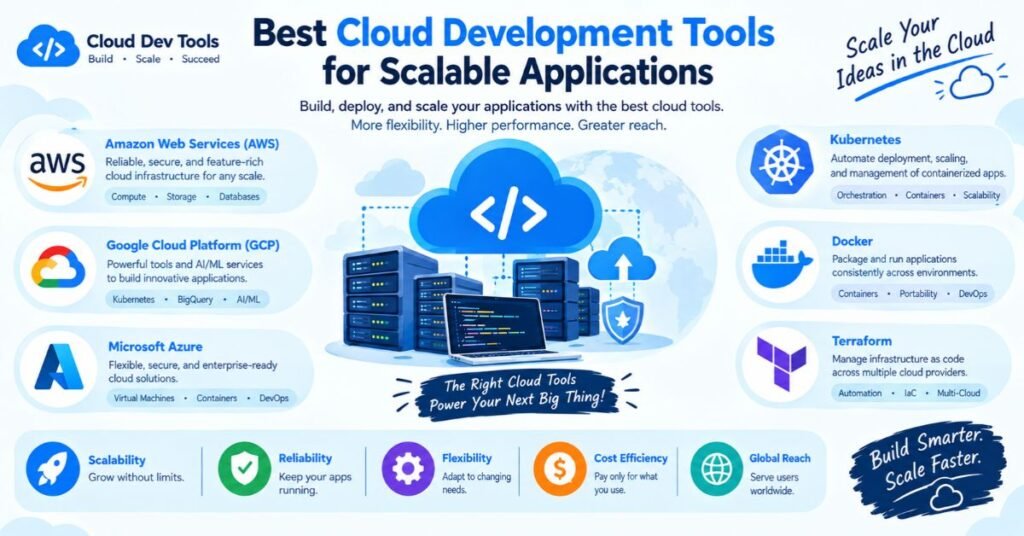
Scalable doesn’t mean complex from day one. Many apps run well on simple managed services. Add orchestration when you have a concrete need. The tools below are building blocks. They’re the core scalable application development tools teams reach for as they grow.
Think of them as a ladder. Containers come first, because they make environments consistent. Orchestration comes next, if you run many services. Serverless sits off to the side as a different path with different trade-offs. Climb only as high as your needs require.
Containerization Tools and Technologies
Containerization tools package an app with its dependencies so it runs the same everywhere. Docker popularized the approach and remains the default. Podman is a daemonless alternative. containerd is a runtime used under the hood by many platforms. Docker Compose defines multi-service setups for local work. Docker Desktop has commercial licensing terms for larger organizations, so check them. Use minimal base images and scan them for known vulnerabilities.
Kubernetes and Container Orchestration Platforms
Is Kubernetes necessary? For many small teams, no. Kubernetes platforms schedule and manage containers across machines, handling scaling, self-healing, and rollouts. That power brings operational complexity. It pays off when you run many services, need portability across clouds, and have people who can operate it. Managed offerings like Amazon EKS, Google GKE, and Azure AKS reduce cluster upkeep. For local work, try kind, minikube, or k3s. Helm packages apps for deployment.
Serverless Development Tools
Serverless development runs your code on demand without server management. Examples include AWS Lambda, Azure Functions, Google Cloud Run, and Cloudflare Workers. You get low operational overhead and automatic scaling. Watch for cold starts, which are delays on the first request after idle time. Also watch execution limits, cost at high volume, and harder local debugging. Serverless suits event-driven tasks and spiky workloads best.
Best Software Testing and Quality Assurance Tools
Layered testing is one of the most dependable ways to protect quality. Fast unit tests form the base. Integration and end-to-end tests sit above them. Performance and security checks round things out. Strong software quality assurance blends all of these.
Your software testing tools should match your stack, not trends. Pick the standard choice for your language first. Add heavier tools only where they earn their keep. That keeps your suite fast and your team happy.
Read More About: TechNewsOutlets.com USA: Complete Guide to Tech News Sources and Categories (2026)
Unit Testing Frameworks
The right unit testing frameworks are usually your language’s standard picks. Use Jest or Vitest for JavaScript and TypeScript, pytest for Python, and JUnit for Java. xUnit and NUnit serve .NET, while Go includes a built-in testing package. Vitest works naturally with Vite-based projects. Pair your choice with a coverage tool. Treat coverage as a signal and not a goal.
End-to-End Testing Platforms
End-to-end testing drives a real browser through complete user flows. Playwright supports Chromium, Firefox, and WebKit across several programming languages. Cypress is known for a friendly runner and debugging experience. Selenium is the long-standing standard with broad support, though it usually needs more setup. These tests cost the most to maintain and break the most often. Keep them focused on critical journeys.
Performance and Load Testing Tools
Performance tests show how a system behaves under pressure before real users find out. Load tests simulate expected traffic. Stress tests push past it. Soak tests run for hours to expose memory leaks. k6 uses JavaScript for scripts and Locust uses Python. JMeter is an established Apache project, and Gatling is another code-based option. Run light versions in CI and larger ones before big releases.
Automated Security Testing Tools
Dynamic application security testing probes a live app from the outside for issues like injection flaws. Penetration testing adds human skill on top. OWASP ZAP is a free, widely used scanner, and Burp Suite is a professional tool many testers use. The OWASP Top 10 is a strong reference for common web risks. Source-code and dependency scanning appear in the security section below.
Best Monitoring and Observability Tools
Monitoring tells you something is wrong. Observability helps you find out why. It relies on three kinds of data. Metrics are numbers over time. Logs are event records. Traces follow a request across services. This is the base of application monitoring and error tracking.
OpenTelemetry is a vendor-neutral standard for producing that data. It lets you change backends without re-instrumenting your code. That freedom is valuable when bills climb or needs shift. Plan for it early.
Application Performance Monitoring
Application performance monitoring tracks response times, error rates, and resource use. Datadog, New Relic, and Dynatrace are commercial platforms with broad features. Grafana with Prometheus is a popular open-source pairing. The trade-off is convenience against effort. Hosted tools save setup time, but bills can grow with data volume. Open-source stacks cost less to license but need someone to run them. Estimate your data volume before you commit.
Log Management and Analysis
Central logs make patterns visible across services. Elastic, with Elasticsearch and Kibana, is a common choice. Grafana Loki indexes labels instead of full log text, which keeps storage cheaper. Splunk often appears in larger organizations, and cloud providers offer their own logging services. Write structured logs as key-value data. They’re far easier to search than free text. Set retention rules early, since storage costs add up quietly.
Error Tracking and Troubleshooting
Error tracking tools capture exceptions along with context such as release version and user segment. Sentry, Rollbar, and Bugsnag are common options. They help you rank problems by impact and not by raw count. Group similar errors and tune alert thresholds. Otherwise you’ll get alert fatigue, and people will start ignoring notifications. A quiet, trusted alert channel beats a noisy one every time.
Best Automation Tools for Developer Workflows
CI/CD is only part of the picture. Many chores sit outside the build pipeline, such as release notes, issue triage, and scheduled reports. Good automation tools for developers handle these for you. That’s how software development workflow automation pays off.
Yet every automation becomes something you maintain. So be picky. Automate what’s genuinely repetitive and clearly defined. Leave the rare and messy tasks to humans. This keeps your software development efficiency high without creating a pile of fragile scripts.
Workflow and Task Automation
GitHub Actions handles many chores inside the repository. n8n is a workflow tool you can self-host, so check its license terms for your use case. Zapier and Make are hosted, mostly no-code options. Plain cron jobs remain the simplest choice for simple tasks. Good targets include notifications, issue labeling, release notes, and reports. Start with one chore that annoys you weekly.
API and Integration Automation
Calls themselves are easy. The tricky parts surround them. Respect rate limits. Handle authentication securely. Add retries with backoff, so brief outages don’t cause failures. Make operations idempotent, so a retried request doesn’t create duplicates. Use webhooks instead of polling where you can. These habits turn a shaky script into a dependable integration.
No-Code and Low-Code Automation Platforms
Retool, Appsmith, and Microsoft Power Apps help you build internal tools quickly. They fit admin panels and reporting screens well. Custom development would often cost more than it delivers there. The trade-offs are lock-in, governance, and a ceiling when needs grow. Check where data lives and who can access it before you adopt one.
Best Security Tools for Modern Development Teams
Security works best when each tool matches a pipeline stage. Two reference points help. OWASP covers common application risks, and NIST’s Secure Software Development Framework (SP 800-218) outlines secure software development practices. AI-generated code adds one more reason to review and scan everything that reaches your repository.
Strong DevSecOps practices put checks where fixes are cheapest. That means early in the editor and on pull requests, not weeks later. The tools below cover code, dependencies, and secrets. Add them in small steps so your team keeps up.
Static Code Analysis and Vulnerability Scanners
Static analysis reads source code for risky patterns without running it. Semgrep, SonarQube, CodeQL, and Snyk Code are common choices. CodeQL powers GitHub code scanning. These vulnerability scanners can flood you with false positives. So start with a small set of high-confidence rules and run them on pull requests. Expand only after your team trusts the results.
Dependency and Software Supply Chain Security
Modern apps pull in many third-party packages. That makes known vulnerabilities a major worry. Dependabot and Renovate open automatic pull requests for updates. Snyk and OWASP Dependency-Check scan for known issues. A software bill of materials lists the parts of your software, which helps when a new flaw appears. Set an update policy so alerts don’t pile up unread.
Read More About: Crackstube Explained (2026): Meaning, Website Features, Safety, and Legitimacy
Secrets Management Tools
Good secrets management has two jobs. First, catch secrets before they’re committed. GitHub secret scanning, gitleaks, TruffleHog, and GitGuardian help here. Second, store them safely with tools like HashiCorp Vault, AWS Secrets Manager, or Doppler. If a secret leaks, act in order. Revoke or rotate it at once. Check logs for misuse. Remove it from code and history. Add a pre-commit hook. Then move it into a proper store.
Integrating Security into DevSecOps Workflows
A workable sequence looks like this. Use secret scanning and linters in the editor or pre-commit stage. Run static analysis and dependency checks on pull requests. Scan container images and build an SBOM at build time. Run dynamic tests in staging. Watch production with monitoring and automatic dependency updates. Start with one or two checks. A pipeline that blocks everything on day one will get bypassed.
How to Build the Best Developer Tool Stack
Work backward from your workflow. Map how code moves from idea to production. Then pick the smallest set of tools that covers each step. That’s the secret to a lean developer tool stack. The examples below are starting points, not rules.
Rule of thumb: One good tool per job beats three overlapping suites.
Also plan for change. Teams grow and needs shift. Revisit your stack every six months or so. Retire what nobody uses. That small habit keeps costs and clutter down.
Recommended Tools for Solo Developers
Solo builders should stay minimal. Pick an editor such as VS Code or a JetBrains IDE. Use a Git host with hosted CI on the same platform. Choose a managed hosting or backend service, so you don’t run servers. Add free or low-cost error tracking. An AI assistant is optional. These are the free coding tools for beginners and solo makers that give the most value. Confirm free-tier limits, since they change.
Best Developer Tool Stack for Startups
Developer tools for startups should favor speed and low overhead. Choose managed services over self-hosted infrastructure. Use the CI/CD built into your Git host. Write down formatting, commit style, and review rules early. Add basic observability from day one, because debugging blind is costly. Set up single sign-on, secrets management, and automated dependency alerts. Watch per-seat pricing as you grow, and adopt Kubernetes only when you truly need it.
Essential Tools for Enterprise Development Teams
An enterprise development tool stack weighs governance more heavily. Look for single sign-on and user provisioning through SCIM. Require audit logs and check compliance needs. Ask about self-hosting where policy demands it. Expect procurement and security reviews. Balance standard tooling with team freedom. Verify each vendor’s enterprise features directly, and don’t assume a certification exists. Many enterprises add a platform team to maintain shared tools.
How to Choose Tools Based on Budget and Project Requirements
Begin with requirements, then check cost. A small web app needs little. A regulated product needs more. Use free tiers to trial tools, and note where limits would bite. Model how pricing grows with seats or usage. Then verify vendor claims on their own pages. This is the clearest path to how to choose the right developer tools without overspending.
Real-World Example: How Developer Tools Improve a Coding Workflow
Here’s a hypothetical case study. It’s an illustration, not a real company, and no real figures are involved. A small team adds a password-reset feature to a web app. We’ll compare how the work flows under two setups. The contrast is about process, not magic.
Many teams sit somewhere between the two versions. That’s normal. The goal isn’t perfection. It’s spotting which steps cause the most waiting and rework, then fixing those first.
Traditional Development Workflow
In a manual-heavy process, a developer writes the feature and tests it by hand, if at all. Changes pile up until a scheduled release. Deployment follows a checklist and often means logging into servers directly. Problems usually surface when users report them. Nothing here is wrong for a tiny project. But as the team grows, the delays and surprises multiply.
Modern AI-Assisted Development Workflow
First, the team opens an issue and a short-lived branch. The developer codes in an IDE, uses an AI assistant for boilerplate, and reviews everything it produces. Unit tests run locally. A pull request triggers CI to run tests, linting, and security scans. A teammate reviews, with an AI tool giving a first pass. Merging deploys to staging, then production after checks pass. Monitoring and error tracking watch the release. This isn’t automatically better, because it costs setup time and upkeep.
Measuring Productivity and Code Quality Improvements
How do you know the new setup helps? Measure it. DORA’s delivery metrics, such as deployment frequency and lead time for changes, are a solid starting point. Also track build time and review turnaround. Measure systems and teams, never individuals. Using these numbers to watch people tends to backfire. Good measurement supports developer workflow optimization instead of creating fear.
Read More About: 34+Results SFFareBoxing SportsFanFare: Complete Guide to Boxing Results, Scores, and Fighter Records
Common Mistakes to Avoid When Choosing Developer Tools
Even experienced teams repeat the same errors. Each one has a clear symptom and a simple fix. Spotting the symptom early saves months of pain. The mistakes below are the ones that show up most often.
A calm review habit helps with all of them. Every quarter, ask three questions. What do we use? What do we pay? What would we miss if it vanished? Honest answers reveal most problems fast.
Using Too Many Tools at Once
The symptom is overlap. You see unused seats and scattered dashboards. The fix is an audit. List every tool, who uses it, what it costs, and what it duplicates. Assign an owner to each one, and retire what nobody can justify. Then set a rule. Adding a tool means naming what it replaces or why it’s truly additive.
Ignoring Compatibility and Integration
The symptom is people copying data by hand between tools. Or they maintain brittle scripts to bridge gaps. The fix is a real-world pilot. Try the tool on an actual repository with your Git host, CI system, and editor. Integration problems show up fast under real conditions. Pay close attention to developer tool integration and compatibility before you sign anything.
Choosing Features Over Usability
The symptom is a powerful tool that most of the team avoids. The fix is a trial with the people who’ll use it daily. Check adoption after a few weeks. Some complexity is justified. But if nobody touches a feature, it isn’t earning its place. A simple tool that everyone uses beats a brilliant one that nobody opens.
Overlooking Security, Maintenance, and Total Cost
The symptom shows up as broad tokens and permissions, AI assistants receiving code nobody approved sharing, and no single sign-on. The fix is a short vendor review before adoption plus least-privilege access. Count upkeep too. Patching, upgrades, and admin time all add to total cost. The security questions earlier in this guide work as your checklist.
Traditional vs. Modern Development Workflows
Both styles have a place. Traditional methods rely on manual steps, scheduled releases, and later feedback. Modern workflows lean on automation, small changes, and constant checks. The table below compares them side by side. Use it to decide how far to go.
| Area | Traditional workflow | Modern workflow |
| Speed | Releases on a schedule | Frequent, smaller releases |
| Collaboration | Handoffs between people | Shared pull requests and chat |
| Automation | Mostly manual checks | Tests, scans, and deploys automated |
| Feedback | Users report problems | Monitoring flags problems early |
| Upkeep | Low tooling, high manual effort | Pipeline needs ongoing care |
The aim isn’t to chase the newest approach. It’s to match your process to your project. Small, stable products can thrive with simple methods. Fast-moving products usually need more automation.
Key Differences in Speed, Collaboration, and Automation
Speed is the clearest gap. Modern teams ship small changes often, so each release carries less risk. Collaboration also shifts from handoffs to shared reviews. Automation then removes repetitive checks, which frees people for harder thinking. These gains come with setup and upkeep costs. So the real difference is where your effort goes, not whether you work harder.
When Traditional Development Methods Still Make Sense
Traditional methods still fit some cases. A small internal tool with rare updates doesn’t need a full pipeline. Strict environments, such as locked-down networks, may limit automation. Teams with low release frequency may never earn back the setup cost. In those cases, keep things simple. Add automation only when manual work starts to hurt.
Developer Tool Trends to Watch in 2026 and Beyond
These are observable directions, not dated predictions. Treat them as areas to watch. Check recent primary sources before you act on any specific claim. The future trends in developer technology below are already visible today.
Notice a pattern. Most trends aim to reduce friction and add safety. That matches the core lesson of this guide. Better tools should make good work easier, not louder.
Autonomous AI Development Agents
Autonomous coding agents already exist. They can take a task, read a repository, edit files, run commands, and open a pull request. What’s less settled is reliability on complex work and how much oversight they need. Open standards such as the Model Context Protocol aim to connect agents to tools and data. For now, treat agent output like any contributor’s. Review it, test it, and limit its permissions.
AI-Assisted Debugging and Predictive Error Detection
Some observability platforms already offer anomaly detection and automated incident analysis, often called AIOps. The bigger claim is that systems will find problems before users notice. That’s partly real and partly marketing. Ask vendors for examples from setups like yours. Then compare their alerts against your own incident history. Trust results, not slogans.
Platform Engineering and Internal Developer Platforms
Platform engineering builds shared, self-service tooling that gives developers ready-made “paved roads.” Backstage, created at Spotify and now a CNCF project, is a well-known open-source developer portal. The idea suits organizations with many teams. Small teams rarely need a dedicated platform. They usually get more from choosing good managed services.
Developer Experience and Workflow Optimization
Developer experience is the sum of daily friction. It includes slow builds, unclear docs, flaky tests, and awkward tooling. Start by asking developers what slows them down. Then measure build times, review turnaround, and deployment frequency. DORA metrics and the SPACE framework offer helpful structure. Measure teams and systems, not individuals. That keeps trust high and data honest.
FAQ’S
Here are quick answers to the questions people ask most. Each one is short on purpose. For deeper detail, jump back to the matching section above. Features and prices change, so verify anything you plan to buy.
If your question isn’t here, start with your workflow. Ask where time is lost today. Then match a tool to that gap. It’s the fastest route to a useful answer.
Is Droven.io a Developer Tool or a Technology Resource Website?
Droven.io is a technology resource website. It’s an editorial site that publishes articles on topics like AI, software development, and cloud computing. It isn’t an IDE, platform, or service you can install or subscribe to. We also found no page on the site under this article’s title, so treat it as reading material.
What Are the Best Developer Tools in 2026?
There’s no single best set. Most developers rely on a good editor or IDE, a Git platform, CI/CD automation, and increasingly an AI assistant. The right mix depends on your stack and team. Check the latest Stack Overflow survey for current usage data. The quick comparison table above is a handy place to start.
Which Developer Tools Offer Free Plans?
Many do. VS Code is free. GitHub offers a free tier. Bruno is a free, open-source API client. OpenTofu is an open-source infrastructure tool. Grafana, Prometheus, and gitleaks are open source too. Free plans and limits change often, so confirm current terms on each vendor’s site before relying on them.
Can AI Coding Tools Replace Human Developers?
Not today. AI tools automate parts of the job, such as boilerplate, explanations, and first drafts. Their output still needs human review. The longer-term effect on jobs is genuinely debated. It’s safer to treat these tools as assistants that change how developers work than to trust confident predictions in either direction.
How Can Beginners Choose the Right Coding Tools?
Start small. Pick one popular editor, such as VS Code, and learn Git basics. Use a free Git host and its built-in CI. Add tools only when a clear problem appears. Follow official tutorials for each tool. Beginners benefit most from fewer tools, learned well, than from a giant stack.
Are Droven.io Resources Useful for DevOps Professionals?
Possibly as overview reading. Droven.io covers cloud computing and software development, along with some deployment and security pieces. We didn’t confirm a dedicated DevOps tutorial series. For hands-on work, rely on official documentation for tools like Kubernetes, Terraform, or your CI platform.
How Can Developers Build an Efficient Tool Stack?
Map your path from idea to production. Choose one tool per job. Pilot each on a real repository with the people who’ll use it. Check integration, security, and total cost. Then review the stack every few months and retire what nobody uses. A lean stack almost always beats a crowded one.
conclusion
Here’s the honest answer. Droven.io is useful for context, but it isn’t a ranking or a product. It works well as a starting point for learning about topics and trends. It doesn’t replace official docs, hands-on trials, or independent benchmarks. So the phrase Droven.io best tech tools for developers points to a real website but not to a definitive tool list. The best developer tools for you come from your own workflow.
Four rules will serve you well. Start from your workflow, and map how code gets from idea to production. Pick per category, not per brand. Pilot before you commit, using a real repository and real users. And verify the details that change, such as pricing, plans, and security terms. If you’re unsure where to begin, choose one or two pain points, like slow releases or noisy alerts. Fix those first. Then use the comparison table to find your next candidates.